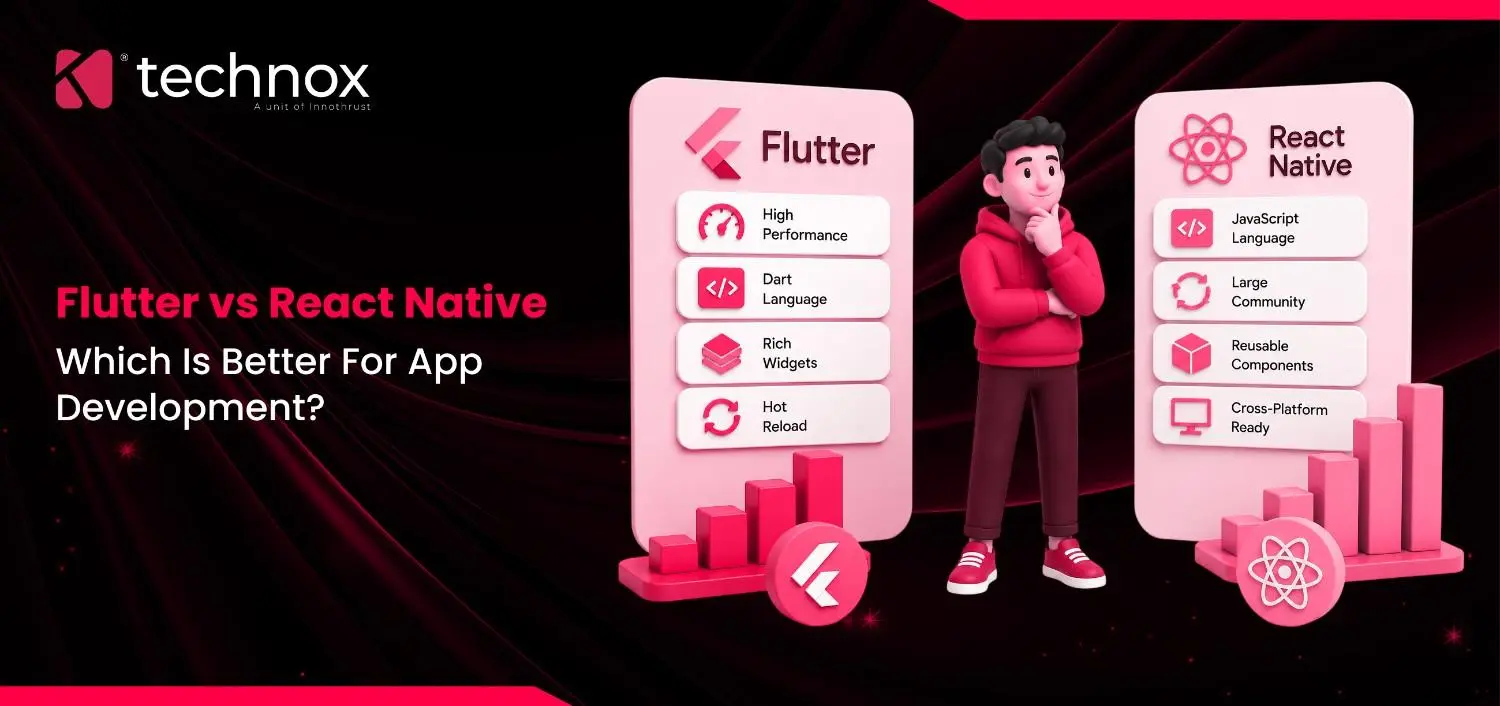
Flutter and React Native are the two dominant cross-platform frameworks, together covering roughly 80% of the market. Choose Flutter if you're starting fresh, care about pixel-perfect brand consistency, or plan to expand into web and desktop. Choose React Native if your team already builds in React/JavaScript and you need to ship an MVP fast. The framework matters less than your team's existing skills, your app's UI complexity, and your 3-year maintenance budget, not launch-week cost alone. Most "Flutter vs React Native" articles are written for developers, by developers. This one is written for the person who has to sign off on the budget. How fast can you ship? What will this cost to maintain over three years, not three months? Can you actually hire for it in your market? Having sat on both sides of this decision, building and advising on mobile products alongside SEO and web platforms, one pattern holds up every time: teams that pick a framework based on GitHub stars regret it within a year. Teams that pick based on team composition, app complexity, and post-launch roadmap rarely do. Flutter is Google's open-source UI toolkit for building natively compiled apps for mobile, web, and desktop from a single codebase, using the Dart programming language. Purpose: Cut the cost of building and maintaining apps across iOS, Android, web, and desktop from one codebase, without sacrificing native-level performance. Core dependencies: Dart SDK, the Flutter engine, and platform-specific build tooling (Xcode for iOS, Android Studio for Android). For the full technical breakdown, seeFlutter's official architectural overview. Business impact: A single Flutter codebase typically replaces two separate native codebases (Swift/Kotlin). That's where most of the savings come from, not just at launch, but every time a feature ships and would otherwise need to be built twice. See how this plays out in practice in our Flutter app development case studies. React Native is Meta's open-source framework for building mobile apps in JavaScript or TypeScript using React's component model, which then renders to real native UI components on iOS and Android. Purpose: Let web development teams reuse React knowledge, and often actual code, to ship mobile apps without hiring separate iOS and Android teams. Core dependencies: Node.js, the Metro bundler, native modules for platform-specific features, and (in most modern setups) theNew Architecture with Fabric and TurboModules. Business impact: If your company already has a React web team, React Native shortens the hiring runway significantly, the mental model and much of the tooling carries over. If that's your situation, our React Native development services page walks through how we structure that handoff. This table is the fast answer. Everything below explains the why behind each row, because the why is what determines whether it applies to your specific project. Performance isn't an abstract engineering concern. It's a conversion metric. The same principle Google applies to page experience and Core Web Vitals on the web holds true inside apps: users abandon slow or janky screens before they convert. This is where team composition matters more than the framework itself. If your team already ships a React web app, React Native lets developers reuse components, state management patterns, and sometimes literal business logic, cutting weeks off the build. If you're building mobile-first from scratch with no existing web codebase, Flutter's single toolchain (one IDE setup, one dependency manager, one build system) often ships faster because there's less tooling fragmentation to manage. Business impact: For SMEs budgeting a first mobile app, the real cost driver isn't hourly developer rates. It's how many sprints get lost to platform-specific bugs. Flutter apps generally need fewer iOS/Android-specific fixes post-launch than comparable React Native builds, simply because there's one rendering layer instead of two native ones underneath a bridge. Developer adoption and job market demand tell two different stories, and both matter depending on your hiring plan. For consumer brands where visual identity is the product, interior design portfolios, wellness apps, real estate listings, Flutter's pixel-perfect rendering is a genuine advantage. Because it isn't relying on native OS components, your design system renders exactly the same on a three-year-old Android phone as it does on the newest iPhone. This is the most underestimated factor in framework selection, and it's where most cost overruns actually happen. Audit your existing team's skills. A strong in-house React/JavaScript team is a real asset, don't discount it. Map your app's UI complexity. Heavy custom animation, brand-specific design systems, or multi-platform reach (mobile + web + desktop) favor Flutter. Check your hiring market. In talent-constrained markets, factor in how easily you can backfill a developer role six months from now. Estimate your 3-year maintenance load, not just your launch budget. Ask any mobile app development company in Coimbatore how they've handled native module breakage or OS-version migrations in past projects. Pilot a small feature in both, if timeline allows. A two-week spike on a single screen reveals more about team fit than any comparison article. Decide based on total cost of ownership, not framework popularity. Popularity affects hiring, not whether the framework is right for your product. Chasing what's "trending" instead of what the team can execute well. A framework your developers know deeply will always outperform a "better" one nobody on the team has shipped with before. Ignoring app store optimization and analytics from day one. Even a flawless Flutter or React Native build fails commercially if nobody has planned for App Store/Play Store visibility, onboarding funnels, or GA4 event tracking. Underestimating backend and API integration effort. The framework choice affects the front end; most project delays come from backend, CRM, or payment gateway integration, regardless of which framework you pick. Skipping a design system before development starts. Both frameworks reward teams that lock a component library and design tokens early; retrofitting design consistency later is expensive either way. Treating the mobile app as disconnected from the website and SEO strategy. Deep links, shared landing pages, and app-to-web attribution should be planned alongside the framework decision, not after launch. Flutter and React Native together account for roughly 80% of cross-platform mobile development adoption, per the Stack Overflow Developer Survey. Business takeaway: you're choosing between two mature, well-supported ecosystems, not gambling on niche tooling. Flutter has been gaining ground on React Native in overall developer usage, with a wider lead among developers new to the profession. Business takeaway: Flutter's long-term hiring pool is trending upward, relevant if you're building a multi-year in-house team rather than a single project. React Native continues to post substantially more job listings in enterprise hiring markets. Business takeaway: if you need to hire fast in a competitive market this quarter, React Native's larger existing talent pool reduces hiring risk. React Native remains disproportionately represented among the highest-revenue apps in major app stores, reflecting its long history at companies like Meta. Business takeaway: React Native has a longer proven track record at very large scale, which can matter for enterprise procurement and vendor-risk conversations. Flutter's own rendering engine tends to produce more consistent frame rates and fewer platform-specific UI bugs in side-by-side benchmarks. Business takeaway: design-heavy, animation-rich apps tend to need less post-launch polish time in Flutter. Flutter's reach beyond mobile is expanding. Teams are increasingly using it for internal dashboards and desktop tools, not just consumer apps. React Native's New Architecture (Fabric + TurboModules) is closing much of the historical performance gap, making the "React Native is slower" argument less true with every release. AI-assisted development is narrowing the practical skill gap between frameworks, both ecosystems now have mature AI coding assistant support, lowering the cost of picking the "less familiar" option if it's otherwise the better fit. Cross-platform frameworks are increasingly expected to integrate cleanly with backend and CRM systems out of the box, a trend visible in client work connecting mobile apps to Laravel-based backends and analytics pipelines. Design-forward brand app: A wellness or interior design brand that lives on visual consistency across every touchpoint is generally better served by Flutter, the design system renders identically on Android and iOS, protecting brand integrity. Web-first company launching mobile: A SaaS company with an existing React web dashboard often ships its companion mobile app faster in React Native, since engineers can share logic and mental models across codebases. Field operations / logistics app: For apps with complex custom UI, offline-first behavior, and frequent feature releases, like agricultural distribution or delivery platforms, Flutter's single rendering engine tends to reduce the number of platform-specific edge cases a small team has to firefight. Framework choice is a business decision wearing a technical costume. The real question isn't "which is better", it's which one fits your team, your app's design demands, and your appetite for maintenance three years from now. It depends on your team. If you already have JavaScript developers, React Native usually gets an MVP out faster. If you're hiring fresh or want tighter design control, Flutter is often the more efficient starting point. Initial build costs are usually comparable. The bigger cost difference shows up in maintenance, Flutter apps tend to need fewer platform-specific fixes over time, which can lower total cost of ownership. Yes, both can. React Native inherits native components by default, giving it a native feel out of the box. Flutter achieves the same result through deliberate design work, since it renders its own UI rather than using native components. No. Dart is a relatively small, well-documented language, and most developers with prior experience in any typed language pick it up within a few weeks. Yes. Flutter can target web and desktop (Windows, macOS, Linux) from the same codebase as mobile. React Native doesn't do this natively, it requires a separate library for the web. Both are actively maintained, Flutter by Google, React Native by Meta, and both have multi-year track records of continued investment, so long-term abandonment risk is low for either. Ask a prospective development partner to walk you through their reasoning for your specific app, not a generic answer. Team composition, app complexity, and your growth roadmap should all shape the recommendation. Not directly, app store visibility depends on metadata, reviews, and app store optimization practices, not the underlying framework. Framework-driven performance (load time, crash rate) does influence store algorithms indirectly, since both Apple and Google factor in app quality signals. Not necessarily, but there's a real advantage if it does, teams using React for both web and mobile (via React Native) can share components and logic, reducing long-term development overhead. No. Both frameworks are growing along different dimensions, Flutter in developer adoption, React Native in enterprise job demand and top-app presence. Neither is losing relevance.Quick Answer
Why This Comparison Is Different
If you're a founder or a CXO, CEO, CMO, COO, or any leader deciding how to build your next app, the framework debate isn't really about syntax or widget trees. It comes down to three business questions:
This guide gives you that decision framework, not just a feature checklist.What Is Flutter?
Flutter doesn't call native UI components. It draws every pixel itself with its own rendering engine. That's why a Flutter app looks and behaves identically on an old Android phone and a new iPhone: the framework isn't translating your design through the operating system's UI kit, it's painting it directly.What Is React Native?
Unlike Flutter, React Native doesn't draw its own UI. It acts as a bridge, translating React components into native UIView (iOS) and View (Android) elements. That means a React Native app inherits each platform's native look and feel by default.Flutter vs. React Native: Side-by-Side Comparison
What Actually Drives the Decision
1. Performance and User Experience
Flutter draws its own UI, which means less variance in frame rates and animation smoothness across devices, because it isn't waiting on the OS to render native components. React Native has closed much of this gap with its New Architecture (Fabric renderer and TurboModules), but apps with heavy custom animation or complex gesture handling still tend to need more hand-tuning in React Native than in Flutter. Our app performance audit service covers exactly this kind of profiling if you're already live and troubleshooting junk.
Practical example: A real estate client with a map-heavy property-browsing app will feel Flutter's rendering consistency far more than a content-driven app like a blog reader, where either framework performs comparably.2. Development Speed and Cost
3. Hiring and Talent Availability
Flutter has been closing the gap with, and in some survey years overtaking, React Native in overall developer adoption, with an even wider lead among developers newer to the field, according to the Stack Overflow Developer Survey. React Native still commands significantly more job postings, largely because it has a longer track record in large enterprises with existing JavaScript teams.
Why it matters: If you're hiring in a competitive market, React Native gives you a deeper bench of candidates today. If you're building a long-term in-house team and can invest in ramp-up time, Flutter's growing adoption curve means the talent pool is only getting better, and Dart is a small enough language that experienced developers pick it up within weeks.4. Design Consistency and Brand Control
React Native apps, by contrast, will subtly inherit platform UI conventions unless developers explicitly override them, which can be a feature (native-feeling UX) or a liability (inconsistent branding), depending on your product goals.5. Long-Term Maintenance
React Native apps depend on native modules, third-party bridges connecting JavaScript to native device features like camera, payments, or biometrics. When Apple or Google ships a new OS version, these bridges are the first thing to break, and maintenance falls on whichever community or vendor maintains that specific module.
This is also the point where many teams begin asking a different question altogether: should the app remain cross-platform, or has it reached the stage where native Android development makes more sense? The answer depends on factors like security requirements, long-term maintenance, performance expectations, and business goals. If you're evaluating that transition, our React Native vs Kotlin comparison explores these trade-offs in greater detail.
Flutter reduces this exposure because more core functionality is handled directly by the Flutter engine rather than external bridges, though it isn't immune to OS-level changes either.How to Choose: A 6-Step Framework
5 Mistakes Businesses Make When Choosing a Framework
What the Data Shows
Trends to Prepare For
Real-World Fit: Three Business Examples
The Bottom Line
Weighing Flutter against React Native for your own app? Talk to our team about a free technical audit, we'll map the decision against your existing stack, hiring plan, and growth roadmap before you write a line of code.Frequently Asked Questions
1. Is Flutter or React Native better for a startup MVP?
2. Which is cheaper to build: Flutter or React Native?
3. Can Flutter and React Native apps look "native"?
4. Is Dart hard to learn compared to JavaScript?
5. Does Flutter support web and desktop apps too?
6. Which framework has better long-term support from its parent company?
7. How do I decide if I don't have technical staff to evaluate this myself?
8. Does the framework choice affect app store rankings or SEO?
9. Should my mobile app framework match my website's tech stack?
10. Is React Native being phased out in favor of Flutter?
Mobile App Development
HOME>
BLOGS>
MOBILE APP DEVELOPMENT
Flutter vs. React Native: Which Is Better for App Development?
Read Time11 mins
AuthorTechnox Technologies Team
PublishedAug 4, 2026