Most businesses find out their traffic has changed before they understand why. A page that has held a top-three ranking for two years suddenly sees impressions climb while clicks fall. The keyword report looks fine. The rankings haven't moved. But the phone has gone quiet. What changed is not the ranking. It's the surface. Google is now answering a growing share of queries directly inside the results page, through AI Overviews, and through a separate, more conversational experience called AI Mode. Neither replaces traditional search. Both sit on top of it, pulling from the same index but presenting information differently, and often intercepting the click before a user ever reaches your site. This guide is written for founders, marketing managers, and C-suite executives (CXOs, CEOs, CMOs, COOs, and similar leadership roles) who need to understand what's actually happening and what to do about it, not another explainer that repeats "AI is changing search" without telling you where to point your development or content team on Monday morning. We manage SEO, technical infrastructure, and AI visibility for clients across real estate, healthcare, wellness, fitness, and agri-tech, and the patterns below are drawn from that operational work, not theory. AI Overviews now appear on roughly 48% of tracked Google queries as of early-to-mid 2026, more than triple the prevalence seen a year earlier. When an AI Overview appears, organic click-through rate on the top-ranking page falls by around 58%, but brands that get cited inside the overview see meaningfully higher clicks than brands that rank below it and get bypassed. AI Mode is a distinct, conversational search surface, not a bigger AI Overview, and it currently accounts for a much smaller share of total query volume, though that share is growing. Structured data does not directly boost rankings, but it materially improves whether AI systems can verify and cite your content with confidence. The optimization target has shifted from "rank in position one" to "be the source the AI trusts enough to name." Google AI Mode Optimization is the practice of structuring a website's content, technical architecture, and entity signals so that Google's AI Mode and AI Overviews can accurately understand, verify, and cite the business as a source. It sits inside the broader discipline of Generative Engine Optimization (GEO), which extends classic SEO principles to any AI system that synthesizes answers rather than simply listing links. This broader approach is part of AI SEO, where optimization increasingly considers how AI systems discover, interpret, and surface information across search and answer experiences. The distinction matters because AI Mode and AI Overviews are not the same feature, even though they're frequently discussed as one thing. AI Overviews are the AI-generated summary blocks that appear above traditional organic results for a subset of queries. They pull from a synthesized set of sources, cite several of them inline, and coexist with the ten blue links below. AI Mode is a separate, chat-style search mode. A user asks a question, gets a conversational answer, and can ask follow-up questions in the same thread, closer to a research assistant than a results page. It draws on a wider retrieval process and tends to synthesize across more sources per query than a standard AI Overview does. Both are powered by Gemini and both depend on the same underlying signals, as outlined in Google Search Central's documentation on AI features in Search: crawlable content, clear entity definitions, and verifiable claims. Optimizing for one substantially benefits the other, which is why this guide treats them as one connected effort rather than two separate projects. The scale of the shift is easy to underestimate if you're only watching your own rankings dashboard. Industry tracking puts AI Overview prevalence at roughly 48% of tracked queries by early-to-mid 2026, up from around 31% a year prior, a near-doubling in twelve months (BrightEdge, 2026). That growth curve alone should change how a marketing budget gets allocated. The click-through impact is where it gets uncomfortable. Ahrefs' 2026 tracking found the top-ranking organic page loses roughly 58% of its click-through rate when an AI Overview appears above it, and Pew Research Center's analysis found users click any organic result in only 8% of visits with an AI Overview present, compared with 15% without one. That's not a ranking penalty. It's a behavioral shift. The user gets an answer without leaving the results page. Here's the part most competing articles leave out: this drop is not evenly distributed. Seer Interactive's 2026 analysis of over 5 million tracked queries found that brands cited inside the AI Overview earn substantially more organic clicks per impression than brands sitting in position one below it. Being cited, not merely ranking, is now the variable that predicts traffic. A business that ranks #4 but gets named in the AI Overview will frequently outperform a business ranking #1 that gets summarized without attribution. This reframes the entire strategy. The goal is no longer "outrank the competition." The goal is "become the source the AI is confident enough to cite by name." Citation is not a popularity contest. It's a confidence assessment. Google's systems are trying to answer a question accurately and defensibly, which means they favor sources they can verify quickly. Ranking is a floor, not a ceiling. Research from seoClarity found that 94% of AI Overviews cite at least one URL from the organic top 20, but only a minority of cited URLs come from the top 10, and that share has fallen sharply since mid-2024. Ranking well gets you into consideration. It doesn't guarantee citation. Entity clarity outweighs keyword density. AI systems build an internal model of who is talking, not just what the page says. A page that clearly establishes the author, the organization, and their relevant credentials gives the model more to verify against. This is why Organization schema and consistent NAP (Name, Address, Phone) data across your Google Business Profile, website, and directories carry more weight in AI visibility than they ever did for traditional rankings. External corroboration matters. Ahrefs' 2026 analysis found a strong correlation (0.664) between how often a brand is mentioned externally, in press, forums, and other sites, and how often it appears in AI Overviews. This is a direct extension of E-E-A-T: Google's AI is checking whether other sources agree with what your page claims. User-generated platforms are cited disproportionately. Reddit and YouTube together account for a large share of AI Overview citations, Reddit alone at roughly 21% in some analyses. This doesn't mean your website is irrelevant. It means your brand needs a presence and a reputation on the platforms Google's AI already trusts, not just on your own domain. Structured data is one of the most misunderstood levers in AI search optimization, and getting it wrong wastes development time without moving the needle. Google has been explicit that no special schema type is required for AI Overviews or AI Mode citation, per Google's own structured data documentation, and in May 2026 Google removed the FAQ rich result from traditional search listings entirely, which means FAQPage schema no longer earns the visual real estate it used to. If your development team is still building pages around "get the FAQ rich snippet," that motivation is gone. What schema still does, and does well, is reduce ambiguity for machine readers. It doesn't change rankings directly. It changes how confidently an AI system can verify what your page is claiming. Think of it as a translation layer: your visitors read the page in plain English, and the AI reads the same information through structured markup, without having to infer meaning from prose. For most of our clients, the highest-leverage schema investment is Organization or LocalBusiness schema implemented once, correctly, and referenced consistently across every page, not FAQPage schema scattered across dozens of blog posts. Organization schema anchors your brand's identity for the AI system. Everything else, including Product, Article, Review, and LocalBusiness, builds on that foundation rather than replacing it. A practical example: a wellness or healing-center client with dozens of scattered service pages and no consistent Organization schema will struggle to be cited even with strong content, because the AI has no clean anchor point to confirm the business's identity, location, and credentials against. Fixing the schema foundation first, before touching content volume, is almost always the higher-return move. Filter Google Search Console for queries and pages generating impressions with little or no click growth. This is often the first sign a page is being summarized rather than clicked. Cross-reference against which of your pages already rank in the top 20 for those terms, since that's your citation eligibility pool. Implement or correct Organization schema sitewide. Ensure your business name, address, and contact details are identical across your website, Google Business Profile, and any directory listings. Inconsistency here is one of the most common and most overlooked reasons a technically strong site still fails to get cited. AI systems extract answers most reliably from content that states the conclusion first and the reasoning after, the opposite of the traditional "build up to the point" blog structure. Lead each section with a direct, extractable answer, then support it. Pursue mentions on industry publications, relevant subreddits, and review platforms in your category. This isn't classic backlink building for anchor text. It's building the kind of independent confirmation that gives an AI system confidence your claims are accurate. A single well-optimized page rarely earns citation on its own. Content clusters, a pillar page supported by linked, interconnected supporting articles, signal depth of expertise that isolated posts cannot. This is where internal linking architecture and topical authority intersect directly with AI visibility. Track brand mentions inside AI Overviews and AI Mode responses for your priority queries manually or through emerging AI-visibility monitoring tools, and treat citation share as a KPI alongside traditional rank tracking. Once these optimisation steps are in place, use an SEO AI Visibility Checklist to audit the technical, content, entity, authority, and measurement areas that support visibility across AI search. Chasing FAQ schema for visibility that no longer exists. Since Google retired the FAQ rich result in May 2026, building pages around FAQ snippet real estate is optimizing for a feature that's gone. Treating AI Mode and AI Overviews as one project. They share underlying signals but different content depths often perform better in each, shorter, decisive answers for AI Overviews; more comprehensive, multi-angle content for AI Mode's conversational depth. Ignoring Core Web Vitals because "AI doesn't care about page speed." It doesn't care directly, but a slow, unstable page depresses crawl efficiency and user engagement signals that still feed the ranking layer AI citation depends on. Publishing content with no verifiable author or organization identity. Anonymous or thin author bios are a quiet trust penalty in an environment where AI systems are actively checking who is making a claim. Neglecting off-site presence. A technically flawless website with zero presence on Reddit, YouTube, or industry publications is competing for citation against brands that show up in all three. Real estate and property platforms tend to see AI Overviews trigger heavily on comparison and "how much does X cost in [city]" queries. Listings pages with structured pricing and location data outperform narrative-only property descriptions in citation frequency. Healthcare and wellness brands operate in one of the categories where AI Overviews appear most often, which raises the stakes on E-E-A-T signals: verifiable practitioner credentials, clear service descriptions, and consistent NAP data carry outsized weight. Fitness and gym businesses benefit disproportionately from Google Business Profile optimization, since local, "near me" style queries remain far less likely to trigger AI Overviews than informational ones. Meaning classic local SEO discipline still drives the majority of visible traffic here. Agri-tech and B2B platforms often compete on genuinely underserved, low-competition topical clusters, where a well-built pillar-and-cluster content architecture can establish topical authority faster than in saturated consumer categories. Expect three shifts over the next 12 to 18 months: broader AI Mode rollout beyond its current query share, continued erosion of legacy rich-result features in favor of direct AI citation, and growing reliance on off-site corroboration (Reddit, YouTube, review platforms) as a trust signal that's harder to manipulate than on-page content alone. Businesses that treat GEO as a bolt-on to existing SEO will keep losing ground to those treating entity clarity and citation-worthiness as core infrastructure. For businesses that need to build these foundations into their wider search strategy, AI SEO services in Coimbatore can bring together technical SEO, entity optimization, content structure, and AI visibility work under one strategy. If you want a clear picture of where your own site stands on citation-readiness before making changes, get a free AI visibility audit. It's the practice of structuring website content, technical architecture, and entity signals so Google's AI Mode and AI Overviews can accurately understand, verify, and cite a business. No. AI Overviews are static AI summaries above traditional results. AI Mode is a separate, conversational search experience. Both rely on similar underlying signals. Not directly. Google doesn't require a special schema for AI citation. What it does is reduce ambiguity, helping AI systems verify your content and cite it with more confidence. It varies by site size and existing technical debt, but most engagements combine a technical/schema audit, content restructuring, and ongoing citation monitoring rather than a one-time fee. Entity and schema fixes can show measurable citation improvements within 4 to 8 weeks. Content cluster and authority-building work typically needs 3 to 6 months to compound. Google Search Console filters for query and page performance, combined with emerging AI-visibility monitoring platforms and manual query tracking for priority terms. Yes, but the emphasis shifts toward mentions and corroboration, being referenced accurately across the web, rather than anchor-text-driven link building alone. This is the AI Overview click-through effect: your page may still rank well but is being summarized rather than clicked, especially if a competitor is the one getting cited. Yes. Local, "near me" queries trigger AI Overviews far less often than informational queries, so Google Business Profile optimization remains one of the highest-ROI local visibility levers. Citation frequency for priority queries, impression-to-click ratio in Search Console, branded search volume, and traditional rank tracking together, not rank alone.Executive Summary
What Is Google AI Mode Optimization?
Why This Matters More Than Most Businesses Realize
How AI Mode and AI Overviews Actually Decide Who to Cite
The Structured Data Reality Check
A Practical Optimization Framework
Step 1: Audit Your Current AI Visibility, Not Just Your Rankings
Step 2: Fix Entity Foundations Before Content Volume
Step 3: Restructure Content to Answer Before It Explains
Step 4: Build External Corroboration Deliberately
Step 5: Strengthen Topical Authority Through Internal Linking
Step 6: Monitor Citation, Not Just Rank
Common Mistakes We See Businesses Make
AI Overviews vs. AI Mode: A Quick Comparison
Industry Snapshots
Where This Is Heading
Frequently Asked Questions
What Is Google AI Mode Optimization?
Is AI Mode the Same as AI Overviews?
Does Schema Markup Improve AI Overview Rankings?
How Much Does AI Mode Optimization Cost?
How Long Does It Take to See Results?
Which Tools Track AI Overview Visibility?
Do Backlinks Still Matter for AI Search?
Why Did My Traffic Drop Even Though My Rankings Stayed the Same?
Does Local SEO Still Matter With AI Mode Around?
What KPIs Should Businesses Track for AI Search Performance?
SEO
HOME>
BLOGS>
SEO
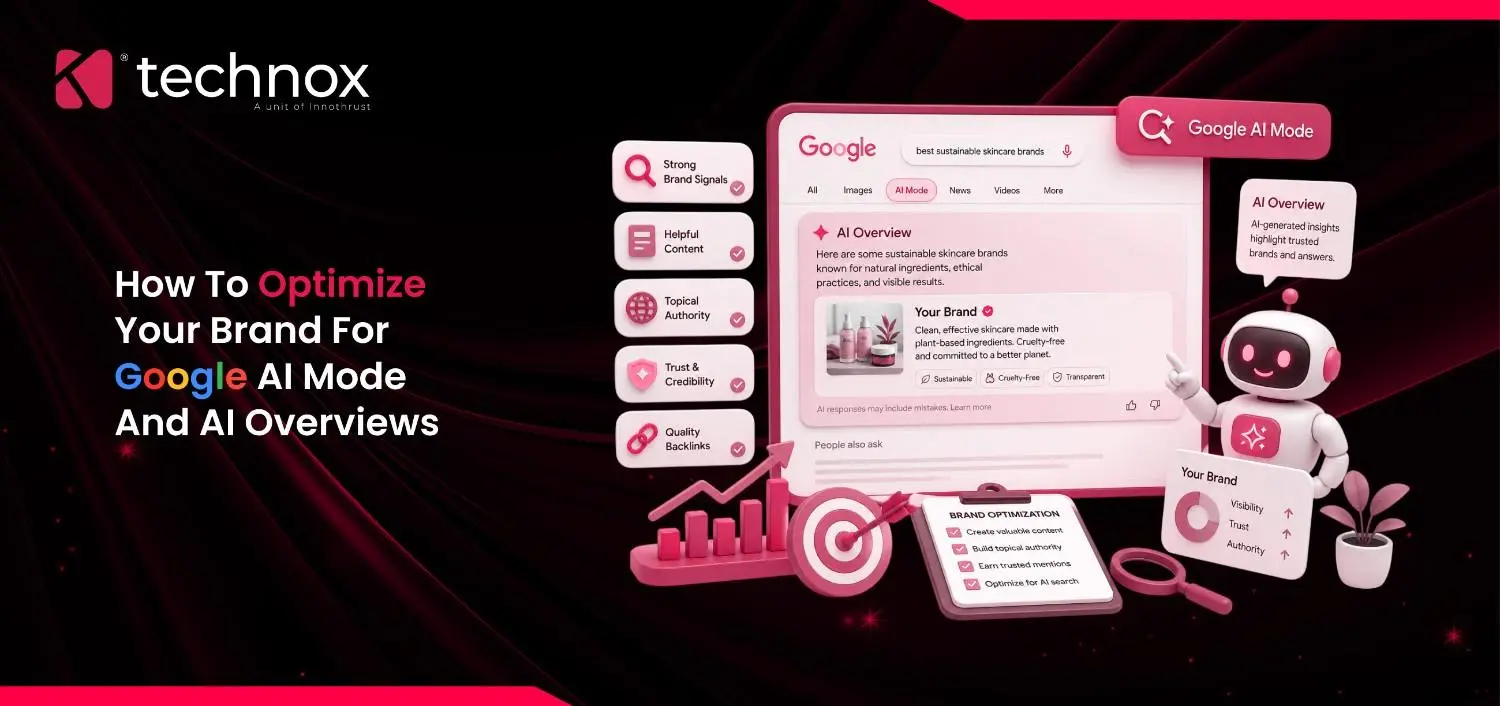
How to Optimize Your Brand for Google AI Mode and AI Overviews
Read Time11 mins
AuthorTechnox Technologies Team
PublishedAug 4, 2026