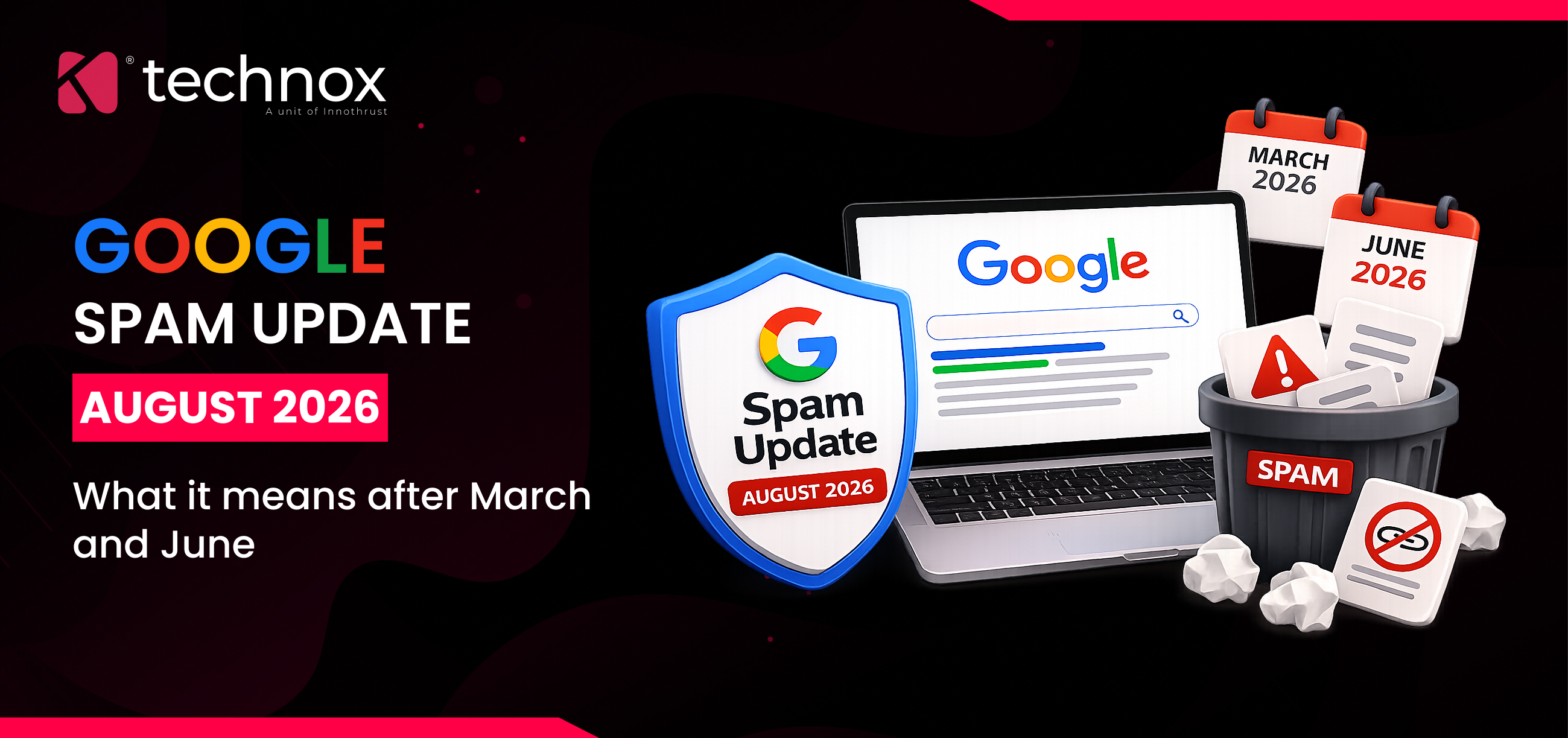
Google began rolling out the August 2026 spam update on August 18, 2026, as confirmed by the Google Search Status Dashboard. The release note went live a minute later, at 9:28 a.m. PDT, and it reads exactly as Google's status page phrases every spam update: the change applies globally, to all languages, and the rollout "may take a few days to complete." That single line is really the entire official announcement. There's no accompanying blog post, no new policy category, and no list of targeted tactics. If you're a site owner, marketer, or SEO who just noticed ranking movement and searched for an explanation, this is genuinely all Google has confirmed so far. Everything else, including what the update likely targets, how long it usually takes, and what you should actually do about it, comes from how Google's spam systems have behaved in the past and how the two spam updates earlier this year played out. This article walks through what's confirmed, what's pattern-based inference, and what a Coimbatore-based SEO team or any site owner should realistically do while the rollout completes. For most websites, no. Spam updates are designed to demote sites that violate Google's spam policies, not to reshuffle rankings for sites that are already following the rules. If your traffic is stable through the rollout window, there's nothing to do. If you see a sudden, sustained drop starting on or after August 18, it's worth reviewing your site against Google's spam policies before assuming it's unrelated noise. This is Google's third confirmed spam update of 2026, following updates in March and June. Seeing three spam updates land within six months isn't unusual (Google ran three in 2024 as well), but it does mean SEO teams need to treat spam-update monitoring as a recurring part of the calendar rather than a once-a-year event. Two patterns are worth noting from this table. First, spam updates in 2026 have landed roughly every two to three months, March, then June, then August, which is a tighter cadence than Google's broader core updates typically follow. Second, actual rollout duration has varied significantly, from under a day (March) to just over two days (June). The March 2026 spam update, at 19 hours and 30 minutes, holds the record as the fastest confirmed spam-update rollout in the Status Dashboard's history, so June's two-day window and August's still-open rollout are both closer to the normal range than March was. Google will mark the August update as complete on the same Status Dashboard entry once it's done, the same way it closed out March and June. It's easy to lump every Google announcement into one mental bucket labeled "algorithm update," but spam updates and core updates are solving different problems, and conflating them leads to the wrong diagnosis and the wrong fix. A core update changes how Google's ranking systems evaluate overall content quality, relevance, and usefulness across the web. It can move rankings for sites that have never violated a single policy, purely because Google's broader quality signals were recalibrated. Recovery from a core update, if warranted, usually means improving content quality, depth, and user experience, then waiting for a future core update to reflect that improvement. A spam update is narrower. It doesn't change what counts as a violation; Google's spam policies haven't changed since December 2025. What changes is how well Google's automated detection, primarily its AI-based system called SpamBrain, catches sites that are already breaking existing rules. Think of it less like a new law being passed and more like a bank upgrading its fraud-detection software: the rules for what counts as fraud haven't moved, but the system got better at catching it. This distinction has a direct, practical consequence. According to Google's own documentation on spam updates, sites that see a change after a spam update should review the spam policies and correct anything that's out of line. If a site genuinely wasn't spamming, a spam update shouldn't move it. If it does move and the site was in violation, cleanup can lead to recovery, but only over a period of months, as Google's automated systems observe sustained compliance. There's one specific exception worth flagging: for link spam specifically, cleaning up the links doesn't restore any ranking benefit those links previously provided. That benefit is gone for good; the ranking then simply reflects what the page would have earned without it. Google hasn't published a target list for the August rollout, and it typically doesn't for spam updates. This is standard, not a sign of unusual secrecy. But because the update enforces the same spam policies that have been in place since December 2025, we know exactly which categories of practice are in scope. Google's spam policies page lists these as the active violation types: Scaled content abuse: publishing large volumes of unoriginal, low-value pages purely to rank, regardless of whether the content was written by humans, AI tools, or some mix of both. Google is explicit that the production method doesn't matter; the test is whether the page adds value for a reader. Cloaking: showing search engines different content than what human visitors see. Doorway abuse: creating near-duplicate pages or domains that funnel users toward a "real" destination rather than serving them directly. Expired domain abuse: buying a domain with an established history and repurposing it to host unrelated, low-value content that rides the old site's authority. Hacked content, hidden text and link abuse, keyword stuffing, machine-generated traffic, malicious practices, misleading functionality, scraping, sneaky redirects, thin affiliation, and user-generated spam: the remainder of Google's standard spam catalogue. Two categories are typically handled by separate systems rather than the general spam update rollout: link spam and site reputation abuse. Site reputation abuse, third-party content published on a host site mainly to exploit that host's existing ranking signals, is enforced largely through manual action rather than the automated spam update sweep. Google confirmed directly to Search Engine Roundtable that the August update does not target link spam, the site reputation abuse policy, or "some other policies," consistent with what was reported about the June update. The one genuinely new element sitting behind this update isn't a new policy category. It's a clarification Google made to its existing spam policy on May 15, 2026. Google updated the definition of "spam" itself to explicitly cover attempts to manipulate not just traditional search rankings, but generative AI responses in Google Search, including AI Overviews and AI Mode. That's a meaningful shift for anyone doing SEO in 2026. Tactics built specifically to game how an AI Overview summarizes a page, or to trick AI Mode's conversational retrieval into citing thin or manipulative content, now fall squarely under the same spam enforcement umbrella as classic keyword stuffing or cloaking. The June 2026 spam update was the first to roll out after that clarification took effect, and Search Engine Journal has noted that Google hasn't said whether June, or now August, specifically targeted this behavior. But the policy is live, and it's reasonable to assume Google's detection systems are increasingly tuned to catch it. For agencies and SEO teams leaning into Generative Engine Optimization (GEO) or AI-search visibility work, the practical takeaway is straightforward: the line between "writing content that's genuinely easy for AI systems to understand and cite" and "engineering content specifically to manipulate what an AI system says" is now an enforceable policy boundary, not just an ethical guideline. Because the August update is still mid-rollout as of this writing, hard conclusions aren't possible yet, and that's an important discipline to hold onto rather than reacting to day-one noise. Industry monitoring around the announcement has generally echoed what happened with June: Search Engine Roundtable's coverage frames this as a routine, no-target-list spam update consistent with the pattern of the last two. Separately, some independent SEO monitoring sites flagged heightened ranking volatility in the days just before the official August 18 announcement, in early August, though Google had not confirmed any update was live during that earlier window. That's a useful reminder that rank-tracker volatility and confirmed Google updates don't always line up on the same calendar. The practical lesson here is one Search Engine Journal made explicitly: don't read a single day's ranking data as the full picture. Different rank-tracking tools sample different keyword sets across different countries, so two tools disagreeing with each other during a rollout is normal, not alarming. Rather than treating this as a five-step universal checklist, here's how to reason through it based on what you're actually seeing on your own site. Do nothing differently. Continue normal monitoring. There's no evidence that a compliant site needs to make defensive changes ahead of or during a spam update. Pull your Google Search Console performance data and isolate that exact date. Compare impressions, clicks, and average position before and after. If the drop is sudden, broad across many queries, and started right at the rollout window, a spam-policy issue is a reasonable hypothesis to investigate, though not a certainty, just a starting point. This is the most common accidental self-inflicted category in 2026, given how widely AI writing tools are now used. Review any bulk-published content, especially large batches of near-identical location pages, programmatically generated comparison pages, or AI-drafted content published with minimal editing or fact-checking. The test Google applies isn't "was AI involved," it's "does this add value a reader couldn't get elsewhere." Pages that fail that test are candidates for consolidation, substantial rewriting, or removal from the index. Check whether your product pages add anything beyond what's copied from the merchant, such as original testing notes, comparison tables, pricing context, or genuine editorial judgment. Thin affiliate pages that mirror manufacturer copy are explicitly named in Google's spam policy. Confirm that third-party content on your domain exists because it serves your actual readers, not because it's riding your site's established authority into topics your audience wouldn't expect. This is the site reputation abuse test, and while it's usually enforced manually rather than through spam update sweeps, it's worth an honest internal audit regardless. Resist the urge to make speculative changes. Google's own guidance is that recovery, where warranted, happens gradually over months as automated systems observe sustained compliance, not instantly after a single edit. Treat this as a triage exercise rather than a single investigation. Segment client sites by risk profile before diving into data. An e-commerce catalogue with thousands of near-duplicate product variants carries different scaled-content exposure than a local service business with a dozen hand-written pages. Pulling Search Console data for every account on the same day and flagging only the accounts with statistically meaningful movement, not single-digit percentage noise, keeps the review efficient and avoids chasing false positives across an entire client roster. Given the March and June precedents, expect the rollout itself to take somewhere between one and three days, though Google's own language, "may take a few days," leaves room for it to run longer. The Status Dashboard will log a completion entry the same way it did for March ("rollout was complete as of March 25, 2026") and June ("rollout was complete as of June 26, 2026"). Until that entry appears, day-to-day fluctuations are part of an unfinished process, not a final result. A reasonable approach is to check performance weekly rather than daily during and immediately after the rollout window, and to wait for the completion note before making any structural decisions based on the update. It's worth stepping back and asking why Google is running spam updates frequently in 2026. The honest answer, based on Google's own framing, is that spam detection is adversarial and continuous by nature. SpamBrain doesn't need a new law to enforce; it needs better pattern recognition against tactics that keep evolving, particularly as AI content generation tools make scaled content production cheaper and faster for bad actors than it's ever been. A tighter update cadence is a reasonable response to a threat landscape that's also moving faster. For legitimate site owners, this mostly changes the operating rhythm: spam-policy compliance isn't a one-time audit item anymore, it's closer to routine hygiene, similar to checking Core Web Vitals or crawl errors. Zoom out on the Status Dashboard's full history and August turns out to be a recurring month for this kind of enforcement. The August 2025 spam update rolled out on August 26, 2025, and took an unusually long 26 days, 15 hours to fully complete, one of the longest spam-update rollouts on record. Going back further, August 2024 saw a core update rather than a spam update, running 19 days, and August 2022 brought a helpful content update. None of this means August is somehow algorithmically special; it's more likely a byproduct of Google's internal release scheduling than any seasonal spam pattern. But it's a useful data point for expectation-setting: if the August 2026 rollout does end up running longer than March's 19 hours or June's two days, that alone wouldn't be unusual by historical standards. Sites shouldn't assume a longer rollout means a "bigger" or more aggressive update; duration and impact aren't reliably correlated across past spam updates. None of this replaces the fundamentals: genuinely useful content, technical health, a site that real users would recommend to a friend. But it does add a layer worth building into a regular workflow, a quarterly self-check against Google's published spam policies, alongside the usual technical and content audits. For businesses managing SEO across multiple properties or industries, that kind of policy review is easy to let slip when day-to-day work is focused on rankings and content calendars. Teams handling SEO for multiple client accounts often build this into standing monthly reporting rather than treating it as a reactive task that only happens after a traffic drop. August 18, 2026, at 9:27 a.m. US/Pacific, per the Google Search Status Dashboard entry. Not as of this writing. Google will update the Status Dashboard with a completion note, the same way it marked March and June as complete. No. Google's spam policies page hasn't changed since May 15, 2026, when it was updated to clarify that manipulating generative AI responses, including AI Overviews and AI Mode, counts as spam. The August rollout enforces existing policy, not a new one. Not necessarily. Confirm the timing matches, then check whether your site or content matches any of Google's listed spam categories. If neither applies, the drop may be unrelated: seasonal demand shifts, a technical issue, or normal ranking volatility are all worth ruling out separately. Google's documentation says it can take months for automated systems to recognize sustained policy compliance. For link spam specifically, any ranking benefit previously gained from the removed links doesn't come back; cleanup only prevents further harm, it doesn't restore lost credit.Quick Answer: Is This a Big Deal?
The 2026 Spam Update Timeline So Far
Spam Updates vs. Core Updates: Why the Distinction Matters
What the August Update Likely Targets
The Piece Most Sites Are Missing: AI Search Manipulation Is Now Explicitly In Scope
What SEOs Are Actually Seeing
What to Actually Do Right Now
If your rankings and traffic are stable:
If you see a drop that started on or after August 18:
If you suspect scaled content abuse might apply to you:
If you run an affiliate site:
If you host guest content, syndicated content, or a freelancer network:
If nothing above applies but you're still worried:
If you manage SEO for several clients across different industries:
How Long Should You Wait Before Drawing Conclusions?
Why Three Spam Updates in Six Months, Not One a Year
August Has a History of Spam Updates
Where This Fits Into a Broader SEO Strategy
Frequently Asked Questions
1. When exactly did the August 2026 spam update start?
2. Is the August 2026 spam update finished rolling out?
3. Did Google announce new spam policies with this update?
4. My rankings dropped around August 18, was it definitely this update?
5. How long does recovery take after a spam update?
Digital Marketing
HOME>
BLOGS>
DIGITAL MARKETING
Google Released the August 2026 Spam Update on August 18
Read Time12 mins
AuthorTechnox Technologies Team
PublishedAug 19, 2026