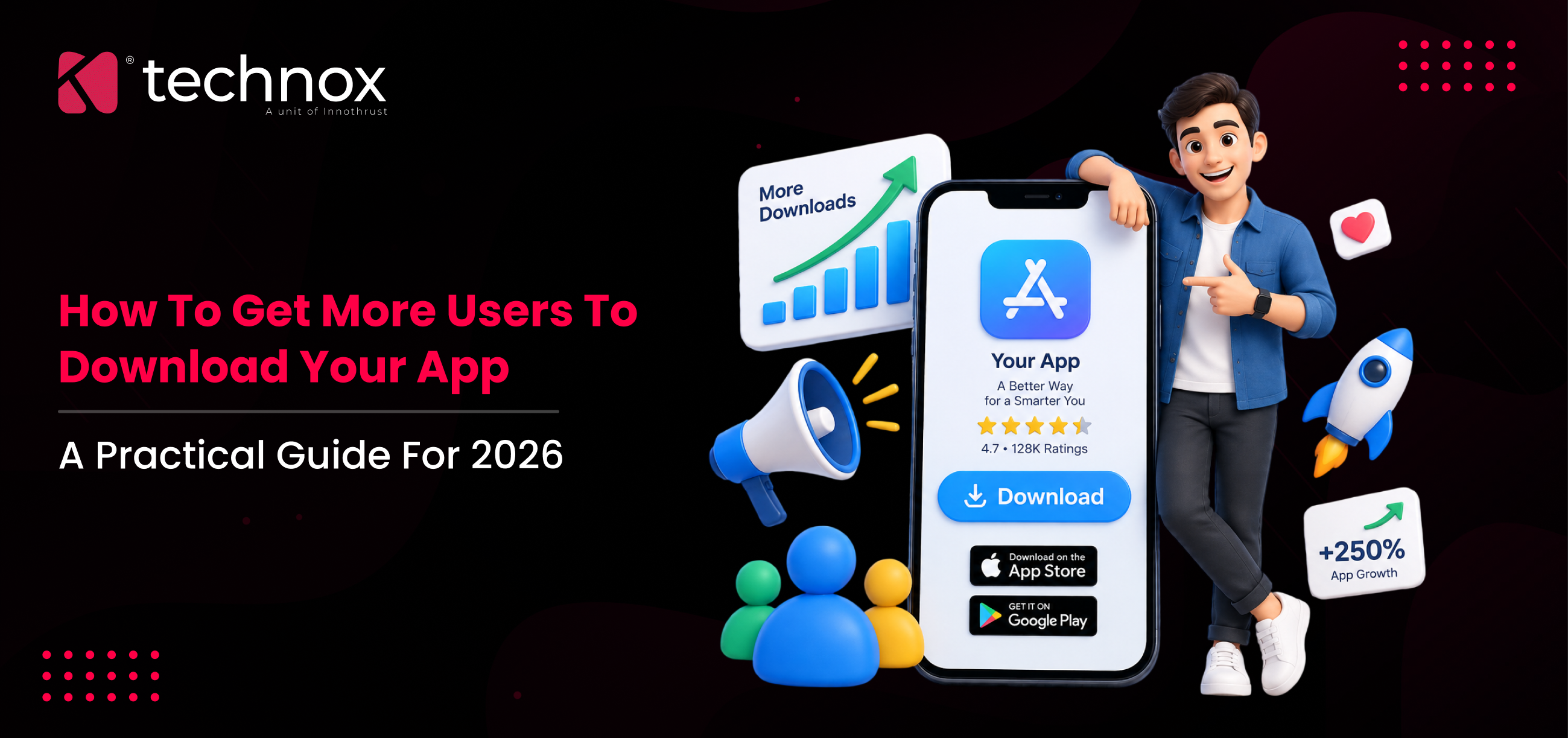
Quick answer: Downloads aren't one task. They're four layers working together: app store ranking (ASO), discovery before the store (your website, content, and now AI assistants), paid acquisition, and retention. Weak retention quietly drags down store ranking too, since Apple and Google both now factor in what happens after the install.
Most apps don't stall because the product is bad. They stall because downloads were treated as a single event instead of a system.
Here's the usual pattern: a founder launches the app, gets a burst of installs from friends and family, and then watches daily installs fall toward zero within 60 to 90 days. The product didn't change. The distribution did.
This guide breaks the problem into the four layers that actually drive downloads, how to sequence them based on where your app stands today, and a fifth channel most guides on this topic still skip entirely: getting recommended by AI assistants like ChatGPT, Gemini, and Perplexity.
Why Downloads Are Harder to Win Than They Used to Be
Two things are true at once in 2026:
The market is still growing. Global app downloads are on track to pass 180 billion across the App Store and Google Play this year, up from roughly 137.8 billion in 2024.
Competition has never been higher. Around 2.19 million apps live on the App Store, and over 2 million more on Google Play. With more than 4 million apps competing for attention, standing out on keywords alone is no longer realistic.
But the bigger problem isn't getting the install. It's keeping it.
Close to half of Android installs get uninstalled within 30 days, according to retention benchmark data compiled by Quash, and independent studies put first-month churn even higher across categories, with some apps losing 75% or more of new users within the first three days alone. Even top-150 apps face 20 to 60% uninstalls in their first 72 hours.
That one fact reshapes everything below: a strategy that only chases the download, without fixing why people leave right after, is optimizing for a number that doesn't translate into a business. It also explains why a low download count is rarely the real problem; a high uninstall rate driving up customer acquisition cost usually is.
Layer 1: Win the App Store Search Results (ASO)
ASO is still the foundation of organic app growth, but the rules behind it have shifted noticeably over the past two years. Apple and Google now weigh two things almost equally, a shift Apple confirmed in its own 2026 research on App Store ranking:
Textual relevance: how closely your listing's metadata matches what someone actually searched
Behavioral relevance: what real users do after they see and tap your app, including whether they install it and what they do afterward
Here's what actually moves the needle in 2026:
Title and subtitle Lead with what the app does, not just the brand name.
"Luna: Sleep Tracker & Meditation" beats "Luna" alone. It gives both the algorithm and the user context instantly, in the same handful of words.
If your app has a distinctive but unclear name, add a short descriptor. A one-word brand name with no context forces users to guess what they're installing, and guessing costs you taps.
Keywords work differently on each platform
Apple has a hidden 100-character keyword field that users never see but the algorithm reads closely. This is where secondary and long-tail terms belong.
Google Play has no dedicated keyword field. Instead, it indexes your long description the way a search engine crawls a webpage. AppTweak's 2026 ASO guide recommends targeting roughly 2 to 3% keyword density for primary terms and 1 to 2% for secondary terms, with your most important keywords placed in the first two to three sentences, since Google Play's algorithm weighs early placement more heavily.
Repeat keywords naturally rather than mechanically. Google's NLP-based systems read for context, not just term frequency, so awkward repetition can hurt more than it helps.
Screenshots and preview video matter more than most teams think If people see your listing but don't tap it, the stores read that as a relevance problem, not just a design one. A weak tap-through rate signals to the algorithm that your app isn't actually what searchers wanted, and rankings drop as a result.
Lead with the outcome the app delivers, not a guided tour of the interface.
Test different value propositions in your first two screenshots, since most users never scroll past them.
Add a short preview video that shows the app solving a real problem within the first few seconds.
Localize screenshots and copy for your top regions instead of translating word for word. A literal translation often misses the phrasing local users actually search for.
Ratings and reviews do double duty
Roughly 77% of users read at least one review before installing a free app, and about 80% before a paid one.
Apps under a ~4.0 rating are frequently scrolled past even when they rank well in search.
On Google Play, the text inside reviews is indexed too, which means real users are unintentionally adding keyword context every time they leave a review.
Respond to negative reviews within 24 to 48 hours with a specific, non-templated reply. Users who get a genuine response to a bad review often go back and update their rating.
Retention is now a ranking factor, not just a business metric Day 1, Day 7, and Day 30 retention, crash rates, and session frequency all feed into visibility on both stores. A smaller app with strong retention and a high rating can genuinely outrank a bigger, better-funded app that's weaker on post-install engagement.
None of this is "set and forget." Treat your store listing the way you'd treat a live landing page: refresh screenshots, keywords, and description copy on a regular cycle, and watch tap-through and conversion rate the same way you'd watch bounce rate on a website. This is the same ongoing-optimization mindset behind Technox's SEO services; a listing, like a webpage, is never really "finished."
Layer 2: Get Discovered Before the App Store
App Store search isn't the only place people decide what to install anymore. This is where most competing guides on this topic stop short, and it's the fastest-growing gap available to close right now.
Your website and content still matter
A meaningful share of installs start with a Google search, a comparison article, or a company's own website, not a direct search inside the App Store or Google Play. If your site doesn't clearly explain what the app does, who it's built for, and why someone should download it today, that entire discovery path is broken before it ever reaches the store.
This is standard technical and content SEO work applied to an app: fast-loading pages, clean structured data, and content that answers the real questions people ask before choosing between apps, not filler copy built around a single keyword. Technox's own SEO and technical audit process applies the same principles, site speed, indexing, and content clarity, to app landing pages as it does to any other business website.
AI assistants are becoming a real discovery channel
A growing share of people now ask ChatGPT, Gemini, Perplexity, or Siri to recommend an app for a specific task, then act on whatever shortlist comes back, instead of opening a store and typing a search term themselves, as detailed in Foresight Mobile's 2026 breakdown of AI app discovery.
A 2026 study by Growth by Kev analyzing thousands of AI app recommendations across ChatGPT, Claude, Gemini, and Perplexity found that only about 16% of recommended apps showed up consistently across all four assistants. Each platform draws on different retrieval sources and weighs them differently, which means winning visibility on one assistant doesn't guarantee visibility on the others. The same research found that adding a single word like "free" to a query can shift the entire recommendation set by close to 40 percentage points, which shows how sensitive these results are to exact phrasing.
What actually influences whether an AI recommends your app:
This channel builds more slowly than paid ads, but it costs nothing to start and it compounds over time. It's also a natural extension of the SEO and content work most businesses already invest in, including Technox's AI SEO and generative engine optimization services, rather than a separate project requiring a new budget line.
Layer 3: Paid Acquisition, Filling the Gaps Organic Can't Reach
Paid acquisition still has a place, but the channel landscape has fragmented since the days when a single platform could carry an entire launch.
Apple Search Ads: consistently delivers some of the highest-intent iOS installs, because it captures people who are already searching the store with clear purchase intent.
Google App Campaigns: remains the Android-first default, with automated bidding spread across Search, Play, YouTube, and the Display Network.
TikTok, Instagram Reels, YouTube Shorts: have become genuine discovery surfaces in their own right, particularly for consumer apps, where a short demo video showing the app solving a real problem in seconds tends to outperform a polished ad.
iOS attribution runs through SKAdNetwork 4 and AdAttributionKit, which limit how granular per-campaign measurement can be. This makes creative testing and aggregated conversion signals more important than they were in the earlier cookie-based attribution era.
How to think about budget allocation:
Rather than splitting spend evenly, most teams get better results by starting concentrated on one or two channels that match where their audience already spends time, proving out a positive cost-per-retained-user, and only then diversifying. Spreading a small budget across five channels at once usually produces underpowered data on all of them rather than a clear signal on any.
The one mindset shift that matters most: stop optimizing for cost-per-install alone.
Given how fast installs churn, a cheap install that uninstalls within three days isn't actually cheap once you account for the wasted acquisition spend and the negative signal it can send to store algorithms. Pair every paid channel report with Day 1 and Day 7 retention broken out by source, and judge budget allocation on cost-per-retained-user, not cost-per-install alone.
Layer 4: Close the Loop, Onboarding and Retention
This is the layer that separates apps with a sustainable download curve from apps that spike after launch and fade. Because retention now feeds back into store ranking, weak onboarding doesn't just cost you the user who churns. It quietly suppresses your visibility to the next user who hasn't installed it yet.
A few figures worth planning around, drawn from Panto's 2026 mobile app retention benchmarks:
Users who reach a genuinely useful action in their first session show roughly 2 to 3x better Day 7 retention than users who don't.
Nearly 25% of users abandon an app after a single use when onboarding feels slow, confusing, or over-explained.
Asking for permissions such as location, notifications, or contacts before the value is clear is one of the most common, and most fixable, causes of early uninstalls.
Personalizing onboarding to a user's actual goal, instead of showing everyone the same generic tour, can lift Day 7 retention by up to 20 percentage points compared with a one-size-fits-all flow.
The window to win back a lapsing user closes fast: automated re-engagement triggered within 3 to 7 days of inactivity produces meaningfully higher return rates than waiting a week or longer.
Fixes that consistently work:
Cut onboarding down to the fewest screens needed to reach real value, not the most screens needed to explain every feature.
Delay permission prompts until the value behind the permission is obvious to the user.
Offer guest access or social login instead of forcing full account creation before someone has experienced the app.
Use behavior-triggered push notifications tied to what a user actually did, rather than a broadcast calendar sent to everyone at once.
Treat crashes as a retention issue, not just an engineering one. A meaningful share of users say they'll leave after just one or two crashes in the same session.
Which Layer Should You Prioritize First?
The right starting point depends on where the app actually is today, not on which layer sounds most exciting to work on.
How to Measure Whether Any of This Is Working
Downloads alone are a vanity metric if you're not tracking what happens next. A short set of numbers, reviewed monthly, tells you far more than total install count:
Reviewing these together, rather than in isolation, is what turns "we got more downloads" into "we built a sustainable acquisition system."
Common Mistakes That Quietly Kill Download Growth
Setting up ASO once and walking away. Store algorithms reward continuous testing of screenshots, keywords, and descriptions, not a listing built at launch and left untouched for a year.
Chasing installs with no retention filter. A channel that produces cheap installs that uninstall within a few days is not actually cheap once wasted spend and negative store signals are accounted for.
Front-loading permission requests. Asking for access before the user understands why is one of the most avoidable causes of Day 1 churn.
Ignoring reviews. Both the star rating and the text inside reviews affect visibility, and unanswered negative reviews compound the damage over time.
Writing descriptions for algorithms instead of people. A clear "what it does, who it's for, why now" description consistently outperforms keyword-stuffed copy, on both store conversion and AI-assistant retrieval.
Treating every acquisition channel the same way. A channel that works for a fitness app rarely transfers directly to a fintech or B2B app; audience behavior and search intent differ too much to copy a playbook wholesale.
A Note for Businesses Building or Marketing an App
If the app was recently built, this strategy works best when it's planned alongside the build, not bolted on after launch. Store metadata, onboarding flow, and the website that supports discovery all influence each other, and untangling them after launch takes longer than designing them together from the start.
Technox Technologies works across mobile app development and AI SEO and generative search visibility for clients who need the product and the discovery strategy handled together, rather than as two disconnected projects. Recent work across Technox's case studies follows the same pattern: distribution and product decisions made together outperform the two handled separately.
Frequently Asked Questions
1. How long until ASO shows results?
Store algorithms need time to gather behavioral data on a new or updated listing. Most teams see meaningful ranking movement within 6 to 8 weeks of consistent optimization, not days.
2. Is ASO still worth it if we're running paid ads too?
Yes. Paid traffic landing on a weak listing converts worse, and a stronger organic ranking lowers the effective cost of every paid channel by improving your baseline conversion rate.
3. Do AI assistants pull app recommendations straight from the App Store?
Not only. They also draw on your website, third-party reviews, press coverage, and category roundups, which is why consistency across all of those sources matters more than optimizing any single one in isolation.
4. Should a small business with a limited budget focus on ASO or paid ads first?
ASO first, in almost every case. It's free to execute (aside from time), compounds over months, and improves the conversion rate that paid traffic will later depend on.
5. Does the app category change which strategy matters most?
Yes. Utility and productivity apps tend to win more on ASO and retention since users search with clear intent. Consumer and lifestyle apps often see more impact from short-form video and social discovery, since users browse rather than search directly.