Every quick commerce founder we've spoken with starts the conversation the same way: "I want to build something like Blinkit or Zepto." Few of them realize that what they're describing isn't one app: it's three, running in permanent sync, with a delivery promise measured in minutes rather than days.
That distinction is where most quick commerce builds go wrong, and it's the one this guide spends the most time on.
What "Quick Commerce App Development" Actually Means
Quick commerce (Q-commerce) is the delivery of everyday essentials, groceries, medicines, snacks, personal care items, typically within 10 to 30 minutes, using hyperlocal dark stores instead of centralized warehouses. Unlike traditional e-commerce, which optimizes for catalog depth and next-day shipping, quick commerce optimizes for proximity, inventory accuracy, and dispatch speed.
That single design goal, sub-30-minute fulfillment, changes almost everything about how the software has to be built. A traditional e-commerce app can tolerate a few seconds of stock-checking latency or a delayed courier assignment. A quick commerce app can't, because the entire value proposition collapses the moment delivery slips past the promised window.
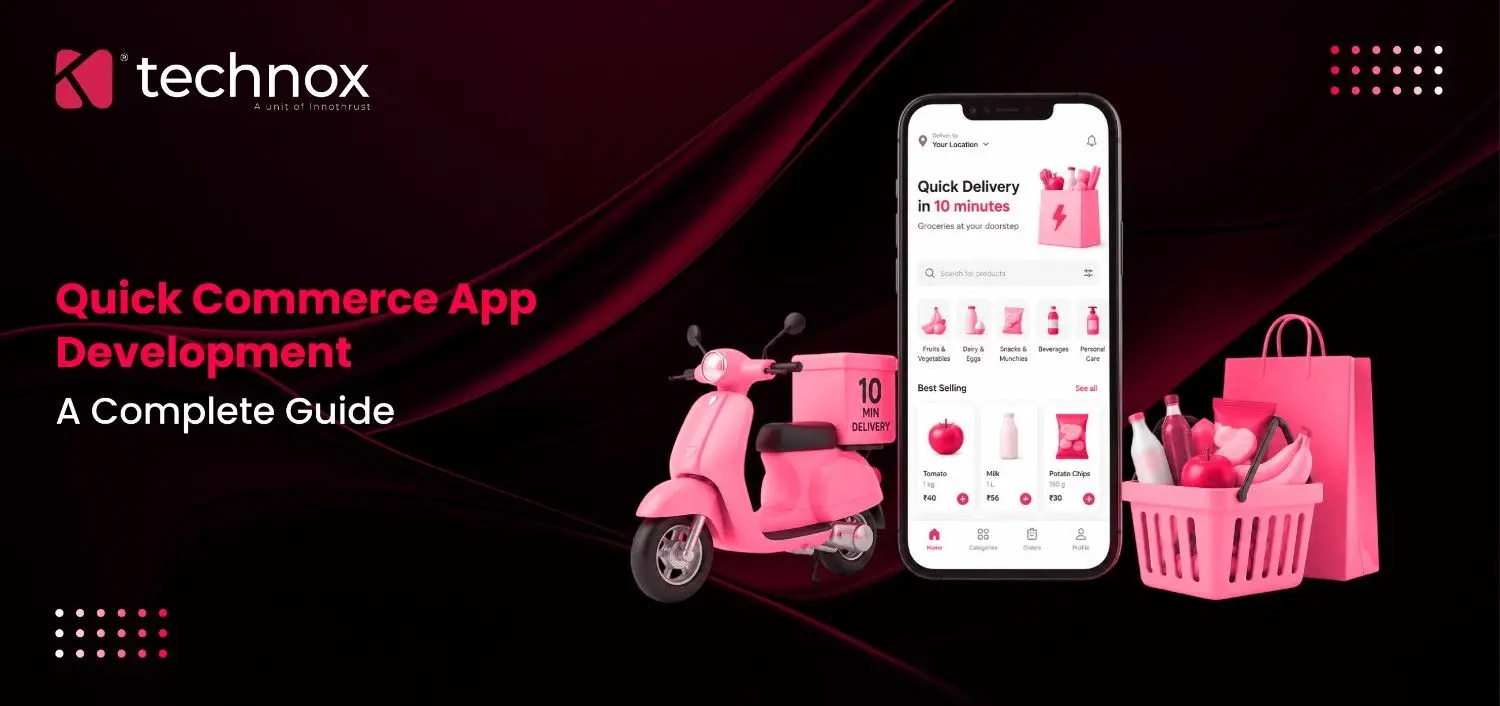
The part most guides skip: a real quick commerce platform is a three-app system, not a single app with a delivery feature bolted on. You need:
A customer app: browsing, cart, checkout, live tracking
A delivery partner app: order assignment, navigation, proof of delivery
A dark store / admin dashboard: inventory, picking, dispatch, staff management
All three read and write against the same real-time inventory layer. If a product goes out of stock in the dark store dashboard, that has to reflect in the customer app within seconds, not minutes, or you sell items you can't fulfill, which is the single fastest way to lose a first-time user permanently.
Why the Market Is Moving Fast, and What the Numbers Mean for You
Quick commerce isn't a niche experiment anymore. According toMordor Intelligence, India's quick commerce market stands at roughly USD 3.65 billion in 2026 and is forecast to reach USD 6.64 billion by 2031 at a 12.74% CAGR. Independent estimates from other research houses (Statista, ResearchAndMarkets) put the longer-range ceiling even higher. The spread in numbers reflects a genuinely fragmented, fast-moving category, but every estimate agrees on direction: sharp, sustained growth.
A few figures are worth sitting with:
Dark store networks expanded sharply year-over-year. Industry tracking from firms like Equirus Research has shown India's largest players growing their combined dark-store footprint by well over a thousand locations in a single year. What this means for you: the competitive moat in quick commerce isn't the app UI; it's fulfillment density. Before you write a line of code, you need a real answer for how many dark stores or partner locations you can realistically service in your first 12 months.
Roughly 77% of quick commerce customers expect delivery within two hours, and most successful platforms deliver in 10 to 30 minutes. What this means for you: your app's performance budget (page load, cart-to-checkout time, map rendering speed) isn't a nice-to-have. Every extra second in the app itself eats directly into the delivery-time promise your business is built on.
Blinkit processed roughly 203 million orders in FY24 on a three-app architecture similar to the one described above, according toZomato's FY24 annual report figures. What this means for you: the pattern that works at scale is well documented, so you don't need to invent your own architecture from scratch, which meaningfully de-risks a first build.
Core Features, Organized by App
Founders often ask for a single feature list. In practice, features only make sense grouped by which of the three apps they belong to, because that's also roughly how your development budget will be allocated.
Two features deserve extra attention because they're easy to underestimate: inventory-aware search and real-time stock sync. Showing a customer an item that's actually out of stock two aisles over in the dark store is the single most common cause of order cancellations in early-stage quick commerce apps, and it's a backend architecture problem, not a UI problem.
Build vs. Buy: The Decision Most Founders Get Backwards
There are two credible paths into quick commerce, and the right one depends almost entirely on your order volume, not your budget.
If you're running (or projecting) roughly 30 to 60 orders a day, a white-label or aggregator-based solution is usually the smarter starting point. You get fulfillment infrastructure and an existing customer base without upfront technology cost, and you can validate demand before committing to custom development.
Once you're consistently clearing that volume, or once commission fees on a third-party platform start outweighing what a custom build would cost, the economics flip. At even a modest order volume, a 20% platform commission can quietly cost an operator well over ₹1.8 crore (roughly USD 200,000+) a year, which is often more than the cost of the custom platform itself. That's the calculation that should trigger a custom build conversation, not a vague sense that "we should have our own app."
Tech Stack: What Actually Gets Used in Production
Most production quick commerce platforms converge on a similar stack, for good reason: it's been proven at scale.
Mobile apps: Flutter or React Native for the customer and delivery partner apps, allowing a single codebase to ship to both Android and iOS without duplicating engineering effort
Backend: Node.js or Python microservices, chosen for how well they handle high-concurrency, real-time order flows
Database: Firebase or PostgreSQL, often paired with Redis for an atomic inventory layer that prevents overselling during traffic spikes
Infrastructure: Cloud hosting with auto-scaling, a CDN layer for product images (this alone measurably improves perceived load time at the exact moment a customer is deciding whether to complete checkout), and CI/CD pipelines so features can ship without a full app-store review cycle blocking every fix
One implementation detail worth flagging because it's routinely skipped in V1 builds: the Redis-based atomic inventory layer. Retrofitting it after launch typically takes six to ten weeks of engineering time versus one to two weeks if it's built in from day one, and the cost of getting it wrong in production is lost customer trust, which is much harder to rebuild than code.
What It Actually Costs and How Long It Takes in 2026
Cost estimates across the industry are wide because "quick commerce app" means very different things at different scales. A realistic breakdown:
Team location is the single biggest lever on this range. Offshore development teams, including experienced teams based in India, typically bring total build costs down 40 to 60% compared to US-based agencies, without a corresponding drop in output quality, since the underlying tech stack (Flutter, Node.js, PostgreSQL) is identical regardless of where the team sits.
Where Most Quick Commerce Builds Actually Fail
Having reviewed a fair number of platform builds and rebuilds, the failure pattern is consistent, and it's rarely "the app looked bad":
Treating inventory sync as a V2 feature. It's the single hardest thing to retrofit and the thing customers notice fastest when it's wrong.
Underestimating the delivery partner app. Founders pour budget into the customer-facing app and treat the courier app as an afterthought, but courier efficiency is the actual bottleneck on the delivery-time promise.
Launching city-wide instead of zone-by-zone. Every successful platform in this space, Blinkit, Zepto, Gopuff, Getir, started in a single dense zone and expanded only once unit economics worked there.
No plan for discoverability beyond the app store. A fast, well-built app still needs people to find it. That means App Store Optimization (keyword-rich listings, screenshots, review velocity) working alongside a real website, because a meaningful share of first-time users still research a service on Google before installing anything. A slow, poorly structured web presence undermines trust in the app before a user has even downloaded it.
That last point is where app development and digital marketing stop being separate workstreams. A quick commerce brand's website needs the same performance discipline as the app itself: clean technical architecture, fast load times, and structured data that helps it surface in both traditional search and AI-generated answers, because increasingly, "is this app legitimate" gets answered by a search result before it gets answered by an app store listing.
Choosing a Development Partner
A short, practical checklist, based on what actually predicts whether a build stays on budget:
Can they show a real-time inventory architecture they've shipped before, not just described in a proposal?
Do they design the delivery partner app with the same rigor as the customer app, or treat it as an afterthought?
Is their cost estimate broken down by component (inventory sync, dispatch, dark store dashboard) rather than a single lump figure? A single number is usually a sign the scoping wasn't done properly.
Do they have experience with both the mobile build and the surrounding web presence (SEO, app store optimization, structured data), or only one half of the discoverability problem?
Conclusion
Quick commerce succeeds or fails on the parts founders are tempted to treat as secondary: a delivery partner app built with real rigor, an admin dashboard that syncs inventory in real time rather than in batches, and a web presence that earns trust before a customer ever opens the app store. The customer-facing app is the easiest of the three systems to get right and the least likely one to sink the business. Inventory accuracy and dispatch speed are where quick commerce platforms actually live or die operationally.
If you're scoping a build, start with the architecture decision (build vs. buy, and at what order volume), lock in the real-time inventory layer from day one rather than retrofitting it later, and budget for the delivery partner app and the dark store dashboard with the same seriousness as the customer app. Get those three things right and the rest, UI polish, marketing, city expansion, becomes a much easier problem to solve.
Technox Technologies works across both halves of this problem: the mobile app development itself and the digital marketing, and SEO work that makes a quick commerce brand discoverable once it's live. If you're scoping a build, that's a conversation worth having before development starts, not after launch.
Frequently Asked Questions
1. What is quick commerce app development?
It's the process of building the software systems, customer app, delivery partner app, and dark store admin dashboard, that power ultra-fast delivery of everyday essentials, typically within 10 to 30 minutes.
2. How much does it cost to build a quick commerce app?
An MVP typically costs $35,000 to $80,000. A mid-range platform runs $100,000 to $200,000, and a full-scale, AI-driven platform can exceed $400,000, depending on features, team location, and number of cities served.
3. How long does it take to build a quick commerce app?
An MVP takes 3 to 6 months. A full-scale platform with dark store management, dispatch automation, and demand forecasting typically takes 9 to 18 months.
4. Do I need three separate apps for quick commerce?
Yes, functionally. You need a customer-facing app, a delivery partner app, and an admin/dark store dashboard, all synced against the same real-time inventory system. Some early-stage builds combine the admin dashboard with a simpler web panel to reduce initial cost.
5. Should I build a custom app or use a white-label solution?
If you're running under roughly 30 to 60 orders a day, a white-label or aggregator-based solution is usually more cost-effective. Above that volume, commission costs on third-party platforms often exceed the cost of a custom build within a year.
6. What tech stack is best for a quick commerce app?
Flutter or React Native for the mobile apps, Node.js or Python for the backend, and PostgreSQL or Firebase with a Redis layer for real-time, overselling-proof inventory management is the most commonly proven combination in production.
7. Is quick commerce only for grocery delivery?
No. While groceries dominate today, the same architecture is used for pharmacy delivery, pet supplies, electronics accessories, and other high-frequency, low-consideration purchase categories.
8. How do I make my quick commerce app discoverable after launch?
Through a combination of App Store Optimization, a fast and well-structured website that ranks for relevant local and category searches, and, increasingly, structured data that helps AI-powered search tools surface accurate information about your service.