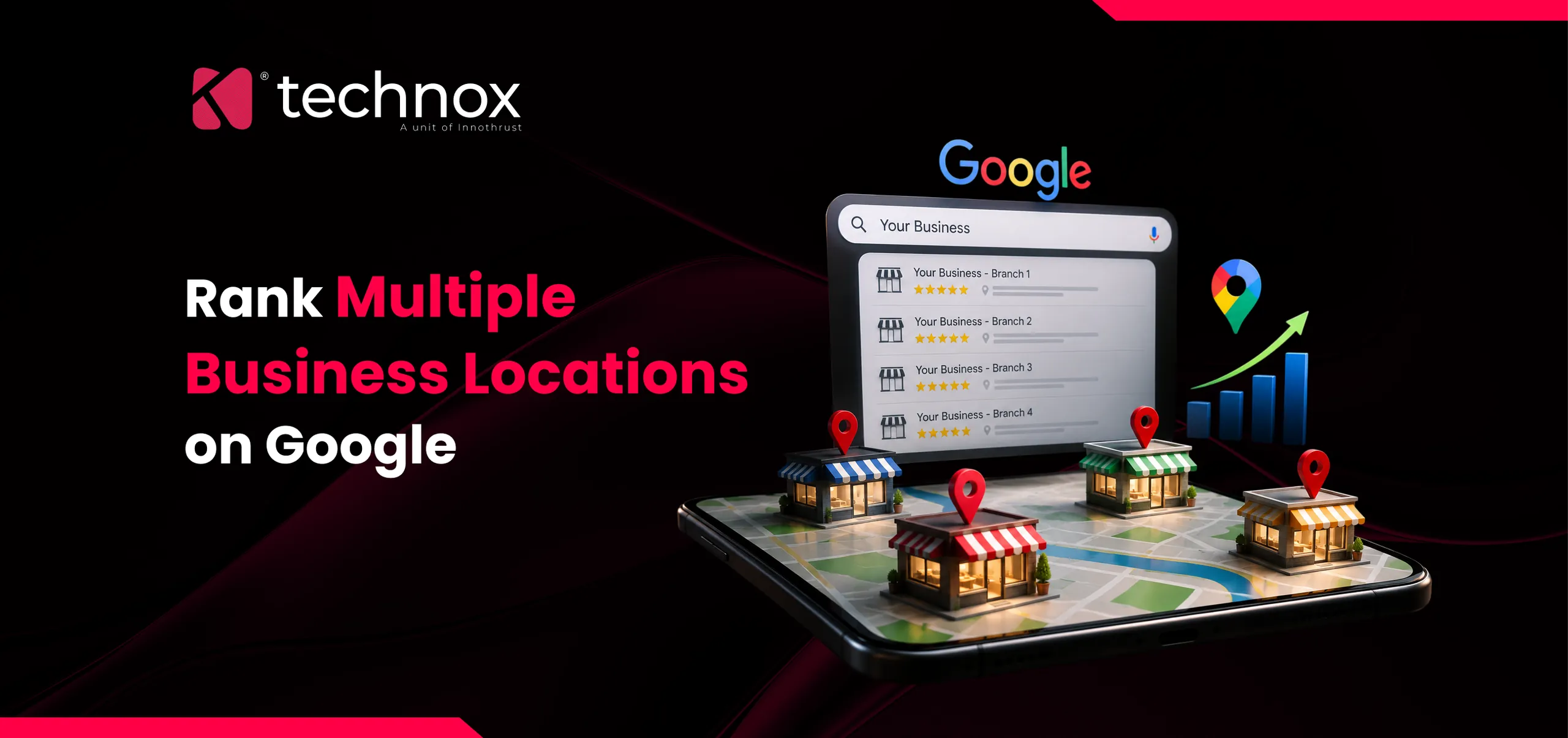
A branch can be fully set up, verified, and accurate on Google. It can still be nowhere near the local pack when someone searches for what it sells. Getting every location live and consistent is a management problem. Getting each one to actually rank is a different problem entirely. Ranking depends on how Google weighs relevance, distance, and reputation against every competitor fighting for the same three map pack slots. If your locations are not yet properly set up, verified, and given their own web pages, that groundwork needs to happen first. Our guide on how to manage Google Business Profiles for multiple locations covers that stage in detail. This guide assumes that stage is done and focuses entirely on what pushes an already-live branch up the rankings. Ranking multiple business locations means getting each individual branch to appear in the local pack, Google Maps results, and organic local search for its own city or neighborhood. It does not mean one flagship branch dominates while the rest stay invisible. Every branch competes on its own, against its own local competitors. Each one uses its own combination of profile completeness, reviews, on-page content, and links. This matters because a business with five branches does not get five times the visibility automatically. Each location has to individually earn a place in results for its own area, using the same fundamentals covered in our what is SEO guide, just applied separately to every branch. For a fuller grounding in how local search ranking works before location count enters the picture, our local SEO guide walks through the core mechanics this article builds on. This guide focuses on the local pack and organic local results together; if your priority is visibility inside Google Maps specifically, the mechanics differ slightly, and our guide to Google Maps SEO covers that distinction in more depth. Google's own Business Profile documentation states that local results are based on three factors: relevance, distance, and prominence. Every ranking tactic in this guide ultimately serves one of these three. Distance is worth naming honestly. You cannot move a branch closer to a searcher, and no amount of content will override a competitor who is genuinely nearer. What you can control is making sure every other factor is working as hard as possible to offset it. Most local SEO content treats every ranking signal as equally important. That makes prioritization nearly impossible. Whitespark's 2026 Local Search Ranking Factors survey, compiled from 47 local SEO practitioners, breaks the local pack algorithm down by weighted category instead. This matters practically because it tells a multi-location business where to spend limited time first. A branch with a strong profile and no reviews is leaving 20% of the algorithm untouched. A branch with reviews but thin, generic content on its location page is leaving nearly a fifth of it untouched too. Proximity itself, separate from this table, is estimated to influence roughly 55% of ranking decisions overall. That is exactly why the controllable factors above need to work harder for locations further from a searcher's default radius. Relevance is decided largely inside the Google Business Profile itself. That is why this stage cannot be skipped even in a ranking-focused strategy. The primary category is the single highest-weighted individual factor in Whitespark's 2026 data. It ranks ahead of proximity and even ahead of keywords in the business name. Each branch should carry the category that most precisely matches what it does, not the broadest one available. A branch that only offers teeth cleaning and checkups should not select "Dental Implants Provider" as its primary category just because the brand offers implants elsewhere. Precision beats breadth here, branch by branch. The services list, business description, and Q&A section on each profile should also reflect what that specific branch actually offers. Use the language customers actually search with, not internal company terminology. Once your location pages exist, the next problem is making sure they do not compete with each other. This is a planning step, separate from building the pages themselves. The pattern shows up once several branches sit close together: your own pages chasing the same search term instead of competing against outside competitors. The fix is deciding, before content goes live, exactly which terms belong to which branch, based on that branch's own service area rather than the brand's full territory. Our SEO company in Coimbatore page is a working example of this: a page written for one specific city, not a generic template repeated everywhere the brand operates. Two location pages can both avoid duplicate content and still rank differently, because one demonstrates real expertise and the other does not. This is where Google's E-E-A-T framework, short for Experience, Expertise, Authoritativeness, and Trustworthiness, applies directly to a branch network. Google's Search Quality Rater Guidelines use E-E-A-T to judge whether content reflects genuine, firsthand knowledge rather than generic filler. For a location page, that means naming the actual staff at that branch, describing services in terms of real experience rather than marketing language, and linking to genuine credentials, certifications, or press coverage specific to that location where they exist. A branch that shows a named manager, a physical team photo, and specific before-and-after results from local customers reads as more trustworthy, to both a human visitor and to Google, than a page built entirely from template copy. This is one of the more overlooked levers in multi-location SEO, precisely because it takes real content work rather than a technical fix. Reviews sit inside the "prominence" factor Google names officially. Whitespark's 2026 data puts review signals at roughly 20% of local pack weight, the second-largest category after the Google Business Profile itself. Three specific patterns inside that 20% matter more than raw star rating. Review velocity, meaning a steady stream of new reviews rather than a pile earned years ago, is one of the top individual signals researchers track. Review recency matters enough that 74% of consumers specifically look for reviews written within the last three months before trusting a listing, according to Whitespark's research. And response rate carries real weight too: businesses that reply to 80% or more of their reviews tend to see a measurable ranking benefit. Volume still matters at a basic level. Industry analysis of the Whitespark dataset found that businesses with 50 or more reviews are roughly 266% more likely to appear in the local pack than businesses with fewer than 10. For a multi-location brand, that number should be tracked per branch, not as a company-wide average. One flagship location with 300 reviews can easily mask three other branches stuck below 10. Link signals account for roughly 15% of local pack ranking weight. This is the category most multi-location businesses under-invest in, largely because it does not scale the way a profile update does. Whitespark's 2026 research notes an important shift here. Local link building has moved away from mass directory submissions and toward relationship-based links, meaning sponsorships, community partnerships, and coverage tied to a specific branch's actual presence in its city. These links take longer to earn than a citation listing. But they are also far harder for a competitor to copy, and they tend to carry more weight per link as a result. Citations, meaning your business listed consistently on relevant directories, still matter as a baseline. They just are not the primary lever they were in earlier years, so treat them as table stakes rather than a strategy on their own. On-page signals make up roughly 19% of the ranking weight in Whitespark's data, and website performance sits inside that category. A location page that loads slowly on a phone, or renders awkwardly on a small screen, works against everything else that page is trying to accomplish. This connects directly to Google's page experience signals and mobile-first indexing, where the mobile version of a page is the version primarily used for ranking. A beautifully written location page that takes six seconds to load on a phone is competing at a disadvantage before a searcher even reads a word of it. Internal links do double duty for a multi-location brand. They help Google understand which pages belong to which branch. And they pass authority from strong pages, like a well-linked blog post, toward newer or weaker location pages that need the help. A useful structure links from the homepage to a locations index page, from that index to each individual location page, and from relevant blog content back to the specific branch a reader is likely closest to. Avoid defaulting every link to the homepage. This is one of the lowest-cost fixes available. It requires no new content, only better linking discipline within what already exists. A mistake specific to multi-location brands is comparing branches only against each other, when the only benchmark that actually matters is whoever currently occupies the local pack in that branch's own city. For each location, check who ranks above you for your core terms, then compare review count, review recency, category selection, and content depth against that specific competitor, not against your own best-performing branch elsewhere. This changes what "good enough" means location by location. A branch with 40 reviews might be comfortably ahead of local competition in one city and meaningfully behind it in another, and the two branches need different levels of investment as a result. Rankings should be tracked location by location, not as a single company-wide number. One strong branch can easily hide several weak ones. A geo-grid rank tracker checks rankings from multiple points around each branch, rather than a single search location. It gives a far more honest picture than checking rank from the office. Alongside rank position, watch these per location: Organic sessions landing on each specific location page, not just total site traffic Review count, average rating, response rate, and review recency, tracked branch by branch Referring domains and local links earned per branch over time Ranking position and review count of the top three competitors in that branch's own local pack According to Whitespark's 2026 research, Google Business Profile signals carry the most weight at roughly 32% of the local pack algorithm. Proximity, primary category, and business name keywords are the top individual factors within that group. No. Each branch ranks on its own merits in its own area. A strong flagship location does not lift a poorly optimized branch in another city. No. Nearby branches targeting identical terms compete against each other instead of outside competitors. Assigning distinct, city-specific keywords to each page improves both pages' chances of ranking. E-E-A-T stands for Experience, Expertise, Authoritativeness, and Trustworthiness, the framework Google's Search Quality Rater Guidelines use to judge content credibility. A location page that names real staff and shows genuine local results reflects this far better than generic template copy. There is no fixed number, but data drawn from Whitespark's research shows businesses with 50 or more reviews are roughly 266% more likely to appear in the local pack than those with fewer than 10. Both matter, but recency carries real weight. Around 74% of consumers specifically look for reviews from the last three months, so a large pile of old reviews is less persuasive than a steady, current flow. Link signals account for roughly 15% of local pack ranking weight. Relationship-based local links, such as sponsorships and community partnerships, now carry more value than mass directory citations. Both. Website performance sits inside on-page signals, which make up close to a fifth of the ranking algorithm, and Google's mobile-first indexing means the mobile experience of a location page is what primarily gets evaluated. Not as the primary benchmark. The competition that matters is whoever ranks above a given branch in its own city, since a branch that looks strong company-wide can still be losing to local competitors.What does it mean to rank multiple locations on Google?
The three things Google actually judges
How much each ranking factor actually matters
Getting the relevance signals right, location by location
Solving keyword cannibalization before it costs you rankings
Content depth and credibility: the signal most location pages miss
Reviews: the ranking factor most businesses underuse
Earning links and citations without a directory-submission spree
Page speed and experience are ranking factors too, not just user experience
Internal linking: the quiet multiplier across a location network
Benchmarking against local competitors, city by city
Mistakes that quietly cap how well multiple locations can rank
Measuring whether the strategy is actually working
Frequently Asked Questions
What is the single biggest ranking factor for local search in 2026?
Does having more locations automatically improve rankings for all of them?
Should every location page target the same keywords?
What is E-E-A-T, and why does it matter for a location page?
How many reviews does a location need to rank well?
Does review recency matter more than review volume?
How important are backlinks for ranking multiple locations?
Does page speed actually affect local rankings, or just user experience?
Should I compare all my branches against each other to see which is doing best?
SEO
HOME>
BLOGS>
SEO
How to Rank Multiple Business Locations on Google With Local SEO
Read Time10 mins
AuthorTechnox Technologies Team
PublishedSep 11, 2026