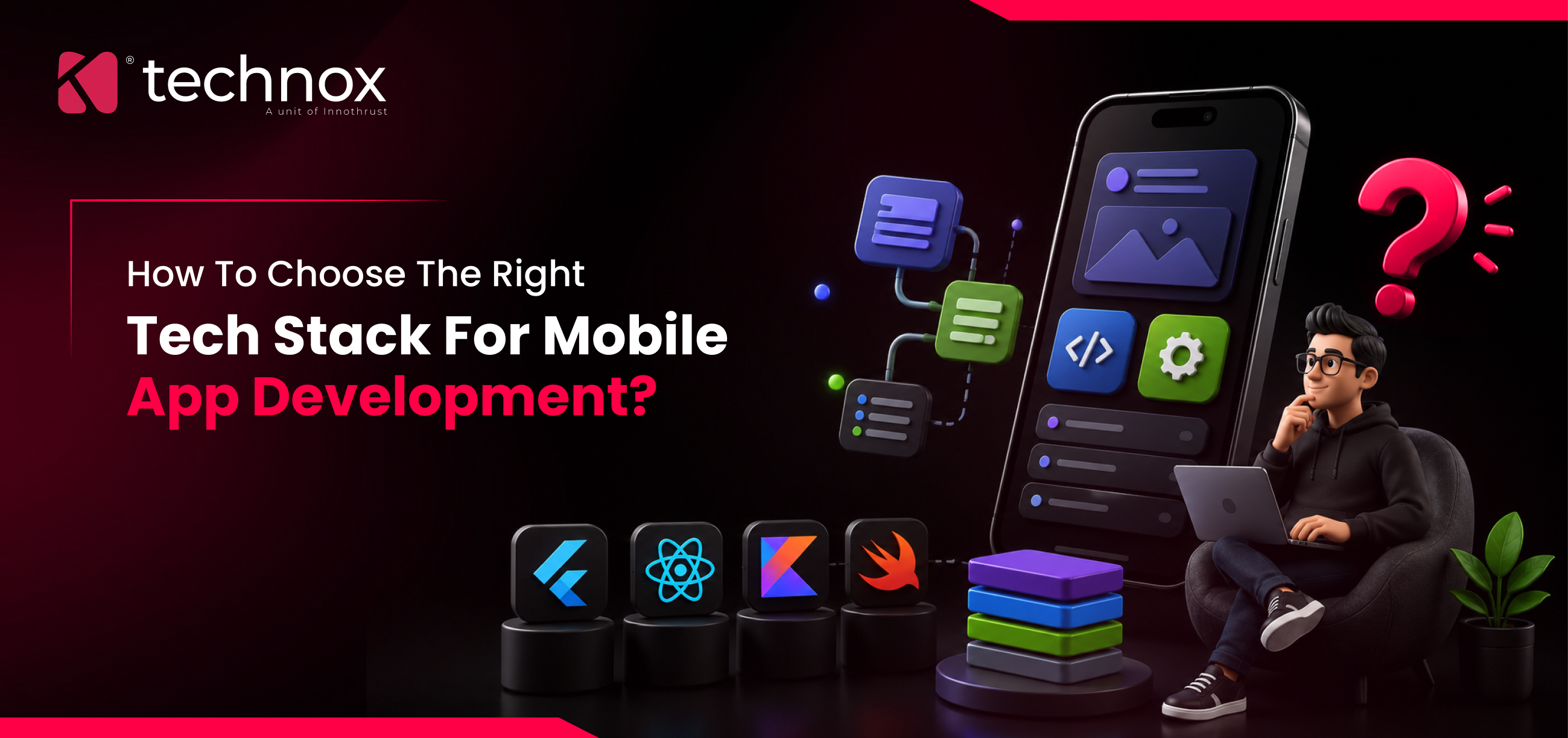
Choosing the right mobile app tech stack is one of the most important decisions for any business. But the framework should not be the first decision. Budget, timeline, team expertise, app requirements, scalability, and maintenance should come first.
Flutter and React Native can both be strong choices, while native development may be better for apps requiring advanced platform-specific features. The right option depends on your business goals and technical needs, not trends or personal preferences.
At Technox, we help businesses choose a tech stack that balances performance, cost, scalability, and long-term maintenance, helping avoid expensive rebuilds after launch.
What Is a Tech Stack?
A tech stack is the complete set of programming languages, frameworks, and tools used to build and run a piece of software, in this case, a mobile app. Strip away the jargon, and it's simply the layered set of choices that make an app exist, split across four layers that each depend on the one below it.
Frontend layer: what actually runs on the user's phone. Built natively in Swift (iOS) or Kotlin (Android), or as a single shared codebase in Dart via Flutter or JavaScript via React Native.
Backend layer: the logic behind the scenes: authentication, business rules, data processing. Handled by a managed service like Firebase, or a custom build in Node.js, Laravel, or Django.
Database layer: where the data actually lives, structured either as relational tables (PostgreSQL, MySQL) or as flexible documents (Firestore, MongoDB).
Infrastructure layer: hosting, CI/CD, monitoring, and the app store release pipeline that gets updates out into the world and catches problems before users do.
Each layer leans on the one below it, which is why getting one wrong early is expensive later. A database chosen for convenience in month one doesn't surface as a bug in month eighteen, it surfaces as a migration project, usually right when the business can least afford the disruption.
Native or Cross-Platform: Settle This First
Before comparing individual frameworks, there's a bigger fork to resolve: does this app need to be built twice, once for iOS, once for Android, or can a single codebase serve both? For most businesses, the answer has shifted decisively toward a single codebase. Industry benchmarking through 2026 puts the cross-platform sweet spot at roughly 80% of new mobile app builds, which means native development is now the exception that needs justifying, not the safe default it once was.
Native still earns its cost when an app depends on deep hardware access, LiDAR, Bluetooth peripherals, advanced camera pipelines, or needs to sustain 60fps-plus performance for gaming and AR, or targets a platform extension like CarPlay or watchOS, where Apple's own developer documentation makes clear there's no cross-platform equivalent. Outside of those cases, which are genuinely rare in day-to-day business apps, a shared codebase is the stronger fit on cost, timeline, and long-term maintenance.
This isn't a minor efficiency question either. The global mobile app market is on track for roughly $542 billion in revenue in 2026, heading toward a projected $626 billion by 2030. Competition for attention on the App Store and Play Store is intense, and the businesses reaching both platforms fastest, on the tightest realistic budget, are the ones capturing share while that market is still expanding. Speed to market is a business metric here, not just an engineering preference.
Flutter or React Native, and Why the Headline Answer Is Incomplete
Flutter and React Native between them account for the large majority of cross-platform builds, and the 2026 data tells a more interesting story than a simple "which one wins" headline suggests.
Market share estimates vary by methodology (developer surveys, GitHub activity, SDK detection), treating these as directional.
The details are worth knowing before deciding: despite Flutter's larger market share, React Native job postings in the US run roughly six times higher. Market share tells you which framework is growing. Hiring data tells you how easily you'll staff and maintain the project two years from now, once the original developer has moved on and someone new needs to pick up the codebase. A framework with a smaller talent pool can still be the right technical choice, it just means budgeting more time, or working with a specialist agency, to keep the team staffed.
A framework with a smaller talent pool can still be the right technical choice, it just means budgeting more time, or working with a mobile app development company in Coimbatore that has the right expertise to keep the team staffed and the project moving.
Performance, for what it's worth, has mostly stopped being the deciding factor. Flutter's Impeller rendering engine now delivers a consistent 60 to 120 frames per second, and React Native's New Architecture has closed most of the responsiveness gap that used to be its biggest weakness. For roughly 90% of business apps, the two frameworks perform close enough that the real decision comes down to what your team already knows how to build, and how you plan to keep the app running once it ships.
One question still remains, though: what if cross-platform isn't the right choice in the first place? Some applications benefit more from native Android development because of their performance requirements, hardware integration, or long-term maintenance priorities. If that's the decision you're weighing, our React Native vs Kotlin comparison examines where each approach fits best and the trade-offs involved.
In practice, this plays out predictably. A Coimbatore-based service business building a customer-and-provider booking app on a four-month runway is usually a React Native project by default, if the team already has web developers on staff, the JavaScript knowledge transfers almost directly, and finding backup developers locally is easier. A furniture or interior design brand wanting a highly polished, animation-rich showcase app built around a strong brand identity that looks identical on every device tends to land on Flutter instead, where visual consistency is a first-class design goal rather than something bolted on after the fact.
What This Actually Costs
Cost comparisons in this space usually get flattened into a headline like "cross-platform saves 30 to 40%," which is directionally true but hides where the savings actually come from, almost entirely in engineering effort, because one team builds one codebase instead of two.
That gap widens over a three-to-five-year horizon, because cross-platform maintenance stays cheaper across the board: one QA cycle, one bug fix applied once instead of twice, one release pipeline instead of two running in parallel. For an enterprise built with heavy native-module requirements, the savings narrow, cross-platform still wins on cost, but by a smaller margin than the headline number suggests. Budgeting the wrong figure here, more than any framework debate, is the single most common reason mobile app projects run out of runway before they reach launch.
The Layer Most Comparisons Skip
Choosing a frontend framework and stopping there is exactly how businesses end up with a beautifully built app sitting on top of a backend that can't keep up. The backend decision carries its own trade-offs, entirely independent of whether the frontend is Flutter or React Native.
A managed backend like Firebase or Supabase gets an app to launch fastest, authentication and real-time sync come built in, and there's almost no DevOps overhead to manage in the early stages. The trade-off shows up later, as vendor lock-in and less control over complex business logic once the app has grown past its MVP stage.
A custom backend build in Node.js, Laravel, or Django paired with PostgreSQL gives far more control and handles complex workflows, payment logic, and integrations with existing business systems more comfortably, but it needs a dedicated backend team and a longer initial build to get there.
The database choice, in turn, should follow the shape of the data rather than habit or familiarity. Structured, transactional information, bookings, orders, payments, inventory, sits naturally in a relational database like PostgreSQL, where consistency between related records actually matters. Fast-changing, loosely structured data, chat messages, activity feeds, notifications, tends to fit better in a document store like Firestore or MongoDB. Getting this backwards is one of the quieter, more expensive causes of re-architecture work later in a project's life.
The Order That Actually Works
When a client asks us to just tell them the framework, the honest answer is that the framework is the last box to tick, not the first. The order that holds up in practice looks like this: define what the app actually needs to do and how complex that really is. A simple booking app and a multi-vendor marketplace with live payments are not the same project. Set a real budget ceiling that includes three to five years of maintenance, not just the number on the initial build quote. Take an honest look at what your existing team, in-house or agency, already knows how to build well. Map out any hardware or API dependencies early, since camera access, Bluetooth, offline mode, and background location all shape whether cross-platform is genuinely sufficient. Let the data's actual shape decide the database, not whatever was used on the last project. Decide between a managed and a custom backend based on how much control the business logic truly needs. Plan the app store review timeline from week one rather than the week before launch, Apple's review process alone can add days that catch teams off guard. And build a maintenance and scaling budget into year one planning, instead of discovering it as a surprise in year three.
Most of the expensive mistakes we see trace back to skipping steps in that order, picking the framework before the budget is real, comparing only the build cost and ignoring the multi-year maintenance total where the actual savings or overruns show up, choosing native for an app that never needed hardware-level access in the first place, or treating app store submission as a final step instead of a planning input from day one.
The App's Website Still Matters
A mobile app doesn't exist in isolation from search visibility, and this is the part most stack conversations leave out entirely. Most users still discover a business through Google, Google AI Mode, or an AI Overview before they ever open an app store. A business with an app but no properly indexable website, or a website built on a stack that renders everything client-side without server-side rendering, is effectively invisible to both traditional search crawlers and AI search engines like Google AI Mode, ChatGPT Search, and Perplexity.
This is why the companion website's tech stack deserves the same level of scrutiny as the app itself: structured data describing the app and its services, content that AI crawlers can actually parse, and clear linking between the website and the app store listings. This is also where a dedicated SEO strategy earns its place, businesses that treat the website as an afterthought to the app usually end up rebuilding it within a year, once it becomes obvious the app has no discoverable front door bringing people to it in the first place.
Where This Is Heading
A few shifts are worth watching if you're planning a build over the next year rather than the next quarter. The performance gap between Flutter, React Native, and native continues to close, which keeps pushing the decision toward team fit rather than raw benchmarks. Kotlin Multiplatform, documented on Android's official developer site, is emerging as a credible third option for teams already invested in the Android ecosystem. AI-assisted development tooling is compressing build timelines across every framework, narrowing the time-to-market gap that used to separate them more sharply. And Progressive Web Apps are increasingly used as a lower-cost validation step, a way to test whether an app is worth building at all before committing to a full native or cross-platform project.
Frequently Asked Questions
What is the best tech stack for a startup mobile app?
For most startups validating an idea, a cross-platform framework paired with a managed backend like Firebase or Supabase gets a working product to market fastest and cheapest, with room to migrate to a custom backend once the business model is proven.
Is Flutter better than React Native in 2026?
Neither is universally better. Flutter tends to win on UI consistency and animation-heavy interfaces; React Native tends to win on hiring speed and access to a larger talent pool. The right answer depends on your team's existing skills more than either framework's benchmark numbers.
How much does it cost to build a mobile app in India?
Cross-platform apps typically run ₹18L to ₹90L depending on scope, while fully native apps for both iOS and Android usually start around ₹40L and climb considerably for enterprise-grade builds.
How long does it take to build a mobile app?
A cross-platform MVP typically launches in two to four months. Native builds for both platforms, or apps with complex backend logic, commonly take five to nine months or longer.
Should I build native apps for iOS and Android separately?
Only if the app genuinely depends on deep hardware access, sustained high frame rates, or platform-exclusive features. Most business apps are better served by a single cross-platform codebase.
What backend should I use for a mobile app?
Start with a managed backend for speed on an MVP, and move to a custom backend once the business logic, integrations, or data control requirements become genuinely complex.
Can I convert my website into a mobile app?
A website can inform an app's structure, but wrapping it directly in a webview rarely delivers a good experience. A Progressive Web App is a more reasonable middle step before a full build.
Does my mobile app need its own SEO strategy?
Yes, App Store Optimization for in-store discovery, and a properly indexable companion website for organic and AI search visibility. Without the second piece, the business is invisible to anyone searching before they know the app exists.
How do I know if my business needs a mobile app at all?
A mobile app earns its cost when users need repeat, high-frequency interactions like bookings or tracking, offline access, or device features a website can't replicate well. A single-visit or research-heavy use case is often better served by a fast, well-built website first.
If you're weighing this decision for your own business, Technox's free audit is a reasonable place to start, it looks at what you already have before recommending what to build next.