Most vegetable delivery app guides are generic grocery-app content with the keywords swapped in. This one isn't. It's built from what's actually happening in the category right now: real operators (Ninjacart, Otipy, the Blinkit/Zepto/Instamart trio), the FSSAI compliance requirements that are mandatory in India but rarely covered, and the honest operating risks (spoilage, stockouts, unproven unit economics) that most "build a grocery app" content leaves out. If you're deciding whether and how to build one, this covers what actually determines whether it works.
Start with what the market actually looks like
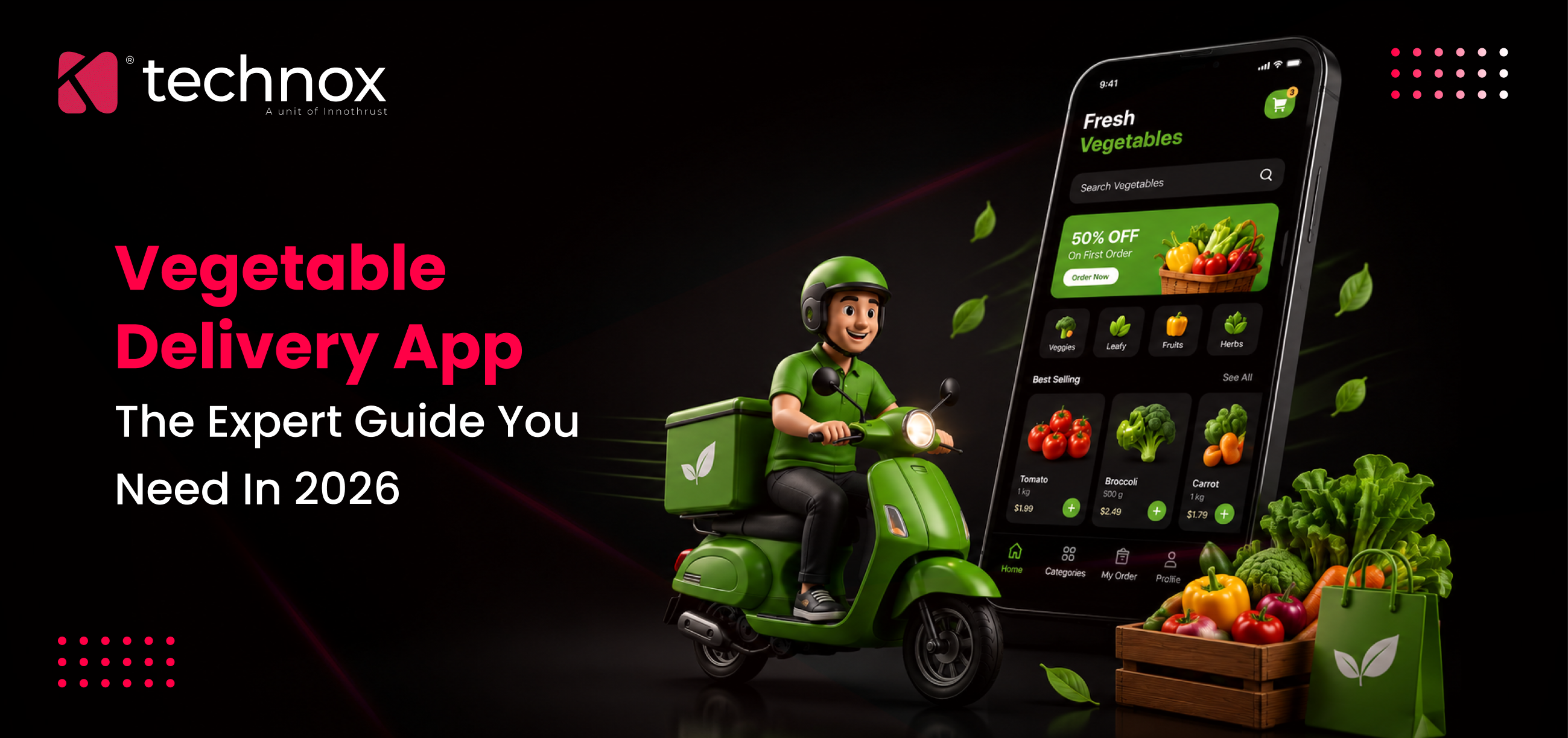
A vegetable delivery app is a mobile or web platform that lets customers browse fresh produce, order within a delivery radius, and get same-day or scheduled delivery. On the backend, it's inventory management, route optimization, and payment integration working together.
The flow is simple: a customer picks a delivery location, browses a catalog by category, orders, and pays online or on delivery. The order then triggers inventory deduction, a delivery-slot or rider assignment, and status tracking through to fulfillment.
That's the mechanism. The harder question, the one most "grocery app development" content skips, is whether the business built around it actually holds up.
Quick commerce is the lens this category gets judged through in India, and per industry tracking from Bain & Company and RedSeer, the growth numbers are real:
GMV hit roughly $6.1 billion in 2024, projected to climb toward $40 billion by 2030
Blinkit, Zepto, and Swiggy Instamart together control over 90% of volume in major cities
But the growth number hides the operating problem underneath it. Independent scraped data from early 2026 found all three major platforms showing sub-75% availability in fresh fruits and vegetables: roughly one in four produce items a customer searches for simply isn't in stock. Combined with spoilage losses, analysts flag fresh produce as a category that drives cost and complaints even as platforms keep pushing it as a growth driver.
The addressable market is also smaller than the funding headlines suggest:
Kirana (neighborhood) stores still account for over 90% of India's total grocery retail
Online grocery penetration overall remains under 1% of total grocery spend
Most vegetable purchases in India still don't happen through an app. That's the real starting context for any business plan here, not the quick-commerce growth curve alone.
The practical takeaway: fresh produce isn't a safe category to bolt onto a generic grocery app template. It's the hardest one to execute well, precisely because of spoilage and availability, which is exactly why inventory and cold-chain matter more than any AI feature on the roadmap.
What the businesses already operating in this space reveal
Feature lists borrowed from generic grocery-app guides don't tell you much. What real, operating platforms in this exact category actually do, and where they break, tells you a lot more.
Ninjacart: B2B, not consumer-facing. Sources vegetables and fruit directly from farmers across 20+ Indian states, delivering to kirana stores and restaurants within roughly 12 hours, using demand forecasting and routing algorithms to decide what farmers should grow and where produce should go. Even so, its own app-store reviews show recurring complaints about stock-shortage cancellations: direct evidence of how hard produce-availability accuracy is, even for a well-funded, tech-first operator.
Otipy: serves Delhi NCR and Mumbai on an "order by midnight, delivered by 7–8am" model. 250+ fruit and vegetable SKUs, no minimum order value (they'll deliver a single 110g pack of coriander), hourly flash deals. This is a fixed-slot, pre-committed model, closer to milk-delivery subscription than 10-minute quick commerce, and it sidesteps some availability problems that plague instant-delivery dark stores, because inventory is procured against confirmed overnight orders rather than held speculatively.
Blinkit, Zepto, and Swiggy Instamart: treat fresh produce as one SKU category inside a much broader dark-store catalog (dark stores now account for roughly half of quick-commerce fulfillment in India). Their model prioritizes speed (10 to 15 minute promises) over deep produce specialization, which is exactly why their fresh-produce availability lags the rest of their catalog.
That split points to two proven, opposite playbooks:
Fixed early-morning delivery windows against pre-committed orders (Otipy-style): better for produce quality and lower waste.
Instant/on-demand delivery via dark stores (Blinkit-style): better for convenience, structurally harder to keep produce in stock and fresh.
Deciding which one you're building has to happen before a single feature spec gets written. The two require different inventory, warehousing, and staffing models entirely.
The regulatory layer most build guides skip entirely
This part isn't optional. Treating it as a "phase 2" item is how businesses end up shut down after launch, not before it.
In India, FSSAI registration or licensing is legally mandatory for any business selling, packing, or delivering fruits and vegetables, including e-commerce operators. The Food Safety and Standards Act, 2006 explicitly prohibits food businesses from operating without one, with fines and potential imprisonment for violations. Applications are filed through the official FoSCoS portal.
Which tier applies depends on scale:
Basic License: turnover under ₹12 lakh (small vendors)
State License: medium-scale operations, including any relabeling or repackaging
Central License: large-scale, multi-state, e-commerce operators
E-commerce food businesses specifically need a Central License, and the part people miss is that they're responsible for ensuring their entire supply chain, every vendor and warehouse they source from, is also FSSAI-compliant. Not just the platform itself.
There's also a set of produce-specific rules under FSSAI's Clean and Fresh Fruit and Vegetable initiative:
FSSAI license number and a green-coded Food Safety Display Board visible at every storage and dispatch point
Ripening with carbide or acetylene gas is banned (only ethylene gas up to 100 ppm from an approved source is allowed)
Wax-coated produce needs a "Coated with Wax + [wax name]" label
Water used in produce handling must be lab-tested for safety every six months
Supplier and vendor records must be maintained and auditable
For the app itself, this is a feature requirement, not a legal footnote. Vendor onboarding in the admin panel needs to collect and verify each supplier's FSSAI number before they can list produce, and compliance documentation (license number, display-board status, water-test records) needs somewhere to live in the system.
Building outside India? The specific rules above won't apply, but the principle will. Every local food-safety authority (FDA in the US, FSA in the UK) imposes comparable licensing and traceability obligations. "Verify every vendor's food safety compliance before they can list" is universal to this category.
What the App Actually Needs, and What's Optional Despite the Marketing
Genuinely necessary for a produce app specifically, not a generic grocery build:
Real-time, SKU-level stock accuracy: the single feature that determines whether availability looks like Otipy's fixed-slot model or the sub-75% dark-store average
Vendor/supplier FSSAI compliance tracking, built into vendor onboarding
No-minimum-order support for small, high-frequency purchases: a 110g herb pack is a common order type here
Weight- and quantity-based pricing, since produce is often sold by weight, not fixed unit count
Batch and lot tracking, so a bad delivery from one supplier can be traced and pulled without guessing
Standard, needed, but not category-specific:
For a broader look at the core features, development process, and cost involved in building this type of platform, see our grocery app development guide.
Customer app: catalog browsing, cart, multiple payment methods, order tracking, restock/deal notifications
Vendor dashboard: inventory management, order management, payout tracking, sales analytics
Delivery app: route assignment, GPS tracking, proof of delivery
Genuinely optional in 2026, despite showing up on every "must-have" list:
Advanced AI personalization / dynamic pricing: useful at scale, but basic stock accuracy matters more for a new entrant
Blockchain traceability: still early-stage industry-wide, mainly a premium/organic trust signal
Drone delivery: not operationally relevant for most produce delivery businesses right now
Tech stack
Whether this gets built in-house or handed to a mobile app development company in coimbatore, web development or custom software development partner, the stack decisions below are the ones that determine whether the platform can actually handle weight-based pricing, real-time stock, and route-level logistics, not just look like a working app in a demo.
Cost and timeline, realistically
Basic MVP: single city, core ordering, fixed delivery slots, manual vendor onboarding: $15,000–$40,000, 2–3 months
Mid-range: all three panels, subscriptions, basic demand-based restocking: $40,000–$120,000, 3–6 months
Full dark-store/quick-commerce scale: multi-city, real-time inventory across warehouses, AI forecasting: $150,000+, 6–12 months
Even well-funded players at this top tier, like Zepto and Instamart, are still running at significant losses while scaling. That tier is a capital-intensive bet, not just a line item on a dev budget.
The honest risk picture
Spoilage and stockouts are the category's core operating problem: not a solvable engineering afterthought. Even data-forward, well-funded platforms report fresh produce as their weakest-performing category on availability. Budget for real operational investment (procurement relationships, cold storage, waste tracking) alongside the app itself. The software is necessary but not sufficient.
Regulatory non-compliance is a shutdown risk, not a fine you can absorb. FSSAI licensing across the entire vendor supply chain has to be in place before launch.
Quick-commerce unit economics remain unproven. Average order values and delivery costs are under pressure industry-wide, and even market leaders are managing thin or negative margins. A new entrant shouldn't assume the instant-delivery model is automatically profitable just because incumbents have raised large funding rounds; that's a separate bet from building the product itself.
Where discoverability fits into all of this
Everything above is the operational half of the business. The other half is whether anyone finds it.
Global grocery delivery revenue is projected in the trillion-dollar range for 2026, and customers increasingly default to app-based ordering over physical store visits for routine purchases. But that demand only converts if the business shows up where people are actually looking, both traditional Google rankings and AI-generated answers across AI Overviews, ChatGPT Search, and similar tools.
The businesses that get this wrong tend to repeat the same mistakes:
Prioritizing native app development over the website's SEO foundations
Underinvesting in substitution and stock-out messaging on the site itself
Treating schema markup as a guarantee of visibility rather than one input among several
This is also where a broader digital marketing strategy, local search, paid acquisition, and AI-search visibility working together rather than as separate line items, tends to outperform an app-only launch plan.
A Progressive Web App is often the faster, cheaper way to establish that search foundation, typically launchable in six to ten weeks, while a full native app with logistics integration runs four to seven months. Either way, the website and its SEO foundation should run in parallel with app development, not start after launch.
Success here is measured less by download counts than by: repeat order rate, average order value, customer acquisition cost by channel, local search visibility (Google Business Profile actions, local pack rankings), and organic plus AI-search-driven traffic.
The realistic build sequence
Pick a delivery model (fixed-slot or instant) based on how much capital can be deployed against speculative inventory.
Secure FSSAI compliance for the business and every vendor before launch.
Build inventory-accuracy and vendor-verification features first, ahead of AI personalization, blockchain, or anything else on the generic "must-have" list.
The businesses that struggle in this category tend to struggle on freshness and availability, not on missing an AI feature.
If the plan involves building the app, the website, and the search visibility as one connected project rather than three separate vendors, that's the kind of work covered in our portfolio, or get in touch to talk through the specifics.
FAQ
What is a vegetable delivery app?
A mobile or web platform that lets customers order fresh produce online for same-day or scheduled delivery within a defined service area.
Why do businesses need one in 2026?
Grocery and produce delivery demand is growing fast, with global grocery delivery revenue projected in the trillion-dollar range for 2026, and customers increasingly default to app-based ordering over physical store visits for routine purchases.
How does it work?
Customers pick a delivery location, browse a categorized catalog, place an order, and pay online or on delivery, while the backend handles inventory, delivery-slot assignment, and order tracking.
Who actually needs one?
Local produce vendors, supermarket chains, quick-commerce startups, and subscription-box businesses, each with different priorities around delivery speed, service radius, and catalog depth.
What are the real benefits?
Higher order frequency from a repeat-purchase category, higher average order value through bundling, and a first-party customer data asset that doesn't depend on a third-party marketplace.
What are the most common mistakes?
Prioritizing native app development over website SEO foundations, underinvesting in substitution and stock-out logic, and treating schema markup as a guarantee of visibility rather than one input among several.
How much does it cost?
From roughly $15,000 for a single-city MVP to $150,000+ for multi-city, real-time inventory at quick-commerce scale; see the cost breakdown above for the tiers in between.
How long does it take?
Six to ten weeks for a Progressive Web App, up to four to seven months for a full native build with delivery logistics; the website/SEO foundation should run in parallel with either.
How is success measured?
Repeat order rate, average order value, customer acquisition cost by channel, local search visibility, and organic plus AI-search-driven traffic.
How is AI changing marketing for this category?
Discovery is splitting between traditional Google rankings and AI-generated answers across AI Overviews, ChatGPT Search, and similar tools, which calls for answer-first content, structured schema, and consistent business-entity signals across every platform.