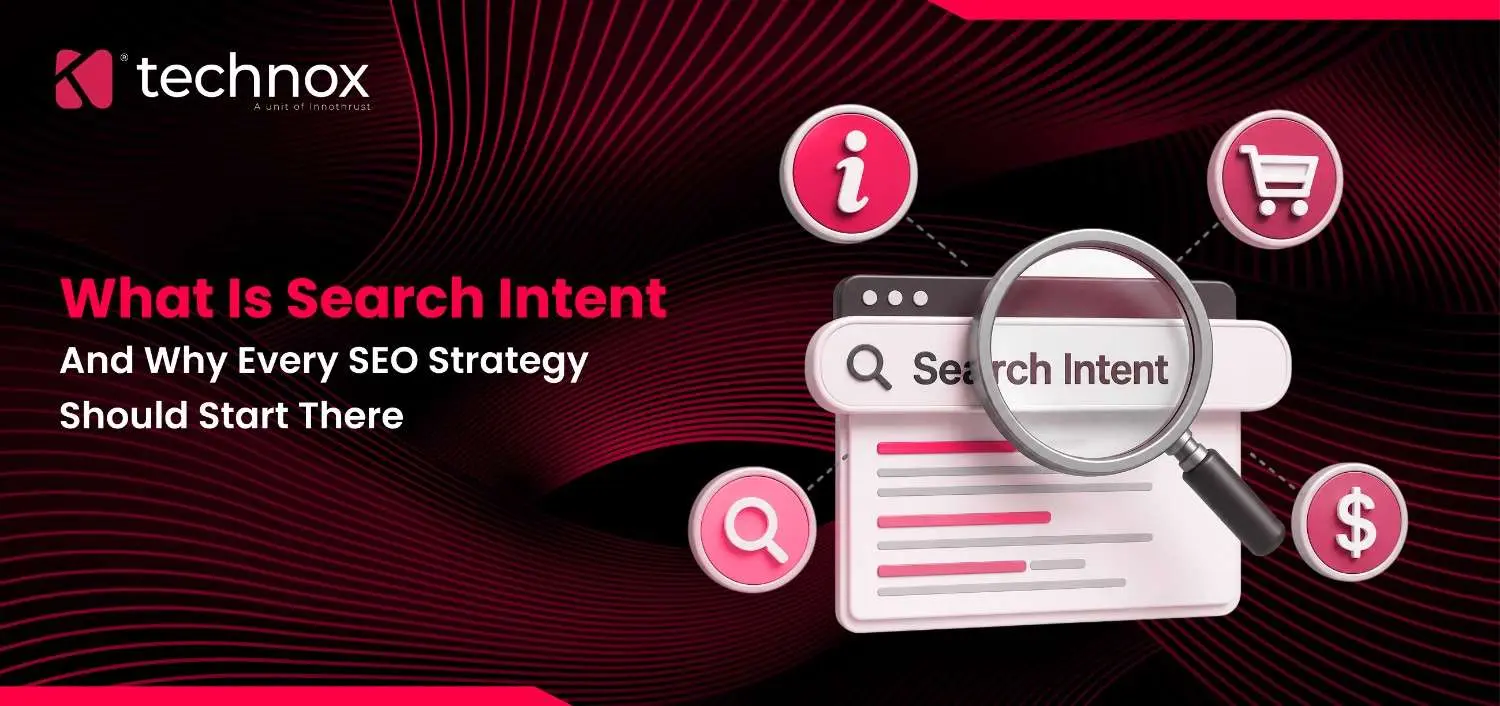
Most SEO strategies still begin with a keyword list. That's backwards. A business owner in Coimbatore selling premium furniture might rank #1 for "modular kitchen designs" and still get almost no calls because the page is a photo gallery, and the person searching actually wanted pricing. A competitor with fewer backlinks and a "thinner" page outranks them simply because their content matches what the searcher was trying to do. That gap is search intent, the single most common reason technically sound, well-written pages fail to convert, or fail to rank at all. If you're building or rebuilding an SEO strategy in 2026, this is the concept to get right before keyword research, content briefs, or link building. This guide covers what search intent is, the types that matter, how Google and AI search engines such as AI Overviews, ChatGPT, Perplexity, and Gemini interpret it, how to identify it accurately, and how to build a content strategy around it, with practical checklists you can apply today. Search intent, also called user intent or query intent, is the underlying goal a person is trying to achieve when they type or speak a query into a search engine. It's not the words in the query; it's the outcome the person wants from those words. Someone typing "best CRM for small teams" isn't looking for a dictionary definition of CRM. They're comparing options before a purchase. Someone typing "CRM login" wants one specific page. Someone typing "what is a CRM" wants a plain-language explanation. Same broad topic, three different intents, three different pages required to satisfy each one. Google's own Search Quality Evaluator Guidelines group intent into four functional categories that map closely to the SEO industry's framework: know (learn something), do (complete a task or action), website (find a specific site), and visit-in-person (find a local business). Every ranking decision Google makes is, at its core, an attempt to match a result to one of these underlying goals. Keyword matching used to be enough. It no longer is. A few data points make the shift clear: Roughly 51 to 60% of all Google searches are informational: people are overwhelmingly trying to learn something, not buy something, on any given search. Around 74% of informational searches end without a click, versus about 31% of transactional searches: because AI Overviews and featured snippets now answer the question directly on the results page. Zero-click searches now account for roughly 68% of U.S. searches, climbing to around 83% when an AI Overview appears. Pages cited inside an AI Overview see meaningfully higher click-through and conversion rates than pages that rank organically but aren't featured. Comparison-style queries ("X vs Y") are among the strongest triggers for AI Overviews, and question-based queries trigger them at a similarly high rate. Content that ignores intent doesn't just rank poorly. It becomes invisible to both traditional search and the AI-generated answers now sitting above it. As Google's own How Search Works documentation explains, ranking systems exist to surface the most relevant, reliable answer to a person's query, which is another way of saying they're built around intent. Matching intent is no longer one ranking factor among many; it's the filter every other ranking factor gets evaluated through. Most SEO frameworks use four core categories. Understanding each, and the content format it demands, is the foundation of intent-based SEO. Two additional categories now matter enough to treat as distinct types: Local intent: queries with an implicit or explicit "near me" component ("SEO agency near me", "digital marketing company Coimbatore"). Local intent touches close to half of all Google searches and converts fast: most people who run a "near me" search visit or contact a business within 24 hours. Generative/conversational intent: queries aimed at AI systems to produce something rather than retrieve a link, such as "write a 30-day content calendar for a real estate brand." This barely existed before ChatGPT and is now a meaningful share of query volume on AI-native platforms. Real queries rarely sit in one neat box. "SEO services Coimbatore" carries local, commercial, and transactional signals at once. Trying to build one page that satisfies all of it dilutes the promise. Instead, pick the dominant intent the SERP is rewarding, build the strongest page for it, and route secondary intents through internal links. A service page can link to a case study for commercial-investigation searchers and to a contact page for transactional ones. Search intent isn't a single moment. It has a life cycle, and content that only addresses the surface query misses most of the opportunity. Pre-search intent: the pain point that sent the person to Google in the first place. Someone searching "why is my website not ranking" isn't curious about algorithms; they're worried about lost business. Primary search intent: the literal, stated goal behind the query. Hidden intent: the unstated need underneath it. Someone searching "SEO cost in India" is really asking, "can I afford this, and is it worth it?" A page that only lists a price range misses this. Post-search intent: what the person needs to do next. This is where conversion happens: a clear next step that meets them where their journey continues. Strong content answers all four layers within a single, well-structured page rather than as separate campaigns. Guessing intent from the keyword alone is unreliable. The only dependable method is reading what Google is already rewarding. It's the same SERP-first process our team follows on every SEO project we run in Coimbatore before a single page gets written. Search the exact target keyword yourself, ideally incognito, and record what ranks in positions 1 to 10. Identify the dominant content format. Are top results how-to guides, comparison tables, product pages, or local listings? That's the format Google has decided satisfies the query. Check the SERP features present: featured snippets, People Also Ask, AI Overviews, local packs, video results. Each is a signal about what searchers expect. Read the People Also Ask questions and Related Searches: these reveal sub-questions that should become H2/H3 sections. Study competitor titles and meta descriptions to see how top pages frame their promise. Cross-check with engagement data if the page already exists. High impressions with low clicks usually signal a title/meta mismatch; fast bounces despite good clicks mean the content doesn't deliver on the promise. Decide: match, rewrite, or build new. If an existing page's format conflicts with what the SERP rewards, restructuring it is rarely enough. A different page type is often needed. High impressions, low click-through rate: title/meta is misreading intent. Good rankings but short time on page for a long-form guide: the query wants a quick answer, not an essay. Stuck on page 2 to 3 despite strong technical SEO and backlinks: wrong content format for the query. Comparison queries landing on a single-product or definition page: a dedicated comparison asset is needed. Mapping intent to funnel stage keeps content strategy coherent: A strategy that only produces awareness-stage blog posts generates traffic without revenue. One that only produces decision-stage service pages struggles to earn organic visibility, since there's rarely enough search volume at the bottom of the funnel alone. Topical authority, and AI citation, requires covering the full journey. Understanding how SEO works as a broader process helps put search intent, content, and the buyer journey into context, which is why our digital marketing services pair awareness-stage content with decision-stage assets like website design and e-commerce development. This is where search intent has changed most since 2023. AI Overviews, ChatGPT Search, Perplexity, Gemini, and Copilot don't just rank pages. They synthesize answers from them, drawing overwhelmingly from content that satisfies informational intent clearly and quickly. A few consistent patterns: AI Overviews trigger far more often for question-based and comparison queries than short head terms: content structured around explicit questions has a real structural advantage. Exact-match keyword phrasing shows up in only a small fraction of AI Overview citations: these systems reward semantic clarity and entity relationships, not keyword density. Longer, more specific long-tail queries are considerably more likely to trigger an AI-generated summary than short, ambiguous ones. AI-native platforms skew heavily informational: research and learning queries make up the majority of volume on tools like ChatGPT Search, while purely transactional queries stay a minority, a pattern tracked in recent AI Overview data breakdowns. This is also the discipline behind Generative Engine Optimization (GEO), structuring content so AI systems can extract and cite it accurately. It's an extension of the same SEO services work we do for Google rankings, not a separate strategy. Answer the core question in the first 1 to 2 sentences of a section: what features snippets and AI Overviews extract. Use descriptive H2/H3 headings phrased as real questions, matching what PAA and AI Overview sourcing rewards. Build comparison tables, definition boxes, and mini-FAQs: the most extractable formats for zero-click features and generative engines alike. Write in entity-rich language, naming concepts and tools explicitly rather than relying on vague pronouns. Keep E-E-A-T signals visible: author expertise, real examples, original data, clear sourcing. Keyword-first planning: choosing a keyword by volume alone instead of checking what the SERP rewards. One page trying to serve every intent: stacking a definition, comparison, and hard sell on one page dilutes all three. Ignoring hidden intent: answering the literal question but missing the real concern, such as cost, risk, or timeline, behind it. Assuming intent never changes: a "how-to" query can migrate toward comparison formats over time; intent needs periodic re-checking. No path forward: fully answering a query but giving the reader nowhere relevant to go next wastes the post-search opportunity. Run a live SERP analysis for every target keyword before writing Identify the single dominant intent and let it define the page format Address pre-search, hidden, and post-search intent on the same page Open each section with a direct, extractable answer Use question-phrased headings sourced from real PAA data Add at least one comparison table or definition block Map internal links to the next logical buyer-journey stage Recheck top-performing pages quarterly, since SERP intent shifts For businesses operating in Coimbatore, Tamil Nadu, and across India, local intent deserves its own focus. Nearly half of all Google searches now carry some local signal, and mobile-driven "near me" behavior converts unusually fast. Recent local search data shows most people who run a local search visit or contact a business within a day. For a Coimbatore-based service business, this means: A query like "digital marketing agency Coimbatore" blends local and commercial-investigation intent: it needs a strong Google Business Profile, genuine reviews, and a service page that reads like a decision-stage asset, not a definition. Our SEO company in Coimbatore page is built around exactly this intent mix. Voice and mobile search continue to grow India's share of long-tail, conversational queries: content answering full natural-language questions outperforms content built around short, clipped keywords. Google holds an overwhelming majority of India's search market, so Google-specific behaviors such as Local Pack, GMB posts, and AI Overviews matter more here than platform-diversification strategies common elsewhere, though monitoring AI search referral traffic is still worthwhile as adoption grows. Blended, multi-part queries: a single search increasingly combines comparison, evaluation, and task-completion in one conversational query, especially on AI-native platforms. Continued growth of zero-click and AI-cited answers: visibility inside an AI Overview will keep mattering as much as the blue-link ranking position. Local intent expanding beyond "near me" phrasing: Google increasingly infers local intent from device and context signals alone. Widening the gap between informational and transactional strategy: relying solely on top-of-funnel content will see organic value decline unless paired with strong commercial and local assets. Search intent isn't a checklist item. It's the lens every other SEO decision should pass through: which keywords to target, what format to build, how to structure headings, and what to link to next. Get intent right, and technical SEO, content, and links compound into real rankings and conversions. Get it wrong, and even the most polished page will quietly underperform for years. If you're unsure whether your current pages match what your audience is searching for, or you're building an SEO strategy from scratch, that diagnostic work is exactly where a structured, data-led SEO partner adds the most value early on. Technox Technologies works with businesses across Coimbatore, Tamil Nadu, and beyond to build SEO strategies rooted in real SERP and search-intent analysis, not guesswork. Browse more strategies on the Technox blog, or get a free audit to see how well your current content matches real search intent, and where the gaps are costing you traffic and customers. The real goal behind a search query, what the person wants to learn, find, compare, or do, not just the words typed. Informational, navigational, commercial, and transactional, with local and generative/conversational now treated as additional categories. A page can rank for a high-volume keyword and still fail to convert, or fail to rank at all, if its format doesn't match what the SERP already rewards. Search the exact keyword yourself, review the top results' content format, check SERP features, and note how competitors phrase titles and meta descriptions. Commercial intent means comparing options before deciding; transactional intent means being ready to act now. Even well-optimized pages underperform, with high impressions but low clicks, or rankings with poor engagement, because the format doesn't deliver what the searcher wanted. Yes. Google's interpretation of a query's dominant intent shifts as user behavior and SERP features evolve, so periodic re-checks are necessary. No. Because SERP composition and AI search behavior keep evolving, intent alignment should be reviewed on a recurring basis, ideally quarterly for priority pages.What Is Search Intent? (Quick Definition)
Why Search Intent Now Decides Rankings, Not Just Relevance
The Core Types of Search Intent
A Note on Blended Intent
Pre-Search, Hidden, and Post-Search Intent
How to Identify Search Intent: The SERP Analysis Method
Signals of Intent Mismatch to Watch For
Search Intent and the Buyer Journey
Search Intent, AI Overviews, and GEO (Generative Engine Optimization)
What This Means for Content Structure
Common Search Intent Mistakes
Best Practices Checklist
Search Intent for Local Businesses in Coimbatore and Tamil Nadu
Future Trends in Search Intent
Turning Search Intent Into Real Business Growth
Frequently Asked Questions
1. What Is Search Intent in Simple Terms?
2. What Are the Main Types of Search Intent?
3. Why Does Search Intent Matter More Than Keyword Volume?
4. How Do I Find the Search Intent Behind a Keyword?
5. What Is the Difference Between Commercial and Transactional Intent?
6. What Happens If My Content Doesn't Match Search Intent?
7. Does Search Intent Change Over Time?
8. Is Search Intent Optimization a One-Time Task?
SEO
HOME>
BLOGS>
SEO
What Is Search Intent and Why Every SEO Strategy Should Start There
Read Time11 mins
AuthorTechnox Technologies Team
PublishedAug 1, 2026