Most business owners already believe SEO is "important." Far fewer can explain why in terms that hold up in a budget meeting, or what's actually changed about SEO now that AI Overviews, ChatGPT, and Perplexity sit between a customer's question and your website. That gap is expensive. Organic search still drives roughly half of all trackable website traffic for the average business, according to BrightEdge's long-running organic traffic research. But in 2026, a second, less visible layer has opened up: whether AI systems understand your business well enough to cite it, often before a searcher ever clicks a link at all. Recent clickstream research from SparkToro and Datos puts the share of US Google searches ending without any click at roughly 60–68%, and that rate climbs to around 83% the moment an AI Overview appears on the page. This guide looks at why SEO matters for business success through that lens: not "SEO gets you seen," but how visibility, trust, and machine-readability now work together, what it costs you to ignore, and what to actually do about it, backed by current data and real case studies, whether you run a business in Coimbatore, across Tamil Nadu, or nationally. Search Engine Optimization (SEO) is the practice of improving a website's visibility in unpaid ("organic") search results, so potential customers can find your business when they search for products, services, or information related to what you offer. SEO works across four connected layers: Technical SEO: whether search engines and AI crawlers can access, read, and correctly interpret your site (speed, mobile usability, structured data, security) On-page SEO: content, headings, and internal linking built around real search intent Off-page SEO: trust and authority earned through backlinks, citations, and brand mentions Generative Engine Optimization (GEO): structuring your content and entity presence so AI systems can understand, trust, and cite your business inside AI-generated answers, not just rank it in a list of links Most explanations of "why SEO matters" stop at the first three. The fourth is where the real shift is happening right now. SEO matters because it determines whether your business exists at the moment a customer is deciding, not through ad spend, but by being genuinely findable and understandable, to people and to the AI systems increasingly standing in front of them. Three things are true at once in 2026: Organic search still converts better than most channels, because it captures people already looking for a solution rather than interrupting their attention. HubSpot's State of Marketing research consistently ranks website/SEO as one of the top ROI-driving channels marketers report. A growing share of searches never produce a click at all, resolved instead inside an AI Overview or chatbot answer, which means "ranking" and "being visible" are no longer the same thing. Being cited inside an AI answer requires a different kind of clarity than ranking on a results page ever did: consistent facts about who you are, structured content, and demonstrable expertise. Businesses that only optimize for clicks are optimizing for half the picture. The other half is whether machines can accurately describe your business at all. This is the evidence layer most "why SEO matters" articles skip. Here's what current, sourced research actually shows: An owned asset, not rented attention Social platforms and ad networks can change algorithms or pricing overnight; a page that ranks organically keeps working without a recurring toll, and its value compounds instead of resetting monthly. A second, invisible distribution channel Well-structured content gets pulled into AI Overviews and cited by ChatGPT and Perplexity, reaching buyers who never click through, a channel most businesses aren't deliberately optimizing for yet. Insulation from rising acquisition costs As paid channels get pricier, a mature organic presence gives you a cost structure of competitors without one that can't match, the difference between a budget that must grow every year and one that doesn't. Influence earlier in the buying journey Considered B2B and high-ticket buyers research long before contacting anyone. If your content doesn't surface, or get cited, during that phase, you're not on the shortlist by the time they're ready to talk. A common misconception is that AI chatbots and AI Overviews are making SEO obsolete. Live industry data and expert commentary point to the opposite conclusion: SEO has changed shape, not disappeared. A significant share of Google searches now resolve without a click, and an even higher share do on queries that trigger an AI Overview, as high as 83% by current estimates. That doesn't mean visibility stopped mattering, it means visibility now happens one layer earlier, inside the summary itself. Being understood by machines is now as important as being understood by people. AI systems rely on structure, consistency, and clearly defined entities, who you are, what you do, where you operate, to decide whether to include and cite your business. Zero-click doesn't mean zero-value. A brand mentioned inside an AI Overview or a ChatGPT answer builds awareness and trust even without a click, and often earns the click later when the buyer is ready to compare directly. Current research suggests visitors who do click through from AI answers convert at meaningfully higher rates than average search traffic, likely because they arrive already informed. Original expertise wins over generic content. As more of the web becomes AI-generated, content backed by real experience, verifiable specifics, and clear authorship becomes more, not less, valuable to both search engines and AI systems. Structured content architecture is now a ranking and citation factor. Clear definitions, direct answers, comparison tables, and FAQ sections all make it easier for AI systems to lift accurate information about your business. Two concepts sit behind almost every AI citation decision, and most businesses have never heard of either: Entity SEO is the practice of making sure search engines and AI systems have a clear, consistent, unambiguous understanding of who you are as a business, your name, services, location, and relationships to other known entities (industries, partners, locations), regardless of which page someone lands on. Inconsistent naming, mismatched details across your website and directories, or vague service descriptions all make you harder for a machine to confidently cite. E-E-A-T (Experience, Expertise, Authoritativeness, Trustworthiness) is the framework search engines use to judge content quality, and it has become the dominant lens AI systems apply too, especially for anything that could affect a buyer's money, health, or major decisions. In practice, E-E-A-T means showing your work: named authorship, verifiable data, real case results, and content that reads like it came from someone who has actually done the thing they're describing. Google's own Search Central documentation frames this directly as part of how its ranking systems assess content quality. Together, these two ideas explain why two businesses with similar keyword rankings can get very different treatment in AI-generated answers: one gets cited by name, the other doesn't get mentioned at all. The real question most business owners face isn't "SEO or ads," it's how to sequence and balance the two given limited budget and time. This framework helps: In practice, most growing businesses need both, sequenced deliberately: paid search to generate immediate volume and test messaging, SEO to build the compounding asset that reduces dependency on that spend over time. Technox's Digital Marketing and Search Engine Marketing services are built around running both in parallel so they reinforce each other instead of competing for the same budget line. This isn't a checklist of local-listing tasks: those are covered in depth in our guide to SEO Services in Coimbatore. This is the strategic sequence behind sustainable, AI-ready organic growth. Step 1: Map Your Business as an Entity, Not Just a Set of Keywords Before targeting keywords, define how your business should be unambiguously described: services, specializations, location, and the topics you're a genuine authority on. This becomes the foundation every other step builds on. Step 2: Align Content With Search Intent and Buying Stage Every keyword maps to a stage: research ("what is..."), comparison ("best... for..."), or decision ("... pricing", "... near me"). Content that ignores this mismatches traffic to intent, which shows up as high bounce rates and low conversion, no matter how well it ranks. Step 3: Build Topic Clusters, Not Isolated Pages Instead of one blog post per keyword, build a pillar page supported by related, interlinked articles. This signals depth of expertise to search engines, and gives AI systems a coherent body of content to pull from, rather than one disconnected page. Step 4: Structure Content for Direct Answers and Citation Answer questions clearly near the top of the page, use tables and lists where they genuinely help, and implement schema markup. These are the same patterns both featured snippets and AI Overviews are built to lift. Step 5: Earn Trust Signals, Not Just Backlinks Backlinks still matter, but so does named authorship, transparent data sourcing, and content that demonstrates real, specific experience, the E-E-A-T signals that increasingly separate "ranked" from "cited." Step 6: Measure What Actually Matters Track leads and revenue attributable to organic search, and, where possible, monitor how often your brand is mentioned inside AI-generated answers, not just where you rank on a results page. SEO matters for your business success because it compounds, and because the ground it's played on just expanded. It's no longer only about ranking on a results page; it's about being clearly, consistently understood by every system, human or AI, that stands between your business and the customer trying to find you. The businesses that lead their categories over the next few years won't be the ones with the biggest ad budgets. They'll be the ones that are unmistakably clear about who they are, to customers, and to the AI systems now speaking on those customers' behalf. Ready to turn search and AI visibility into real business growth? Technox Technologies helps businesses in Coimbatore, across Tamil Nadu, and throughout India build SEO and GEO strategies that drive measurable leads, revenue, and long-term authority, combining SEO, Digital Marketing, Website Design & Development, and Branding into one integrated growth strategy. Get a free audit and see exactly where your business stands today. SEO matters because it determines whether your business is findable and understandable at the exact moment a customer is deciding, both in traditional search results and, increasingly, inside AI-generated answers. Yes. AI Overviews and chatbots draw their answers from well-structured, trustworthy, high-ranking content, meaning strong SEO fundamentals are now a prerequisite for AI visibility, not a separate concern. Most businesses see measurable movement within three to six months, with stronger, compounding results typically building over six to twelve months, though documented case studies show meaningful gains as early as three to five months when technical and content fixes are addressed together. It's rarely either/or. SEO builds a compounding, owned asset; paid advertising delivers immediate volume and lets you test messaging quickly. Most growing businesses need both, sequenced against their timeline and budget. Often more so. A well-optimized, clearly structured small business site can outrank and out-cite much larger competitors who haven't invested in the same clarity and consistency, as shown in documented local-business case studies. Treating it as a one-time project rather than an ongoing strategic function, and measuring it against rankings instead of business outcomes. Yes. Consistent, well-structured, expertise-backed content builds credibility with both human readers and the AI systems now filtering information on their behalf. Keyword and audience research from SEO strengthens paid ad messaging and content strategy across every channel, while a strong organic and AI-citation presence reinforces trust in paid campaigns too.What Is SEO?
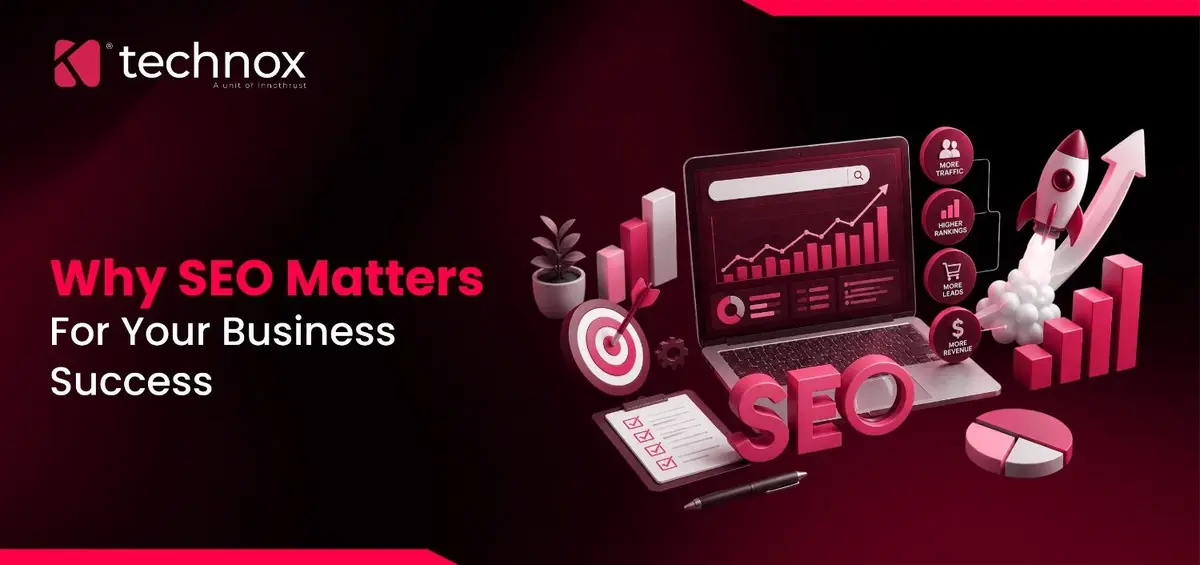
Why SEO Matters for Your Business Success: The Short Answer
The Data Behind Why SEO Matters in 2026
The Business Case: What SEO Actually Buys You
SEO in the Age of AI Search: The Part Most Businesses Are Missing
What Actually Changes for Your Business
Entity SEO and E-E-A-T: The Trust Layer Behind AI Citations
Choosing Where to Put Your Budget: SEO vs. Paid Search
How to Grow Your Business Through SEO: The Strategic Steps
Common Strategic Mistakes That Undercut SEO's Business Value
Final Thoughts: Turning SEO Into Real Business Growth
Frequently Asked Questions
1. Why does SEO matter for business success?
2. Is SEO still worth it with AI search and AI Overviews on the rise?
3. How long does SEO take to show results?
4. Should I choose SEO or paid advertising?
5. Do small businesses really benefit from SEO the same way large companies do?
6. What's the biggest mistake businesses make with SEO?
7. Does SEO help build trust, not just traffic?
8. How does SEO support other marketing channels?
SEO
HOME>
BLOGS>
SEO
Why SEO Matters for Your Business Success
Read Time11 mins
AuthorTechnox Technologies Team
PublishedJul 31, 2026