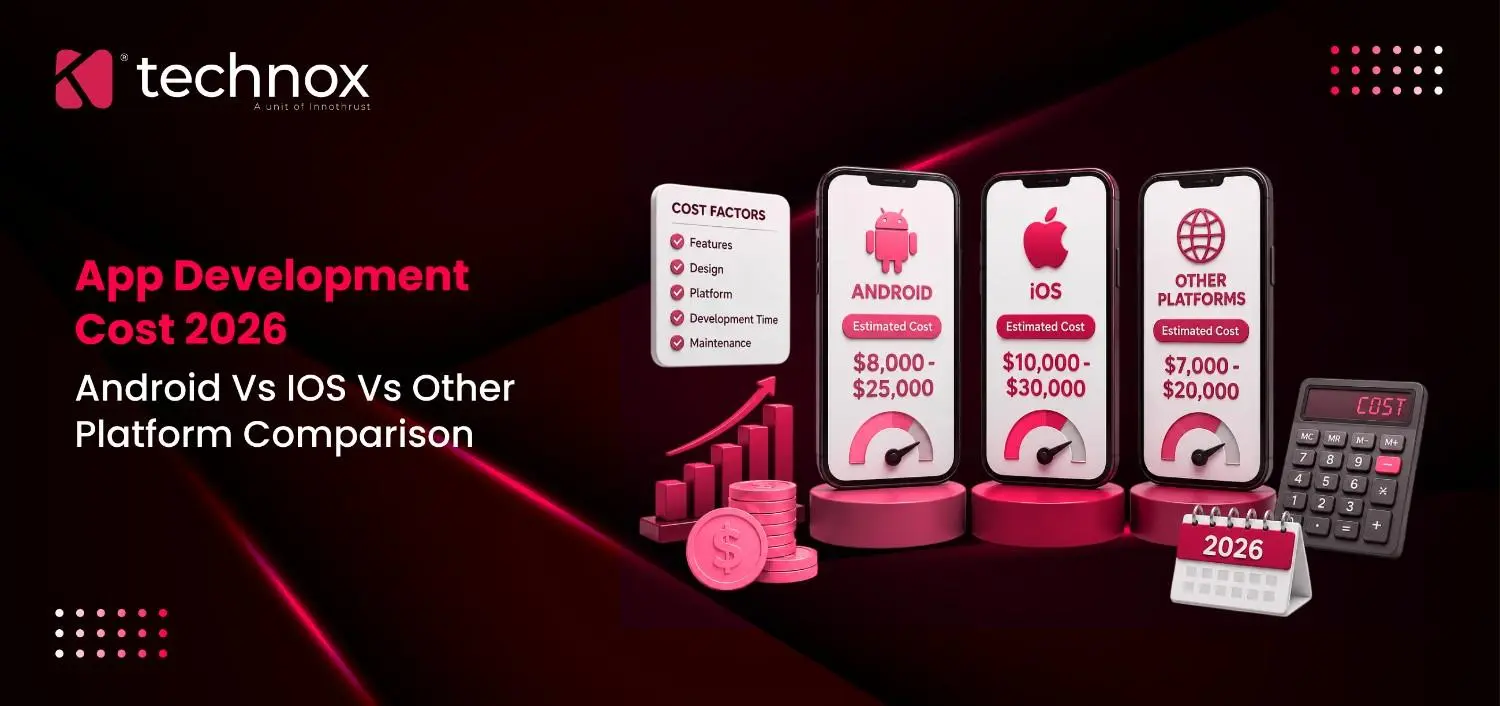
If you've asked three agencies "how much will my app cost?" and received three wildly different numbers, you're not alone. In 2026, mobile app development cost ranges from roughly $15,000 for a lean MVP to $500,000+ for an enterprise-grade product, and the platform you choose (Android, iOS, or cross-platform) can swing that number by 20-75%.
For founders, product managers, and business owners in Coimbatore, across Tamil Nadu, and throughout India, as well as international businesses evaluating Indian development partners - the real question isn't "what does an app cost?" It's "what does my app cost, on the right platform, without hidden expenses derailing the budget six months in?"
This guide breaks that question down completely: platform-by-platform cost comparisons, India-specific hourly rates, hidden costs most quotes leave out, and a decision framework to help you choose Android, iOS, or a cross-platform build like Flutter or React Native, backed by 2026 industry data.
What Determines Mobile App Development Cost in 2026?
Before comparing platforms, it helps to understand what actually drives the number on a quote. Platform is one lever, but five factors interact to produce your final budget:
App complexity - number of screens, user roles, and custom workflows
Platform choice - native Android, native iOS, both, or cross-platform
Design depth - template-based UI vs. a custom, brand-led interface with micro-interactions and accessibility compliance
Backend and integrations - payment gateways, APIs, real-time features, AI capabilities
Development team location and seniority - US/UK agencies vs. Indian agencies vs. freelancers
Feature complexity, not platform alone, is typically the single biggest cost driver. A simple single-screen utility app and a marketplace app with payments, chat, and multiple user roles can differ in cost by 10x, regardless of platform.
App Complexity Tiers (2026 Benchmarks)
Android vs iOS Development Cost: The Core Comparison
This is where most budgeting conversations start, and where the most persistent myths live. For years, the assumption was that Android is "cheaper" because Kotlin/Java talent is more widely available. By 2026, that gap has narrowed considerably, and in many cases reversed.
Why Android Often Costs More Overall
Android's biggest cost driver isn't the code, it's device fragmentation. Thousands of Android device and OS-version combinations mean significantly more QA time. Google's ownPlay Console device catalog lists thousands of certified device models that a serious Android release needs to account for, which is exactly why fragmentation testing takes as long as it does:
Android development typically runs 10-30% higher in total cost than iOS, largely due to extended testing cycles across device types and screen sizes.
iOS benefits from a much smaller, more uniform hardware lineup (a handful of current iPhone models), which shortens QA and simplifies performance optimization.
A medium-complexity app that takes about 12 weeks to build for iOS can take 14-15 weeks for Android at the same quality bar, largely due to this fragmentation testing overhead.
Why iOS Has Higher Upfront Pricing
iOS development commands a premium on developer hourly rates and design expectations, particularly for startup-stage apps:
Startup-stage apps often average around $28,000 for iOS versus roughly $23,000 for Android at the initial build stage, but Android frequently overtakes iOS in total cost once testing and fragmentation work is added.
Apple's strictApp Store Review Guidelines and Human Interface Guidelines require more design and QA discipline upfront, which agencies price into the initial quote.
Android vs iOS: Side-by-Side Comparison
Global mobile OS share figures above are consistent with current tracking onStatCounter Global Stats, which is a useful source to check before locking in a platform-first strategy for a new market.
Cross-Platform Development: Flutter, React Native & Kotlin Multiplatform
For most businesses in 2026, the real decision isn't "Android or iOS", it's "native or cross-platform." Building separately for both platforms essentially doubles your frontend development investment. Cross-platform frameworks solve that by sharing a single codebase across both operating systems.
How Much Do Cross-Platform Apps Save?
Cross-platform development withFlutter orReact Native typically reduces total build cost by 30-50% compared to two separate native builds, according to multiple 2026 industry benchmarks.
A dual-native budget of roughly $120,000 can often be delivered as a single cross-platform build for $70,000-$85,000 with near-native quality for most business use cases.
Performance differences between React Native/Flutter and fully native apps are typically in the 5-15% range for standard business apps, imperceptible to most end users outside of graphics-intensive apps or games.
Comparing Your Platform Options
Emerging trend to watch:Kotlin Multiplatform (KMP) is gaining real enterprise traction in 2026 as a middle path. It shares business logic across Android, iOS, and even desktop while keeping the UI fully native (SwiftUI on iOS, Jetpack Compose on Android), giving teams native polish without duplicating core logic.
When Native Still Wins
Cross-platform isn't the right answer for every project. Choose native development when your app needs:
Deep hardware access (advanced camera controls, Bluetooth peripherals, AR/VR)
Heavy background processing or real-time performance at scale
Platform-exclusive features on day one of an OS release
Long-term apps expected to serve millions of users where marginal performance gains compound
Mobile App Development Cost in India (2026): What Businesses Actually Pay
India remains one of the most cost-efficient destinations globally for mobile app development, without a proportional trade-off in quality, which is why so many US, UK, and UAE businesses outsource here, and why understanding local rates matters even for Indian founders comparing quotes.
India Hourly Rate Benchmarks (2026)
For comparison, equivalent teams in the US typically bill $100-$200/hour, and UK/Australia rates run similarly high, meaning Indian agencies can deliver comparable engineering quality at roughly 60-75% lower cost.
Typical India Project Budgets by App Type
A common pattern for Tamil Nadu and South India-based startups: a lean 3-4 member team can build a solid MVP in roughly ₹3-6 lakh over 3 months when the feature scope is clearly defined upfront, the operative phrase being clearly defined, since scope creep is the single biggest cause of budget overruns in India-based projects.
Hidden Costs Most Quotes Don't Include
A development quote is not your total cost of ownership. Businesses that budget only for the initial build are routinely surprised by costs that emerge over the following 1-3 years:
Cloud hosting and infrastructure - server costs scale with users, not flat fees
App Store and Play Store fees - Apple's annual developer fee plus Google's one-time registration
Push notification and messaging infrastructure - free tiers (Firebase Cloud Messaging, APNs) work initially, but segmentation and A/B testing tools like OneSignal add monthly costs at scale
OS update compatibility - every major Android and iOS release can require code changes to stay compliant
Post-launch bug fixes and maintenance - industry guidance consistently recommends budgeting 15-25% of your initial build cost annually for maintenance
Third-party API and SDK costs - payment gateways, maps, analytics, and AI services often carry usage-based pricing
Marketing and app store optimization (ASO) - a technically excellent app with no discovery strategy still fails commercially
Across a 3-year horizon, these hidden costs typically add 50-60% on top of your initial development budget. Any quote that doesn't account for this isn't a complete quote, it's a down payment.
AI's Impact on Mobile App Development Cost in 2026
Two AI-driven forces are pulling app budgets in opposite directions simultaneously:
AI coding tools are lowering build time. Tools like GitHub Copilot and similar AI-assisted development environments are reducing routine development time by roughly 30-40%, and agencies using AI across UI generation, code completion, and testing report meaningfully faster delivery for equivalent quality.
AI features are raising user expectations and budgets. Adding genuine AI-powered functionality (personalization, recommendation engines, conversational interfaces, predictive features) typically adds $15,000-$50,000 to a project in 2026, because users now expect intelligent features as table stakes rather than a differentiator.
The net effect: development labor is getting cheaper per feature, but the feature bar users expect is rising just as fast. Budget accordingly rather than assuming AI tools alone will shrink your total cost.
Step-by-Step: How to Choose the Right Platform for Your App
Step 1: Define Your Primary Market If your target users are concentrated in India, Southeast Asia, Africa, or Latin America, Android's dominant market share makes it the natural first platform. If your primary market is the US, UK, or Western Europe, or your business model depends on higher-spending users, iOS often delivers better return per user despite Android's larger raw audience.
Step 2: Clarify Your Monetization Model Ad-supported and volume-driven apps generally perform better on Android, where broader reach and less restrictive tracking support advertising revenue. Subscription, in-app purchase, and e-commerce-driven apps often perform better on iOS, where average order values and conversion rates tend to run higher.
Step 3: Decide Native vs. Cross-Platform Ask: does this app need deep hardware access, AR/VR, or extreme real-time performance? If yes, lean native. If the app is a standard business app, accounts, content, bookings, e-commerce, service marketplaces, Flutter or React Native will very likely deliver 90%+ of the native experience at 55-70% of the cost.
Step 4: Scope an MVP Before Committing to "Both" Launching on both platforms simultaneously from day one is rarely the capital-efficient choice for early-stage products. Validate demand on one platform (or via cross-platform), then expand.
Step 5: Budget for Year One, Not Just Launch Day Add 20-30% to your development budget to cover maintenance, hosting, and compliance costs for the first 12 months post-launch.
Common Mistakes That Inflate Mobile App Development Cost
Skipping proper UX/UI design investment. A custom, brand-centric interface with thoughtful micro-interactions and accessibility compliance takes 3-5x longer than a template-based design, but cutting this corner directly hurts retention and app store ratings, which costs more to fix later than to build right the first time.
Choosing hourly billing without a fixed scope. Hourly billing is unpredictable and frequently exceeds the initial estimate; a fixed-price contract with milestone-based payments and a defined change-request process gives far better budget control.
Underestimating post-launch costs. Treating launch as the finish line rather than the starting line of a 15-25%-of-build annual maintenance commitment.
Building custom infrastructure for solved problems. Reinventing payments, video calling, SMS, or maps instead of integrating proven services wastes weeks of development time and budget.
Vague feature scoping. A "medium complexity" app without clearly defined user roles and workflows is the most common source of budget overruns, a multi-role marketplace app can cost 2-3x more than an equivalent single-role app.
Building for both platforms natively before validating demand. Doubling your frontend investment before you know the app resonates with users is a preventable risk.
Best Practices and Expert Tips for Budgeting Your App
Start with an MVP, not a "complete" vision. Launch the smallest version that tests your core value proposition, then reinvest based on real user data.
Negotiate fixed-price, milestone-based contracts rather than open-ended hourly billing wherever scope is well-defined.
Use proven third-party services (Razorpay or Stripe for payments, Firebase for notifications, Google Maps for location) instead of custom-building solved problems.
Default to cross-platform unless you have a specific native requirement. For most business apps, bookings, e-commerce, service platforms, content apps, Flutter or React Native is the capital-efficient default in 2026.
Budget maintenance from day one. Treat 15-25% of build cost annually as a fixed line item, not an afterthought.
Vet agencies on delivered projects, not just hourly rate. The cheapest hourly rate rarely produces the cheapest total cost once rework, delays, and poor documentation are factored in.
Future Trends Shaping Mobile App Development Cost Beyond 2026
Kotlin Multiplatform adoption is accelerating in enterprise settings as teams seek native UI quality without duplicated business logic.
AI-native features becoming a baseline expectation, not a premium add-on, pushing average project budgets upward even as AI coding tools cut labor time.
Rising compliance and data-privacy requirements across fintech, healthtech, and other regulated sectors adding to backend and security line items. Businesses handling sensitive data should also plan for secure mobile app development from the beginning rather than treating security as a post-launch requirement.
Continued growth of India as a global development hub, with agencies increasingly winning enterprise contracts previously reserved for US/UK teams, driven by cost advantage and maturing quality standards.
PWAs gaining renewed interest as a low-cost validation step before committing to full native or cross-platform investment.
Final Thoughts: Choosing the Right Platform Strategy for Your Budget
There's no universally "cheapest" platform in 2026, there's only the platform that's cheapest for your specific app, market, and growth stage. Android suits reach and volume. iOS suits premium markets and higher revenue per user. Cross-platform frameworks like Flutter and React Native suit the majority of business apps that don't require deep, platform-specific hardware access, and they're increasingly the default starting point for capital-efficient teams.
The real cost driver isn't the platform logo, it's clarity. A tightly scoped feature list, a fixed-price contract, a realistic first-year maintenance budget, and the right platform decision for your actual market will save far more money than chasing the lowest hourly rate.
Planning a mobile app and want a realistic, itemized cost estimate before you commit a budget? Technox Technologies, a mobile app development company in Coimbatore, designs and builds native Android, native iOS, and cross-platform (Flutter/React Native) apps for businesses across Coimbatore, Tamil Nadu, and beyond, backed by web application development, custom software development, and digital marketing / SEO services to support your app's full growth journey, not just its launch. Get in touch with our mobile app development team to scope your project and get a clear, milestone-based quote.
Frequently Asked Questions
1. Is Android or iOS cheaper to develop in 2026?
Android often has a lower per-hour development rate, but total cost frequently ends up 10-30% higher than iOS once device fragmentation and extended QA testing are factored in. iOS has higher upfront pricing but lower long-term testing overhead.
2. What is the average mobile app development cost in India in 2026?
Most Indian agencies bill a blended team rate of $25-$60/hour (₹2,375-₹5,700/hour). A simple MVP typically costs ₹8L-₹25L ($10,000-$30,000), while medium-complexity apps run ₹25L-₹75L ($30,000-$90,000).
3. Should a startup choose Android or iOS first?
It depends on your target market and monetization model. Android suits volume-driven, ad-supported, or India/emerging-market-focused apps. iOS suits apps targeting premium markets or higher revenue-per-user through purchases and subscriptions.
4. Is Flutter or React Native better for cost savings?
Both typically deliver 30-45% cost savings versus native. Flutter often has a slight edge for pure mobile apps with heavy custom UI; React Native can be more efficient for teams with existing JavaScript/web expertise.
5. What hidden costs should I budget for after app launch?
Cloud hosting, app store fees, push notification infrastructure, OS compatibility updates, third-party API costs, and ongoing maintenance, typically 15-25% of the build cost annually, and 50-60% cumulative over three years.
6. What is Kotlin Multiplatform and does it affect cost?
KMP shares core business logic across Android, iOS, and desktop while keeping the UI fully native on each platform. It offers moderate cost savings compared to two fully separate codebases while preserving native-quality UI, a growing choice for enterprise teams in 2026.
7. How much should I budget for app maintenance each year?
Industry guidance consistently points to 15-25% of your initial development cost annually, covering bug fixes, OS compatibility updates, and minor feature improvements. For a detailed breakdown of mobile app maintenance cost in India in 2026, including the factors that affect your ongoing budget, see our dedicated guide.
8. How do I get an accurate cost estimate for my specific app?
Start with a clearly scoped feature list (not a vague description), decide your target market and platform strategy, and get a fixed-price quote from an experienced agency that itemizes design, development, QA, and first-year maintenance separately.