Most businesses budget carefully for the app build and then treat maintenance as an afterthought. That's the single biggest reason app budgets blow up in year two. Development is a one-time cost. Maintenance is a recurring one, and it doesn't stop as long as the app stays live, which means it needs its own line item, its own scope, and its own accountability, not a vague assumption that "the developer will handle it."
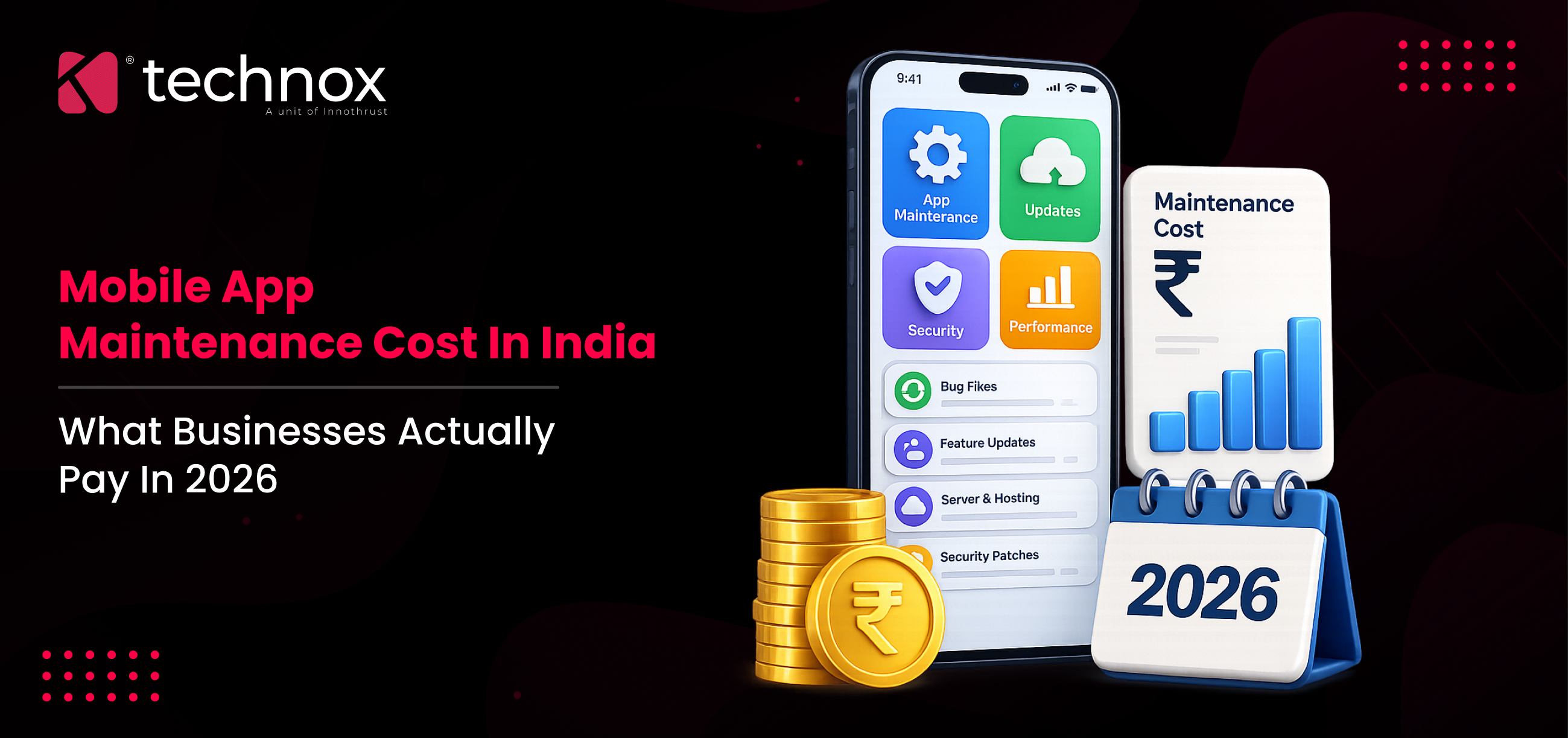
Quick answer: In India, mobile app maintenance in 2026 typically costs 15-25% of the original development cost every year, or roughly ₹15,000 to ₹2,00,000+ per month depending on app complexity, active user base, and how many platforms you support. A basic utility app on a small budget might cost ₹8,000-₹35,000 a month to keep running; an enterprise or high-traffic app can run past ₹2 lakh a month once you factor in monitoring, security patching, and active feature releases.
The rest of this guide breaks down where that money actually goes, why the range is so wide, how India's pricing compares to what businesses pay elsewhere, and how to tell a fair maintenance quote from a padded one.
Why "maintenance" gets underestimated
Founders usually price an app build against a fixed scope: screens, features, integrations, a launch date. Once that's delivered, the project feels finished. Maintenance doesn't work that way, because it isn't driven by a scope document. It's driven by things outside your control. Apple and Google push new OS versions every year whether you're ready or not. A payment gateway changes its API without much warning. A security vulnerability gets disclosed in a third-party SDK you didn't even choose directly, and now you're patching a dependency you never thought about at launch.
Skip maintenance, and the failure mode isn't dramatic. It's quiet. Crash rates creep up after an OS update nobody tested against. The app slips out of compliance with a store policy and gets flagged during a routine review. Users on the latest phones start seeing broken layouts that nobody on your team ever sees, because nobody on your team is testing on that device. None of this shows up on day one. It shows up six to twelve months after launch, which is exactly when founders assume the expensive, uncertain part of the project is behind them. By the time it's visible in reviews or support tickets, the fix usually costs more than ongoing upkeep would have.
There's also a budgeting bias at play. A development quote is concrete: a number, a timeline, a deliverable. A maintenance quote feels open-ended, so it gets deprioritized or assumed away entirely. That gap between "what we budgeted" and "what the app actually needs to stay stable" is where most first-year cost overruns come from, not from the original build going over budget, but from nobody having budgeted for what happens after launch.
The 2026 benchmark: what businesses actually pay
Across current industry data, the standard rule of thumb is consistent: annual maintenance runs 15-20% of the original build cost, with more feature-heavy apps trending toward 25%. If your app cost ₹10 lakh to build, budget roughly ₹1.5-2.5 lakh a year to keep it running well. This isn't a number vendors invented to pad quotes; it holds up across eCommerce, on-demand, and content-app maintenance data from multiple Indian and international sources, which is unusual for an industry where pricing otherwise varies enormously by agency and region.
On a monthly basis, Indian agency pricing for 2026 clusters into three bands:
A very basic app with low traffic can sit as low as ₹8,000-₹15,000 a month. A high-traffic, integration-heavy platform (think payments, logistics, or real-time features) can exceed ₹2 lakh a month once you add monitoring, security reviews, and a standing development team that's available on short notice.
The actual number for your app depends on codebase condition, how many platforms you support (Android, iOS, backend, and an admin panel each add a separate release and testing path), how many third-party integrations you rely on, and how fast you need issues fixed once they're reported. A business that can tolerate a 48-hour bug-fix turnaround pays less than one that needs a 4-hour SLA, even if the underlying app is identical.
How India compares globally
It's worth knowing this context even if you're only staying in India: the same 15-25% rule applies globally, but the absolute numbers differ sharply by region because they're driven by developer wages, not app complexity. A US-based Android app commonly runs $250-$1,000 a month in maintenance, and cross-platform apps with real complexity can run $500-$5,000 a month internationally. An Indian team maintaining a comparable app typically charges $15-$40 an hour, which is why outsourced maintenance from India, Vietnam, or the Philippines is the default choice for many international businesses trying to control this specific line item. If you're an Indian business comparing quotes and one vendor's number looks unusually high, it's worth asking whether they're pricing against international benchmarks rather than the Indian market.
What you're actually paying for
"Maintenance" is a bundle of very different kinds of work, and quotes vary wildly because agencies scope that bundle differently. Here's what typically sits inside a maintenance retainer:
OS compatibility updates: Android and iOS each ship major releases annually; your app needs testing and adjustment against both, even if you change nothing else.
Bug fixes and crash resolution: ongoing, based on real usage and crash reports, not a fixed monthly count. A quiet month costs less; a rough one after a store update costs more.
Security patching: dependency updates, vulnerability fixes, and, for apps handling payments or personal data, periodic security review against current standards.
Server and hosting costs: cloud infrastructure, scaled to traffic. This is frequently billed separately from the development retainer, and it's the line item businesses most often forget to ask about upfront. Expect roughly $70-$320 a year for a small app's hosting alone, scaling well beyond that with traffic.
Third-party API maintenance: payment gateways, maps, OTP providers, and CRMs change their APIs without much notice, and integrations break on their schedule, not yours.
Minor feature updates and UX polish: small improvements based on user feedback, distinct from a full new feature build.
Store compliance: keeping the app aligned with current Apple App Store and Google Play policies, which change more often than most teams expect, and which can result in an app being pulled if ignored.
Feature development, meaning genuinely new functionality rather than upkeep, is usually quoted separately and can run 25-35% of the original build cost annually if you're actively growing the product. That's a different budget line from maintenance, and a quote that blends the two without breaking them out is worth questioning, because it makes it impossible to tell whether you're paying for upkeep or for growth.
Platform fees businesses forget to budget for
Maintenance quotes from agencies rarely include the store-level costs you pay directly:
Apple Developer Program: $99/year (roughly ₹8,500), required to keep an iOS app live on the App Store. Miss the renewal and your app doesn't disappear immediately, but Apple eventually pulls distribution once the membership lapses, and expired certificates can quietly break testing builds before that happens.
Google Play developer account: a one-time $25 (~₹2,100) registration fee, with no annual renewal required.
Store commissions: apply only if you sell digital goods or subscriptions through the app: 15% for most developers under the $1M/year proceeds threshold on both stores, rising to 30% above it.
India-specific billing rule: following a Competition Commission of India order, Google allows third-party billing on Play in India at a reduced 26% service fee for apps that use it, relevant if you're selling digital subscriptions and want to avoid Play's standard billing system and its full commission.
None of these are "maintenance" in the technical sense, but they're recurring costs tied to keeping the app live and legally distributable, and they belong in the same annual budget line as your maintenance retainer, not treated as a separate surprise.
Cost by app complexity
These are planning ranges, not quotes. The real number depends on your specific integrations, compliance needs, and how actively you plan to ship updates after launch. A mid-complexity app that adds a payments integration and starts handling personal data effectively moves toward the upper end of its band, regardless of how simple the original feature set was.
In-house team, freelancer, or agency retainer?
This decision matters more for maintenance cost than it does for the original build, because maintenance is ongoing and mistakes compound over time rather than showing up once at delivery.
In-house developer(s) make sense once your maintenance workload is genuinely full-time, usually once you're managing a large user base or multiple apps. It's the most expensive option on paper but gives you the fastest response time and the deepest product knowledge, since the person fixing the bug is the person who understands the whole system.
Freelancers offer the cheapest hourly rate, but response time and continuity are the trade-off. A freelancer who's unavailable during an outage, or who moves on to another project, is a real risk for anything business-critical, and re-onboarding a new freelancer to an undocumented codebase costs time you don't get back.
Agency retainer is the common middle ground for Indian SMBs and mid-market businesses: predictable monthly cost, a defined SLA, and a team rather than a single point of failure. This is usually the better fit when the app supports revenue directly and downtime has a measurable cost, because the response commitment is contractual rather than dependent on one person's availability.
What actually drives the cost up
Undocumented or legacy code: if the original build wasn't documented, the maintenance team spends billable time just understanding the codebase before they can fix anything, which inflates the first few months of any new engagement regardless of who's doing the work.
Multiple platforms: Android, iOS, backend, and an admin panel are effectively four separate release and testing paths, each with its own risk of breaking independently. Supporting multiple platforms also increases both development and ongoing maintenance costs, making the Android vs iOS vs other platform cost comparison useful when deciding your platform strategy. Businesses running a companion web application alongside the mobile app (an admin dashboard or a customer-facing portal) are maintaining a fifth path on top of that.
Regulatory scope: apps handling payments, health data, or operating under India's data protection obligations need ongoing compliance work, not a one-time setup. A rule that was sufficient a year ago may require new controls today, and ignoring that creates both technical and legal risk.
Third-party integrations: every payment gateway, OTP provider, or mapping API is a dependency that can break on someone else's schedule, and each one adds a point of failure the maintenance team has to monitor.
Release frequency: a business shipping new features monthly pays more than one doing quarterly patches, simply because there's more QA and testing volume attached to every release.
How to control maintenance cost without cutting corners
Ask for a fixed monthly retainer with a written SLA rather than ad-hoc hourly billing, since it's easier to budget and forces the agency to define scope upfront instead of billing by the hour for undefined work.
Get the maintenance scope in writing before signing: what's included (bug fixes, OS updates, monitoring) versus what's billed separately (new features, major redesigns, third-party integration overhauls).
Choose a cross-platform framework (Flutter or React Native) if you're building from scratch, one codebase instead of two cuts ongoing testing and update effort roughly in half, which shows up directly in the monthly maintenance bill. This is worth raising directly with whoever handles your mobile app development before the build starts, since it's a much harder change to make after launch.
Automate crash reporting and monitoring so issues are caught before users report them, since this reduces emergency, high-cost fixes that come from problems sitting unnoticed for weeks.
Review the codebase condition before hiring a new maintenance team if you're switching providers, since undocumented code inflates the first few months of any new engagement, so it's worth asking a prospective vendor to assess the codebase before quoting a fixed monthly number.
Red flags in a maintenance quote
A maintenance quote that doesn't specify response times, doesn't separate "bug fix" from "new feature," or bundles hosting costs into a vague single number is harder to hold accountable later. Before signing, compare the written scope and SLA, not just the headline monthly fee, against what your app actually needs: platforms supported, integrations in use, and how quickly a critical bug needs to be fixed. A quote that looks unusually low compared to the bands above is worth a second look too; it often means fewer hours are actually committed than the app needs, and the gap shows up later as slow response times rather than as a line item you can compare upfront. If you're evaluating an existing quote or unsure whether your current retainer matches what the app actually needs, a scope review with a maintenance-focused development team is usually faster than trying to reverse-engineer it from the invoice alone.
It's also worth remembering that a well-maintained app is part of a business's broader search visibility: store listings get crawled and cited by AI answer engines the same way web pages do, so an app that's stable, current, and free of policy flags tends to perform better in that visibility too. That's a separate discipline from app maintenance itself, closer to AI SEO and search optimization, but the two are worth planning together rather than treating maintenance as a purely technical concern.
Frequently asked questions
1. Is app maintenance really necessary if the app already works fine?
Yes, in the sense that "working fine" today doesn't guarantee it works fine after the next Android or iOS release. Apps that go unmaintained tend to fail quietly, through rising crash rates, layout breaks on new devices, or falling out of store policy compliance, rather than breaking all at once.
2. Can I skip maintenance for the first year to save money?
You can, but it's a false saving. Most budget overruns in year one don't come from a bad build. They come from underestimating what it costs to keep the app stable after launch, and emergency fixes after something breaks typically cost more than a standing retainer would have.
3. Does maintenance cost scale with users, or with features?
Both, but features tend to matter more early on, and user scale matters more once you're past a few thousand active users, since server load, support volume, and monitoring needs all rise with traffic.
4. Why do maintenance quotes for the same app vary so much between agencies?
Mostly because of scope, not skill. One quote might cover only crash fixes and OS compatibility; another might include proactive monitoring, security review, and a fixed feature backlog. The headline number means little until you compare exactly what each quote includes.