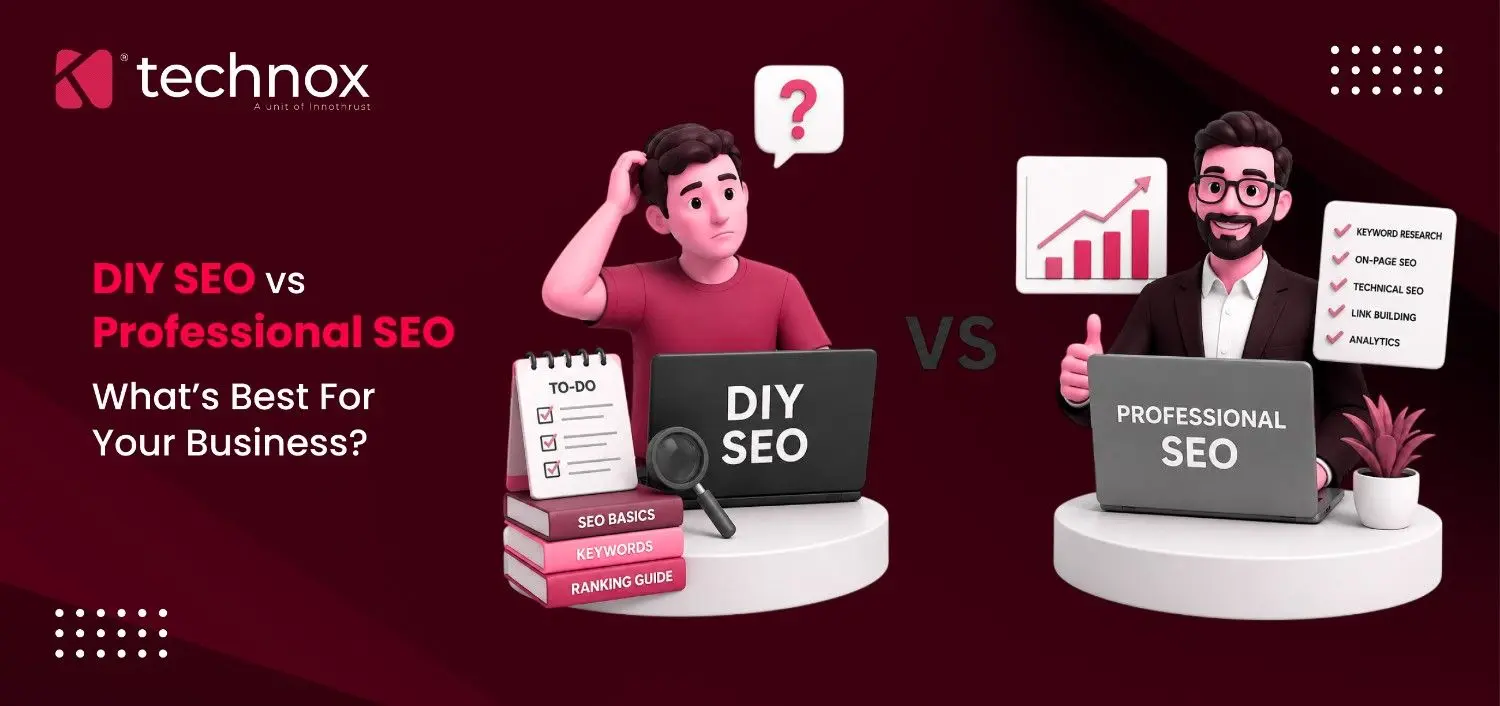
Right now, somewhere in Coimbatore, a customer is typing "web design company near me" into Google. One business shows up on page one and gets the call. Another, often with a better product, sometimes even a better website, never enters the conversation at all. The difference usually isn't luck or budget size; it's whether someone is actively managing SEO, and how well. That leaves every growing business facing the same decision sooner or later: learn to do it yourself, or bring in someone who already knows the terrain. It's a more expensive question to get wrong than it looks.
Lean too hard into DIY in a genuinely competitive market, and you can spend a year of evenings and weekends chasing rankings a specialist would have moved in a fraction of the time. Hire too early, or hire the wrong provider, and you pay recurring fees for fixes you could have handled yourself in an afternoon, or worse, for tactics that put your site at risk of a penalty.
Here's the version most articles skip: there's no universally "right" answer, and anyone who tells you DIY always wins or agencies always win is selling something. What actually determines the right call is a handful of concrete factors, how competitive your market is, how many hours you genuinely have each week, what stage your business is at, and, increasingly in 2026, whether your content needs to be cited by AI search tools like Google AI Overviews, ChatGPT, and Perplexity, not just ranked by Google.
This guide is built on live research into current search behavior, 2026 pricing data from the Indian market, and how generative AI search is reshaping the calculation entirely, so by the end, you'll have a framework, not just an opinion.
What Is DIY SEO vs. Professional SEO?
DIY SEO is when a business owner, marketer, or internal team manages search optimization without hiring an external agency. In practice, that means setting up and actively managing a Google Business Profile, handling on-page SEO (title tags, meta descriptions, header structure, internal links), publishing content around keywords real customers search for, building local citations, and monitoring performance through free tools. It tends to work well early in a business's life, or in low-competition local niches where a handful of correct, consistent actions is enough to outrank thin or neglected competitor sites.
Professional SEO means outsourcing your search strategy to a specialist or SEO agency that manages it end-to-end: technical audits, content strategy, on-page and off-page optimization, link acquisition, analytics, and, increasingly, optimization for AI-driven search surfaces. What separates a credible agency from a DIY effort isn't effort or intent; its compounding expertise built across dozens of client campaigns, access to enterprise-grade tools most single businesses can't justify, and dedicated time that isn't competing with sales calls and daily operations. Quality varies enormously across the agency landscape, a strong provider brings senior specialists and a verifiable track record, while a weak one delivers templated reports and generic content.
If you need a broader understanding of the discipline before deciding how to manage it, start with what SEO is and how it works.
The State of Search in 2026: Why This Decision Got Harder
Three shifts have changed the DIY-vs-professional calculation more in the last 18 months than in the previous five years combined.
AI Overviews have changed where clicks go. Google AI Overviews, AI-generated summaries shown directly on the results page, now trigger on a substantial and growing share of queries, with independent studies reporting coverage anywhere from roughly 18% to over 48% of tracked searches depending on methodology, skewing far higher for long, question-style, and B2B queries. When an AI Overview appears, click-through on the top organic result commonly drops 34–61%, though pages actually cited inside the overview earn meaningfully more of the remaining clicks than pages that simply rank (Search Engine Land, 2026). Practically, this means informational content ("what is," "how to") is now competing to be cited, not just ranked, while transactional, local, and branded searches like "SEO company in Coimbatore" remain far less affected and still drive most small-business revenue.
Zero-click search is the new normal. Search behavior researchers have tracked zero-click search, queries that end without any click at all, climbing to a majority of all searches today, up from roughly 45% a decade ago (Search Engine Land / SparkToro, 2026). SEO hasn't stopped working; visibility just has to be measured beyond raw click volume now.
Generative Engine Optimization (GEO) is now a distinct discipline. Ranking well in traditional search no longer guarantees visibility inside AI-generated answers, only a shrinking share of AI Overview citations now come from pages that also rank in the organic top 10. Being #1 on Google and being cited by an AI Overview are increasingly two different jobs, requiring structured, entity-rich, clearly sourced content built for extraction by language models. This is the biggest reason the DIY-vs-professional gap has widened: traditional on-page SEO is still learnable by a motivated owner in a few months, but keeping pace with GEO is a much steeper, faster-moving climb.For the broader picture of how search optimisation is changing around AI-generated results, see what AI SEO is and how it works.
For a closer look at how traditional search optimisation differs from answer-focused optimisation, see our guide to AEO vs SEO.
DIY SEO vs. Professional SEO: Full Comparison
The Real Cost of DIY SEO (It's Rarely "Free")
DIY SEO looks free on paper. The real cost shows up in time and tools. Business owners transitioning from DIY commonly report a learning phase of 40–80 hours over the first two to three months, followed by ongoing execution of 10–20 hours a week, roughly one to two full working days weekly, taken directly from revenue-generating work. A realistic toolkit, keyword research, rank tracking, a technical crawler, commonly runs $200–$500/month once you move past free tiers.
The costliest DIY error isn't a single bad tactic; it's sequencing. Publishing content before a site is properly crawlable. Building links before there's a page worth linking to. A limited budget spent in the wrong order produces meaningfully worse results than the same budget spent correctly, often the exact gap a professional technical SEO audit closes on day one.
The Real Cost of Professional SEO in India (2026 Benchmarks)
The actual cost can vary depending on the business, competition, SEO goals, and scope of work. For businesses comparing these factors in more detail, our guide on how much SEO costs in Coimbatore breaks down the pricing ranges and what influences them.
Globally, small businesses typically pay $500–$2,000/month, with competitive verticals like legal, finance, and healthcare commanding $3,000–$15,000/month, useful context if you're comparing India-based and international quotes. A growing share of agencies now bill AI search optimization (GEO/AEO) as a separate line item; if a provider's quote doesn't mention AI search visibility at all, ask why. And treat any guarantee of a specific ranking within a fixed number of days as a disqualifying red flag, no one controls Google's algorithm.
Pros, Cons, and When Each Path Makes Sense
DIY SEO gives you full control and no recurring fees, and it builds SEO literacy that helps you evaluate any professional you hire later, but it carries a steep learning curve, limited tool access, slower results, and real risk of technical mistakes that quietly hurt rankings. It makes sense if you're a single-location business in a genuinely low-competition niche, have 10+ consistent weekly hours, and your goal is foundational visibility rather than competing for high-value keywords.
Professional SEO delivers faster, more predictable results, access to premium tools and technical depth, and frees your time for the parts of the business only you can do, but it costs more upfront, requires trusting an external partner, and quality varies enormously across providers. It's the stronger fit once you're in a competitive market, facing a redesign or migration where traffic dropped, hit a plateau despite consistent DIY effort, or are expanding into a new city or market and need faster authority-building.
Many growing businesses don't pick one lane permanently. A common, cost-effective hybrid model keeps content creation in-house, since no one understands your customers better than you do, while outsourcing technical audits, link building, and GEO to a digital marketing partner who tracks algorithm changes daily.
Where DIY Effort Most Often Falls Short: Technical SEO
Technical SEO consistently shows the biggest DIY-vs-professional gap, because problems are often invisible without the right tools. Core Web Vitals (loading speed, interactivity, visual stability) affect both rankings and conversions but often need code-level fixes. Crawlability issues, orphaned pages, broken internal links, incorrect canonical tags, can silently keep good content out of Google's index. Missing or malformed structured data is one of the most common issues found in audits of DIY-managed sites, and it increasingly affects whether AI systems can accurately cite your content. Site migrations and website redesigns are among the highest-risk SEO events a business can go through, redirect mapping mistakes here routinely cause traffic drops that take months to recover without expert intervention.
EEAT Matters More in 2026, Not Less
Google's quality guidelines evaluate content on Experience, Expertise, Authoritativeness, and Trustworthiness, and this has become more consequential as the web fills with generic AI-generated content. The sites earning both traditional rankings and AI Overview citations in 2026 share common traits: clear authorship, original data and case studies rather than rehashed summaries, transparent business information, and consistent accuracy over time. Building genuine EEAT signals is achievable through DIY effort, but it's an ongoing editorial standard, not a checklist item, one that an experienced content partner can accelerate considerably.
Common Mistakes and Expert Tips
The most common DIY missteps: keyword stuffing instead of writing for intent, ignoring technical SEO, publishing inconsistently, buying spammy backlinks, skipping Google Search Console entirely, and treating SEO as a one-time project instead of an ongoing process.
Whichever path you choose, start with Google's own SEO Starter Guide and Search Console, both free, and the right foundation whether SEO is managed in-house or by an agency. Ask any prospective provider directly about their link-building methods; vague answers are a warning sign. Track cost per lead and revenue impact, not rankings alone, and reassess your approach every 6–12 months as your business and search behavior evolve.
Case Studies: Professional SEO in Practice
In documented client work, Technox Technologies has driven measurable e-commerce growth for clients like Valayaa (+78% e-commerce growth) and Powerage Performance (+82% e-commerce growth) through combined SEO, paid search, and paid social strategy. For SR Jungle Resort and Sree Daksha, a similar integrated strategy delivered a +90% increase in engagement rates for both, showing how professional execution adapts to different business goals rather than applying one generic playbook.
Consider a Coimbatore interior design studio competing locally. Early on, a founder-led approach, an optimized Google Business Profile, a handful of local citations, a few blog posts on regional design trends, built solid initial visibility with no agency fees. As the studio expanded into Tamil Nadu-wide inquiries and e-commerce for design products, the competitive landscape changed: ranking for broader, higher-intent keywords required technical SEO and consistent authority-building that a lean internal team couldn't sustain alongside client delivery. That inflection point, not DIY "failing," but the growth stage outgrowing part-time attention, is exactly where professional SEO typically starts outperforming DIY.
Future Trends to Watch
AI Overviews and zero-click search will keep expanding, making conversion-focused local content and AI citations more valuable than raw traffic. Entity SEO and topical authority will matter more than isolated keyword targeting. Structured data will move closer to mandatory for AI systems to cite content accurately, and verifiable EEAT signals will increasingly separate trusted sources from generic AI content flooding the web.
Final Verdict
Choose DIY SEO if you're early-stage or single-location with time to invest and a genuinely low-competition niche. Choose professional SEO if you're in a competitive market, facing a trigger event, or your time is better spent running the business. Choose a hybrid model if you want in-house content backed by expert technical execution. Whichever path you take, the goal is the same: consistent, measurable visibility that turns into real business, not vanity rankings.
Ready to Stop Guessing and Start Ranking?
If DIY SEO has plateaued, or you're not sure your business can afford to keep guessing while competitors invest in professional strategy, Technox Technologies can help. As a full-service digital growth partner based in Coimbatore, Technox combines SEO, AI search optimization, digital marketing, and web design and development under one transparent, data-driven roof, backed by 140+ client reviews and documented results.
Get a free SEO audit from Technox →
Frequently Asked Questions
1. What is the main difference between DIY SEO and professional SEO?
DIY SEO is managed internally using free or low-cost tools, while professional SEO is handled by specialists using advanced tools and processes tested across many campaigns, typically delivering faster, more consistent results.
2. Is DIY SEO effective for small businesses?
Yes, particularly for single-location businesses in low-competition local niches. Optimizing a Google Business Profile, building quality local citations, and publishing consistent content can achieve solid visibility without agency fees.
3. How much does professional SEO cost in India in 2026?
Freelancers typically charge ₹8,000–₹25,000/month, small to mid-size agencies charge ₹15,000–₹75,000/month, and full-service or e-commerce SEO can range from ₹50,000 to ₹2,00,000+ depending on competition and scope.
4. Can I switch from DIY SEO to professional SEO later?
Yes, many businesses start with DIY to learn the fundamentals, then bring in an agency once revenue supports it, or shift to a hybrid model.
5. What tools do I need for DIY SEO?
At minimum, Google Search Console and Google Analytics (both free), plus a keyword research and rank-tracking tool, a realistic budget-tier toolkit runs $200–$500/month.
6. Is professional SEO worth it for a small local business?
It depends on local competition. If several competitors are actively investing in SEO, professional help usually pays for itself faster than a slower DIY learning curve.
7. How do I know if an SEO agency is trustworthy?
Ask directly about their link-building methods, request verifiable case studies in similar industries, and treat any ranking guarantee as a red flag.
8. Does AI Overview reduce the overall value of SEO?
No, it changes where the value is concentrated. Being cited inside an AI Overview drives meaningfully more clicks than ranking without a citation, and local/transactional searches remain far less affected.
9. What's the difference between traditional SEO ranking and being cited in an AI Overview?
They're increasingly separate outcomes, a shrinking share of AI Overview citations come from pages that also rank in the traditional top 10.
10. How do I decide between DIY and professional SEO for my business?
Score your competition level, available weekly hours, current SEO stage, budget, and how central organic search is to your revenue. A low score points to DIY, a high score points to professional SEO, and a middle score usually points to a hybrid approach.