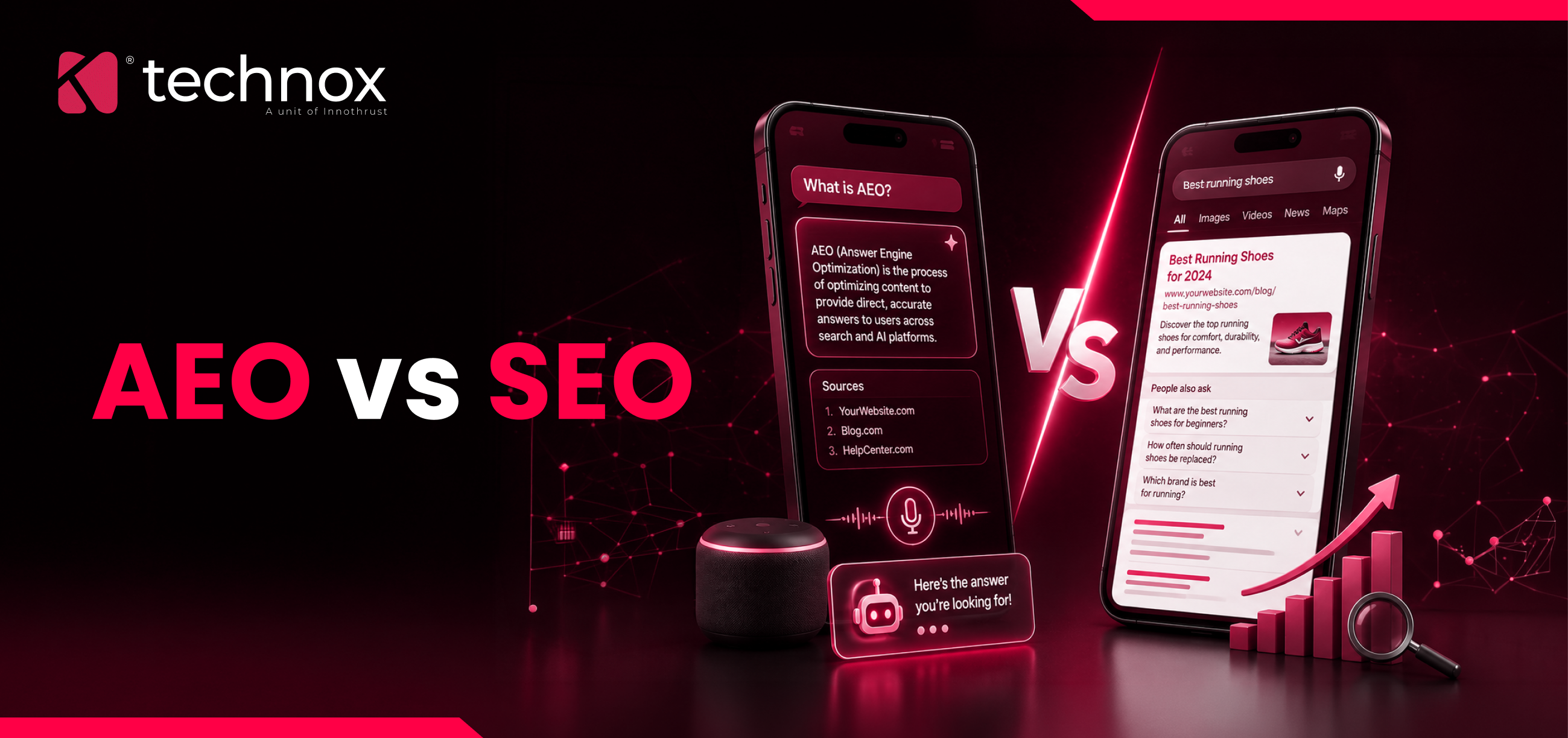
Here's a strange thing happening right now. A business can rank #1 on Google for its most important keyword and still lose traffic. Not because the ranking dropped, because Google answered the question itself, right on the results page, before anyone had to click through.
This isn't rare anymore. By mid-2026, less than a third of all Google searches ended in a click to any website, according to tracking by Similarweb and SparkToro. Two years earlier, that number was closer to half. And when an AI Overview shows up above the #1 result, click-through on that top spot falls by more than half, based on Ahrefs' own data.
So the real question for most businesses isn't “how do we rank higher.” It's “how do we still get found and get clicked when Google, ChatGPT, or Perplexity might just answer the question for us.” That's what this guide walks through, in plain language, with the actual research behind it.
AEO and SEO: What's the Difference?
SEO (Search Engine Optimisation) is the classic goal: rank high on Google so people click through to your website. If you want the broader foundation first, start with what SEO is and how it works.
AEO (Answer Engine Optimisation) is newer: get your content picked up and quoted directly inside an AI-generated answer, whether that's a Google AI Overview, ChatGPT, Perplexity, or Gemini. Often, the person never visits your site at all. They just see your information inside the answer.
Here's the important part: Google doesn't use a separate database for AI answers. It pulls from the same indexed pages that already rank in normal search. What's different is a layer on top that decides which of those pages get quoted in an AI summary, and how much of your actual message survives once it's rewritten.
That means a page can rank well and never get quoted. Or a page buried on page two can get pulled word-for-word into an AI answer, just because it answered the question clearly and directly.
Think of it this way: SEO gets you a seat in the room. AEO decides whether you're the one who gets to speak.
A Quick Example
Say a business sells water purifiers. A search for “best water purifier for hard water” used to send that person to a ranked comparison article, where they'd read through pros and cons and eventually click a product link.
Now, Google or ChatGPT might just generate a short comparison itself, pulling facts from two or three trusted sources, and answer the question directly on the results page. If the business's own article isn't one of those two or three sources, it doesn't matter how well it ranks, the customer never sees it, and never clicks.
That's the shift in one sentence: it's no longer enough to rank. You need to be the source the AI trusts enough to quote. This is the exact audit Technox's SEO team runs for clients before recommending anything else.
The Numbers Behind This Shift
You don't need to take our word for this. Here's what the research shows.
A few things stand out here.
First, clicks aren't disappearing everywhere, just on quick-answer questions. Searches without an AI Overview are actually converting slightly better than before, because the people left clicking are the ones with real, deeper questions. That's good news if your content answers those deeper questions well.
Second, there's a whole new audience showing up outside Google entirely. ChatGPT alone had around 900 million weekly users by early 2026. Add Gemini and Google's AI Mode, and a huge amount of everyday research and shopping decisions now happen inside a chat window, not a search results page. If your business only thinks in terms of Google rankings, you're already missing a growing part of the picture. Technox covers this shift in more detail in its guide to Google AI Mode optimisation.
Why Schema Markup Won't Get You Cited (On Its Own)
You've probably heard that adding FAQ schema or structured data to your website will get you into AI answers. It's a popular claim. It's also not true, at least not on its own.
Ahrefs tested this directly. They tracked almost 1,900 pages that added schema code, and compared them to similar pages that didn't. Over eight months, the pages with schema got no extra AI citations. Some AI tools, when reading a page directly, don't even look at the hidden schema code, they just read what's visible on the page.
That doesn't mean schema is useless. Google's own guidance confirms it still helps Google understand your content correctly, and it still earns better-looking search results with higher click-through, sometimes 25 to 80% higher. It just won't be the thing that gets you quoted by an AI. What actually earns that is simple: content that's genuinely useful and clearly written. Schema is worth doing. Just don't expect it to do the heavy lifting.
What Actually Works for AI Visibility
Good news: fixing this doesn't mean starting over. Most of what helps AEO is also what helps SEO. The broader shift is covered in our guide to what AI SEO is and how it works, including how traditional search optimisation connects with visibility across AI-driven search.
A slow website, or one Google struggles to crawl properly, will underperform in both regular rankings and AI answers, for the same reason, both draw from the same technical foundation.
Once that foundation is solid, a few specific things make the biggest difference:
• Answer the question first, then explain. Don't build up to your answer with a long intro, say the answer clearly in the first sentence or two, then add detail and nuance after that. AI tools tend to pull from the parts of a page that answer a question most directly. If someone lands on your page looking for “how much does X cost,” don't make them scroll past three paragraphs of company history to find the number.
• Go deep on fewer topics instead of wide on many. Ten shallow blog posts about related keywords won't help as much as three genuinely detailed, well-researched pages. AI tools are increasingly good at spotting thin, generic content, because that's exactly the kind of content they're trained to avoid repeating. If you can't say something a real expert in the field would nod along to, it's probably not detailed enough yet.
• Earn mentions on sites AI already trusts. Wikipedia, Reddit, YouTube, and major review or news sites get cited constantly by AI tools. You can't outrank Wikipedia, and you shouldn't try. But you can get your original research, data, or expert commentary picked up and referenced by those sites and by journalists. That's a realistic way in, think of it as digital PR rather than link building.
• Connect your content properly. A website with 200 unrelated blog posts and no clear links between related pages is harder for both Google and AI tools to trust as an authority on any one topic. Group related content together, and link between those pages using clear, descriptive text, not just “click here.”
• Keep your facts current. AI tools favour pages that are clearly up to date. A pricing page from three years ago, or a “best tools in 2023” article still sitting online in 2026, sends the wrong signal. Reviewing and updating your highest-traffic pages every few months does more for AI visibility than most people expect.
Common Mistakes We See
• Treating AEO as a whole new department. It isn't, it's mostly the same content and technical work done well, just with a slightly different goal in mind. You don't need a separate team or a separate budget line to get started.
• Adding schema and stopping there. Schema without genuinely useful content underneath it changes very little. Fix the content first, then treat the schema as a finishing touch.
• Only measuring success by website traffic. This is the biggest blind spot right now. A person can see your brand mentioned in an AI answer, remember it, and buy from you later, without ever clicking through. Forrester found buyers were far more likely to shortlist a company they'd seen referenced during AI-assisted research, even without visiting that company's site. Google Search Console won't show you this, you need to manually check how your brand shows up in ChatGPT, Perplexity, and Google AI Mode for your key search terms, or use a tool built for tracking that.
• Ignoring the questions people actually ask. A lot of businesses write content around what they want to say, not what customers are actually asking. Read your own customer support tickets, sales calls, and WhatsApp chats. The real questions are usually simpler and more specific than the keywords a typical SEO tool suggests.
Tools That Help With This
You don't need a huge budget to start tracking any of this. A few simple habits go a long way.
• Use Google Search Console to watch impressions and clicks on your key pages over time. If impressions hold steady or grow while clicks slowly shrink, that's often a sign an AI Overview is now appearing for those searches. It's not proof your content stopped working, it's a sign the traffic pattern changed.
• Search your own brand name, and your top five service or product terms, directly inside ChatGPT, Perplexity, and Google's AI Mode once a month. Note whether your business gets mentioned, and how accurately. This takes fifteen minutes and tells you more about your AI visibility than any dashboard currently can.
• Keep a simple spreadsheet of your highest-traffic pages, and revisit each one every few months. Check whether the opening paragraph answers the main question directly, whether the facts are still current, and whether the page links to other relevant pages on your site. Small, regular updates like this tend to matter more than one big rewrite done once a year.
• If your team is already using Google Analytics 4, keep an eye on branded search traffic as a separate trend line from generic keyword traffic. A rise in people searching your business name directly, even while generic traffic dips, is often a sign that AI-driven exposure is working, just not in a way that shows up as a click.
Where This Is Heading
Google has said AI Mode usage is more than doubling every few months, even though it's still a small piece of total search volume today. That's the exact kind of trend that sneaks up on businesses, small today, much bigger in a year or two. Waiting until it's a large share of your traffic before acting usually means starting from behind. Technox breaks down what this shift means for local and regional brands in its Google AI mode optimisation guide.
The smart move isn't to drop your SEO budget and chase AI visibility instead. It's to make sure everything you build works for both: a fast, well-structured website with clear, direct answers that a machine can quote, and enough genuine value that a real person still wants to click through and stay.
What To Fix First
If you take one thing from this article, take this: check three things, in this order.
1. Is your website actually fast and easy for Google to crawl? This matters equally for normal rankings and AI answers. A slow, poorly built site holds back both at once.
2. Does your content answer questions directly, right at the top, instead of building up slowly to the point? This is often the fastest, cheapest fix available, and it doesn't require new content, just better editing of what you already have.
3. Do you know what AI tools are actually saying about your business right now? Most businesses don't, because normal analytics tools don't show it. A simple monthly check across ChatGPT, Perplexity, and Google AI Mode for your top ten search terms goes a long way.
Fix those three things, and most of the AEO-versus-SEO confusion disappears. It was never really two separate strategies. It's one job, updated for how people search today, and it's the exact audit Technox runs before recommending anything else. If you're deciding whether to handle this internally or bring in specialist support, DIY SEO vs professional SEO breaks down what each approach involves.
If you’re looking for an SEO company in Coimbatore to assess the technical foundation, content and search visibility of your site, this is where we start.
Questions Businesses Ask Us
Is AEO replacing SEO?
No. AEO relies on the same technical and content foundation as SEO. If your SEO fundamentals are weak, your AI visibility will be weak too. Think of AEO as a new layer on top of SEO, not a replacement for it.
Will adding schema markup get me cited by ChatGPT or Google's AI Overviews?
Not by itself. Testing in 2026 found no direct link between adding schema and getting cited more. Schema still helps with search appearance and clarity though, so it's worth doing anyway, just not as your main AEO strategy.
How long does it take to see results?
Usually three to six months. AI tools re-check trusted sources continuously, not on a fixed schedule, so improvements tend to show up gradually rather than overnight.
What should I track besides rankings?
Check how often your brand shows up in ChatGPT, Perplexity, and Google AI Mode for your key search terms. Also watch branded search volume, meaning people searching your business name directly. It often rises even when direct clicks fall.
Do small or local businesses need to worry about this yet?
Less urgently. Local searches trigger AI Overviews less often than general questions. But keeping your Google Business Profile and reviews strong still matters, since local AI answers rely on the same information.
If my clicks are dropping, does that mean my SEO has failed?
Not necessarily. If people are still seeing your content and your brand keeps getting mentioned, that's still visibility, just in a different shape. Check whether impressions and brand mentions are holding steady before assuming something's broken.
What kind of content gets quoted by AI tools most often?
Content that gives a clear, direct answer right away, backed by real data or a specific example. Generic summaries that repeat common knowledge rarely get chosen, since the AI already has that information from ten other sources.
Should I rewrite my whole website for this?
No. Start with your highest-traffic informational pages, the ones most likely to get intercepted by an AI Overview, and fix those first. Expand from there once you see what's working. Technox's SEO team typically starts every client engagement with exactly this kind of page-level audit.