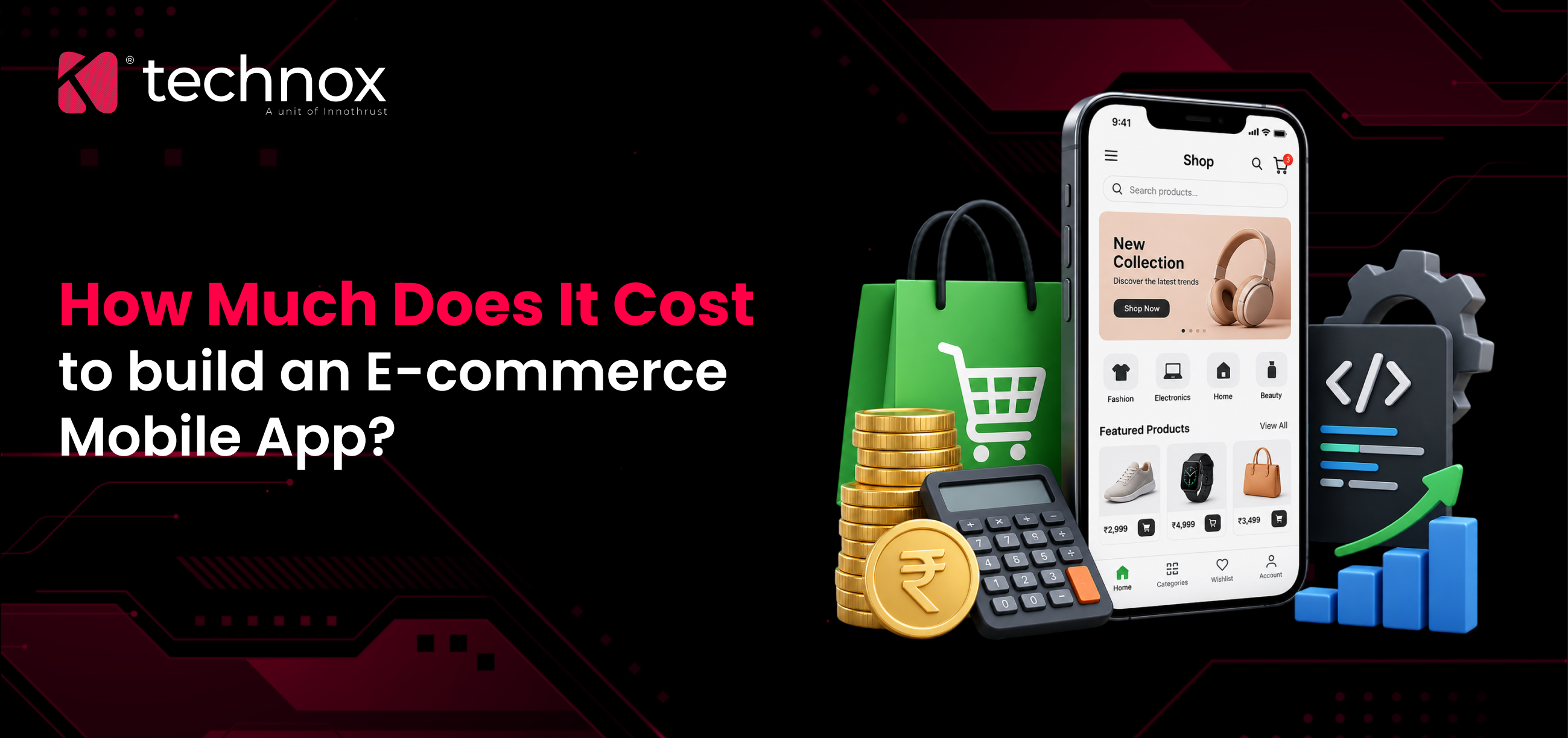
Search this question and you'll find answers all over the map — ₹50,000 on one site, ₹1 crore on another; $10,000 here, $500,000 there. None of these numbers is wrong. They're just describing completely different products. A basic storefront app and a custom multi-vendor marketplace with AI recommendations are both technically "e-commerce apps," and they sit at opposite ends of that range.
So here's the short answer, followed by everything that actually determines where your project lands on it.
The Quick Answer
After launch, budget 15–20% of your build cost every year for maintenance. That part is where most first-time founders get caught off guard — it isn't optional, and it doesn't stop.
The rest of this guide explains why the range is so wide, and how to figure out where your project actually falls within it.
Why the Same Question Gets Such Different Answers
"E-commerce app development cost" isn't one number. It's the sum of four separate decisions, each with its own price tag:
What the app needs to do — the feature list
How it's built — native, cross-platform, or a platform-based builder
Who builds it — an agency, freelancers, or an in-house team, and where they're located
How polished it needs to be — template UI vs. fully custom design
Two businesses asking for "an e-commerce app" can land 10x apart in price because they answered these four questions differently — not because one of them got a worse deal. Fix these four variables for your own project first, and the range narrows fast.
Cost by App Complexity
Most agency quotes are built around three tiers. Here's what each one actually includes, and how long each typically takes.
Think of it this way: a basic app proves the idea works. A mid-tier app runs a growing business day to day. An enterprise app exists because the business has outgrown what a template-level product can support — multiple seller types, complex pricing, or transaction volume that needs dedicated infrastructure.
Most D2C and small-to-mid retail brands land in the basic-to-mid range. Marketplace-scale budgets only make sense once there's proven demand and a business model — commissions, subscriptions, ads — that justifies the spend.
What Actually Moves the Number Inside Each Tier
Complexity tiers are a starting point. Within any tier, specific features move the price more than others:
A word on security, specifically. It's the one line item businesses are most tempted to trim. An e-commerce app handles payment data and personal information by default, and skimping here is expensive in a way that's easy to underestimate: IBM's 2026 Cost of a Data Breach Report puts the global average cost of a data breach at $4.99 million — a record high, up 12% year over year. That single number dwarfs whatever you'd save by cutting corners on encryption and PCI-compliant payment handling at launch.
AI recommendations and AR try-on are the two features seeing the fastest cost growth in 2026 builds. AI-driven recommendations tend to pay for themselves within 6–12 months through better conversion; AR is worth it mainly for fashion, furniture, and beauty brands, where product appearance drives the purchase decision. For a first launch, most businesses are better off shipping without either — and adding them later, once real usage data justifies the spend.
Native, Cross-Platform, or Platform-Based: The Build Decision
Before features, there's a more fundamental lever on cost: how the app gets built. This single decision can swing your budget by 30–60%.
The cost difference becomes clearer when you compare Android vs iOS vs other platform costs, especially when choosing between native and cross-platform development.
Native (separate iOS and Android builds). Two codebases, two teams — the highest cost and longest timeline. Native still earns its keep when the app needs deep hardware access: camera-based AR, Bluetooth peripherals, CarPlay/Android Auto. For a standard shopping app — browse, cart, checkout, order tracking — native rarely earns the extra cost.
Cross-platform (Flutter or React Native). One codebase, both platforms. This is the default choice for most e-commerce apps in 2026. In India and Southeast Asia specifically, where Android dominates, a Flutter build typically cuts cost by 30–40% compared to native, with no meaningful performance penalty for a shopping app's actual feature set. Flutter tends to win on UI consistency and animation; React Native wins on hiring, since JavaScript developers are easier to find in most markets.
Platform-based builders (Shopify app builders, website-to-app converters). Already running Shopify or WooCommerce? Converting that store into a branded app can cost a low four-figure setup fee plus a monthly cost — a fraction of custom development. The trade-off is customization: you inherit your platform's constraints, and complex logic (multi-vendor, deep loyalty programs) is harder to bolt on later. For a single-storefront brand mainly after push notifications and a faster checkout, this route is worth evaluating before committing to a custom build.
The Hidden Costs Most Budgets Miss
The development quote is rarely the full cost of owning an app. Four things consistently get left out of first-time budgets:
App store fees. Apple charges $99/year for the Developer Program; Google Play charges a one-time $25 registration fee. Small amounts, but Apple's is a recurring commitment, not a one-time line item.
Annual maintenance. Budget 15–20% of your total build cost every year for bug fixes, OS compatibility, security patches, and API updates as payment gateways and third-party services change. On a ₹15 lakh build, that's ₹2.25–3 lakh a year, indefinitely.
Third-party integration fees. Payment gateways, shipping carriers, and CRM tools often charge setup fees, monthly subscriptions, or a cut of every transaction — on top of the development cost to integrate them.
Post-launch marketing. An app nobody downloads doesn't generate revenue, however well it's built. App Store Optimization and initial user-acquisition marketing need their own budget, separate from development.
A reasonable planning rule: whatever your development quote is, expect total year-one spend to run 1.5–2x that figure once maintenance, integrations, and launch marketing are folded in.
Why India-Based Development Changes the Number
Developer location is one of the single biggest cost levers here — it's why the same app scope produces wildly different quotes depending on where the team sits.
In 2026, hourly development rates run roughly:
$150–250/hour in the US
$80–200/hour in Western Europe
$25–60/hour in India
That gap is why outsourcing to an Indian team, or working directly with an India-based agency, can cut total project cost by 50–60% compared to hiring the same scope onshore in the US or UK — without a corresponding drop in code quality. It's a difference in market rates, not skill.
This is also why the India-specific figures above (₹3–50 lakh) look so much lower than the global USD range — they largely reflect India's own development costs, not a discount on a US-priced project. If you're a US or UK business evaluating an India-based team, those INR figures are a reasonable proxy for what a comparably-scoped app would cost you, once you strip out the premium of onshore rates.
The scale of India's own market makes this worth taking seriously in its own right. According to Bain & Company's "How India Shops Online" research, India's e-retail sector closed at roughly $65–66 billion in gross merchandise value, growing 19–21% year over year — a market expanding fast enough that Android-first, cross-platform development deserves even more weight here than in markets with a heavier iOS split, simply because Android's dominance in India makes the Flutter/React Native cost savings more pronounced.
Do You Actually Need an App — Or Would a Better Website Do?
This is the question worth asking before any of the numbers above matter. Not every business needs a native app, and building one prematurely is a common way to spend ₹8–15 lakh on something that doesn't move revenue.
An app is worth it when:
You have repeat buyers who'd benefit from a faster, app-native checkout and push notifications
Your business model is complex (multi-vendor, subscriptions, loyalty tiers) in ways a website struggles to handle smoothly
You want direct, permission-based engagement a website and email/SMS can't replicate
A strong mobile website is the better first move when:
You're pre-revenue or still validating product-market fit
Most traffic is one-time or discovery-driven (search, social, ads) rather than repeat visits
Budget is tight and a mobile-optimized e-commerce website can deliver most of the customer experience for a fraction of the cost
Global context matters here too: mobile devices already account for roughly 59–61% of all online transactions, out of a global e-commerce market forecast at $6.88 trillion for 2026 (Statista's e-commerce market data tracks the underlying figures). That volume is real — but it's driven overwhelmingly by mobile web traffic, not app downloads specifically. An app with 200 downloads and low retention is a worse outcome than a website that converts well on mobile browsers. Many businesses get better ROI investing in a fast, mobile-first website first, then building a dedicated app once there's a proven base of repeat customers who'll actually download it.
How to Control Costs Without Cutting the Wrong Corners
Start with an MVP. Ship the core buying flow — browse, cart, checkout, order tracking — before adding AI, AR, or loyalty programs. Validate that people use the app before investing further.
Default to cross-platform. Unless a specific hardware-dependent feature says otherwise, Flutter or React Native saves 30–60% over native with no meaningful trade-off for a standard shopping experience.
Scope integrations early. Lock in your payment gateways, shipping providers, and analytics tools before development starts — adding them mid-build is where timelines and budgets both slip.
Budget maintenance from day one. Treat the 15–20% annual maintenance cost as part of the original budget, not a surprise — that's how apps quietly break after an OS update, because nobody planned for the fix.
Get an itemized quote. A single lump-sum number with no feature-by-feature breakdown makes it impossible to know where the money is going, or where you could trim.
If you're weighing a custom app, a website-to-app conversion for your business, that scoping conversation is worth having before development starts.
Frequently Asked Questions
1. Is it cheaper to convert my existing website into an app instead of building one from scratch?
Yes, usually significantly. Website-to-app conversion tools can launch a branded app for a low four-figure setup cost plus an ongoing monthly fee, instead of a five- or six-figure custom build. It works best for single-storefront brands mainly after push notifications and a faster mobile experience — deep custom features are harder to add this way.
2. Should I choose native or cross-platform development for my e-commerce app?
For most e-commerce apps, cross-platform (Flutter or React Native) wins — it cuts cost by 30–60% compared to separate native iOS and Android builds, with minimal performance trade-off for a standard shopping flow. Native only earns its cost if you need deep hardware features like advanced camera-based AR.
3. Do I need a mobile app if I already have a mobile-friendly website?
Not necessarily. An app pays off once you have repeat buyers who'd benefit from push notifications and faster checkout. If most of your traffic is first-time or discovery-driven, a well-optimized mobile website often delivers similar results for a fraction of the investment.
4. How long does it actually take to launch an e-commerce app?
A basic MVP typically takes 3–4 months from planning to launch. Mid-complexity apps run 4–8 months, and enterprise-level marketplace apps can take 8–14 months or longer.
5. What ongoing costs should I budget for after launch?
Plan for 15–20% of your build cost annually for maintenance, plus app store fees ($99/year for Apple, a one-time $25 for Google Play), third-party integration costs, and a separate budget for post-launch marketing and App Store Optimization.