Most guides on this topic read like the same checklist with the company name swapped out: check the portfolio, ask about communication, compare pricing, look at reviews. None of that is wrong, but it skips the decision that actually determines whether the rest of the checklist even matters — what kind of partner does this specific project need, at this specific stage of your business?
A five-screen booking app for a single-location clinic and a multi-vendor marketplace with payment processing are not the same hiring decision, even though both are "an app." The engagement model, the contract structure, and the questions worth asking change depending on where your project sits. This guide works through the decision in that order: model first, contract second, vetting third, because getting the first two wrong is what makes the vetting checklist irrelevant.
Quick answer: Choosing an app development partner comes down to five checks, in order: (1) pick the right engagement model — freelancer for small, well-defined builds; agency for most production MVPs; in-house only for a continuous, multi-year product roadmap; (2) match the contract to your certainty level — fixed-price when scope is locked, time-and-materials when it will evolve, or the 2026-standard hybrid of a fixed-price discovery phase followed by a build contract; (3) vet the shortlist on verifiable proof — live apps, references who can confirm the final cost stayed close to the estimate, and a clearly described discovery-to-launch process; (4) get code, design, and app-store account ownership written into the contract before signing; (5) budget 15–20% of the build cost per year for post-launch maintenance. A partner that asks detailed questions before quoting a price is a stronger signal than one that quotes fast.
Start With the Engagement Model, Not the Vendor List
Before comparing individual companies, decide which structure fits your project. The three options — freelancer, agency, and in-house team — carry genuinely different cost, risk, and control trade-offs, and the "right" one depends on your budget and how long the product will need active engineering.
A useful way to frame it: freelancers suit narrow, short-lived builds; in-house teams suit companies where engineering is a permanent, ongoing function; and an agency is usually the right call for a defined product launch where you want a coordinated team without the fixed payroll commitment. Many growing businesses use a hybrid — an agency for the initial build and launch, then either retain that partner for ongoing work or bring development in-house once the product has traction.
If you're unsure which bucket you're in, ask: is this a one-time build, or the start of a product that will need engineering attention for years? A one-time build points toward a freelancer or agency. An ongoing product roadmap points toward an agency-to-in-house transition.
Understand the Contract Structure Before You Look at Any Proposal
This is the part most businesses skip, and it's the single biggest driver of whether a project finishes on budget. There are three common structures, and each shifts financial risk to a different party.
Fixed price. You agree on a scope and a number. The agency absorbs the risk of the project taking longer than planned; you absorb the risk of anything you didn't specify not being included. Fixed-price quotes typically run higher at signing than an equivalent time-and-materials estimate, because the agency is pricing in the risk it's accepting. This works well when requirements are locked down and won't change mid-build.
Time and materials (T&M). You pay for actual hours worked. It's more flexible when requirements are likely to evolve, but the client carries the overrun risk — final invoices on T&M contracts commonly land well above the original estimate once mid-project changes are factored in. This suits genuinely exploratory projects where you can't fully specify the app before development starts.
Dedicated team / retainer. A team works on your product monthly, on an ongoing basis. This isn't really a pricing model for a single build — it's the structure for continuous product development after launch, which is why most experienced buyers pair it with one of the two models above rather than using it alone.
The pattern that's become standard for 2026 engagements is a hybrid: a fixed-price (or fixed-fee) discovery phase to nail down scope, followed by either a fixed-price build for the defined MVP or a time-and-materials/dedicated-team arrangement for the ongoing iteration that follows launch. If a company skips discovery and hands you a firm number after one call, that's worth questioning — not because low prices are inherently bad, but because an accurate estimate requires understanding your edge cases, integrations, and user flows first.
What a Realistic Budget Looks Like
Cost ranges vary widely by region, team seniority, and app complexity, so treat any number — including the ones below — as an orientation point, not a quote. As a general shape for 2026 production builds:
Two things move the number more than anything else: the vertical (a HIPAA-adjacent healthcare app or a payments-handling fintech app cannot be scoped like a content app, regardless of who builds it) and the region where the development team is based, since hourly rates differ substantially by country. This is also where an India-based partner is often part of the conversation for global clients — offshore rates typically run well below U.S. or Western European agency rates for comparable engineering quality, which is a legitimate reason many businesses widen their search beyond their home market rather than a reason to assume lower cost means lower quality. Coimbatore-based mobile app development services, for instance, are a common example of this pattern — regional engineering hubs that combine lower delivery cost with production-grade Android, iOS, and Flutter capability.
Whatever the build cost, budget separately for what comes after launch: a common industry guideline is 15–20% of the original build cost per year for maintenance — bug fixes, OS compatibility updates, and security patches — and that figure typically doesn't include new feature development, which gets scoped separately.
How to Actually Vet a Shortlist
Once you know the model and contract structure you want, the vetting itself comes down to a few things that predict outcomes better than a slick pitch does.
Look past the portfolio's surface. Polished screenshots don't tell you whether the agency understood the problem it was solving. Look for context: what constraint or trade-off did they navigate, what was the measurable outcome, and — where possible — download or use the actual live app rather than judging static images. Reviewing a partner's portfolio alongside its case studies side by side is a quick way to check whether the visuals are backed by an explained process and a stated outcome, or just a gallery. A portfolio that shows only visuals with no explanation of the process behind them is a weaker signal than it looks.
Ask for references and use them properly. A reference call is most useful when you ask about the relationship, not just the outcome: how the team communicated during rough patches, whether the final cost stayed close to the original estimate, and what they'd do differently next time. A team that delivered a good product but went quiet for weeks at a stretch is a pattern worth knowing before you sign, not after.
Confirm industry-specific experience where it matters. For a general content or booking app, broad experience is usually enough. For healthcare, fintech, or anything handling regulated data, ask directly about compliance experience (HIPAA, PCI-DSS, or the relevant regional equivalent) — this is one case where "we can figure it out" is a legitimate reason to keep looking.
Get the process in writing. A credible partner should be able to describe discovery, design, build, QA, and launch as distinct phases with real deliverables at each stage — not just "we'll build it and show you when it's ready."
That discovery process should also include a clear discussion about the technology behind your application. If a team recommends Flutter, React Native, Kotlin, or another framework without explaining why it suits your product, that's a warning sign. The right technology choice should always follow your business requirements, not a developer's personal preference. Understanding the fundamentals of a Tech Stack for Mobile App Development can help you ask better questions and evaluate those recommendations with confidence.
The Contract Terms Worth Reading Twice
Two clauses cause more post-launch disputes than everything else combined, and both are easy to verify before signing:
Code and asset ownership. Confirm in writing that you receive full ownership of the source code, design files, cloud/hosting accounts, app store developer accounts, and documentation once the engagement ends — not conditional access, and not a partner who quietly retains control of a key account. This matters in practice because both the Apple Developer Program and the Google Play Console tie an app's listing to a specific verified account — if your agency enrolled that account under its own business identity instead of yours, transferring ownership later can be slow and, in some cases, requires the original account holder's cooperation. Confirm upfront whose legal entity the developer accounts are registered under. If a company is vague here, treat it as a serious flag rather than a detail to sort out later.
Change management. Ask specifically how scope changes are priced and approved mid-project. A partner with a clear change-order process protects both sides; one with no defined process is the most common source of budget surprises on both fixed-price and T&M contracts.
Red Flags That Show Up Before You Sign
The warning signs that predict a bad engagement are almost always visible during the sales process — the difference is knowing what to watch for.
An exact price and deadline after one short call, before requirements are documented. Reliable estimates come from understanding features, integrations, and edge cases, not from a rehearsed number.
No client references, or reluctance to provide app store links to apps they've actually shipped.
Vagueness about who owns the code and accounts after launch.
No mention of testing or QA process when you ask how they catch bugs before release.
A team that says yes to every request without pushing back or asking clarifying questions. A partner that dives straight into solutioning without understanding your business goals first is optimizing for winning the deal, not for the outcome.
Recently abandoned apps in their portfolio — check whether the apps they've shipped are still being maintained and updated; a two-year-old app with no updates tells you something about their long-term support habits.
One flag on its own can be a fluke. Two or three together is a pattern worth acting on.
A Short Evaluation Framework
Before making a final call, it helps to score your shortlist against the same criteria rather than comparing pitches in isolation:
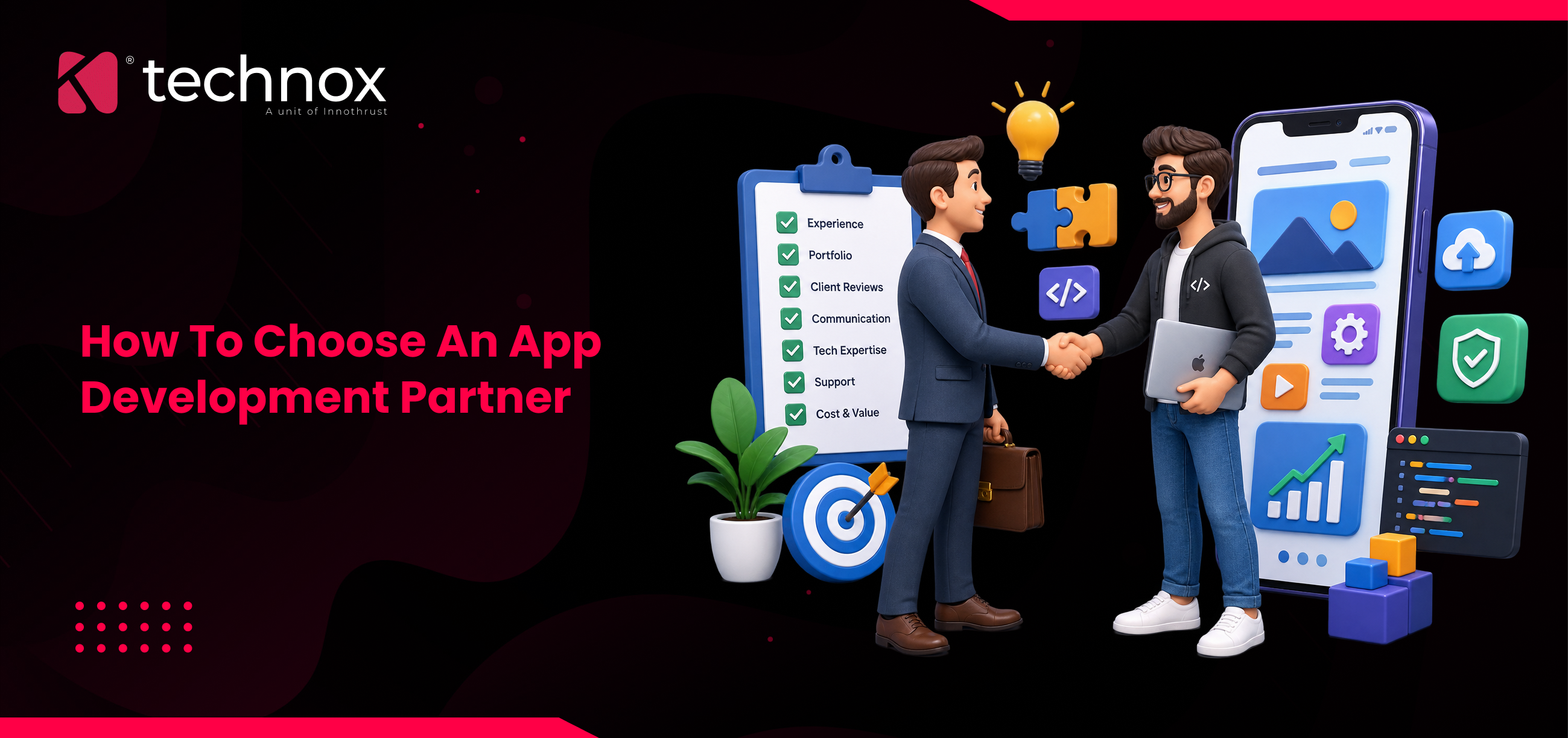
Relevant experience — have they shipped something comparable in complexity or industry, and can you verify it?
Process transparency — can they describe discovery, design, build, QA, and launch as distinct, deliverable-backed stages?
Communication cadence — is there a named point of contact and a stated response-time expectation, confirmed before signing?
Contract clarity — is the pricing model matched to your project's certainty level, and is ownership spelled out in writing?
Post-launch commitment — do they offer maintenance and support, and is the ongoing cost structure clear upfront?
A partner that scores well across all five is a stronger bet than one that scores exceptionally on price or portfolio alone but is weak elsewhere — the point of failure in most troubled app projects is rarely a single bad decision, but one of these five being ignored during the sales process.
The Underlying Principle
Every checklist in this space eventually reduces to the same idea: the partner you choose absorbs risk on your behalf, and the contract structure determines how much. A fixed-price agency contract with clear ownership terms and a defined process shifts most of the delivery risk away from you. A cheap, vaguely-scoped engagement with no defined process shifts nearly all of it back — you just don't see that cost until the project is already underway.
Getting the engagement model and contract structure right before you start comparing portfolios is what actually protects the budget and timeline; the rest of the vetting process works far better once those two decisions are made first.
Frequently Asked Questions
1. How long does it typically take to build and launch an app?
A simple MVP with a single core use case usually takes 8–12 weeks from discovery to launch. A standard business app with multiple user roles and a handful of integrations typically runs 3–6 months. Complex apps with compliance requirements, heavy integrations, or high concurrency needs can take 6–12 months or longer. Discovery and scoping typically account for 1–3 of those weeks and shouldn't be skipped even under a tight deadline, since skipping it is what causes the biggest delays later.
2. Should I hire a local or an offshore app development company?
Both can deliver production-quality work; the difference is cost, time zone overlap, and how much in-person collaboration you need. Offshore and regional hubs — including India-based teams — typically cost less for comparable engineering quality, which is why many businesses widen their search beyond their home market. The trade-off is coordinating across time zones and, occasionally, a language or cultural communication gap. If your project needs frequent in-person workshops, weight the decision toward local; if it's mostly async communication with clear written specs, geography matters less than the vetting criteria covered above.
3. Who owns the app's source code and app store accounts after the project is completed?
You should, in full — but this has to be written into the contract, not assumed. Check specifically whether the developer accounts on the Apple Developer Program and Google Play Console were registered under your business's legal entity or the agency's. If they're registered under the agency's entity, transferring ownership later can be a slow process that requires the original account holder's cooperation.
4. What should be included in a post-launch maintenance contract?
At minimum: bug fixes, OS and device compatibility updates (each time Apple or Google ships a major platform update), and security patches. This is typically priced separately from new feature development, at roughly 15–20% of the original build cost per year. Ask specifically whether crash monitoring, uptime monitoring, and a defined response-time SLA for critical bugs are included, since these are often left out of the base maintenance quote and added as extras later.
5. Is it a bad sign if an app development company asks a lot of questions before giving me a quote?
No, it's the opposite. An accurate estimate requires understanding your business goals, user flows, edge cases, and integrations first. A company that asks detailed questions before pricing is doing the discovery work an accurate quote depends on. Be more cautious of a company that gives you a firm price and deadline after a single short call, before any of that has been discussed.