"Why did ChatGPT recommend my competitor instead of me?"
That's a question more business owners are asking in 2026. Their websites rank well. Their SEO reports look healthy. Their traffic hasn't disappeared. Yet when potential customers ask ChatGPT for the best company in their industry, someone else gets recommended.
The reason isn't a lack of backlinks or keywords. AI search works differently. Modern AI engines evaluate trust, entity recognition, third-party mentions, reviews, videos, and brand authority before deciding who deserves to appear in an answer. If your brand isn't building authority beyond your own website, you're becoming invisible where tomorrow's customers are searching.
This is exactly the pattern we saw with a Coimbatore interior design client last month. He had noticed that ChatGPT recommended two competitors by name when a prospect asked for "the best interior design firm in Coimbatore," and never mentioned his business at all. His website ranked on page one of Google. His domain metrics looked healthy. None of it showed up in the answer.
That gap is becoming the defining problem in search. A shrinking share of buying decisions now start with a list of ten blue links. A growing share start with an AI assistant composing a single answer. The question worth asking is not whether your site ranks. It is whether your brand exists strongly enough, in enough independent places, for a language model to recall it with confidence.
The short answer: yes, brand authority really does matter for AI visibility, more than most SEO reporting currently shows. The longer answer, and the more useful one, is in the data below.
The Search Landscape Is Changing Faster Than Most Businesses Realize
Before getting into brand authority specifically, it helps to see the scale of the shift it sits inside.
Why this matters: total search volume hasn't collapsed the way the 2024 prediction implied. Google still handles the overwhelming majority of searches. What has changed, measurably, is what happens after the search. More queries now end on the results page itself, and the traffic that does leave the page, especially traffic referred by an AI assistant, converts noticeably better than old-style organic clicks. A business chasing raw click volume in this environment is optimizing for a share that keeps shrinking. A business chasing citation inside AI answers is optimizing for the smaller, higher-value pool that is left.
Business impact: this is why "we still rank well on Google" is no longer a reliable proxy for "our business is visible to buyers." A page can hold position one and still lose the customer to a competitor named inside the AI Overview above it, the exact scenario the interior design client ran into.
How to apply it: stop measuring success by ranking position alone. Start tracking whether your brand is named, and named accurately, inside the AI-generated answers your buyers actually see.
Redefining Brand Authority for an AI-First Audience
In traditional SEO, authority was shorthand for link equity, expressed through metrics like Domain Rating or Domain Authority. That framework made sense when Google's job was to rank pages against each other, and it's still the framework a lot of new and growing sites get stuck chasing when what actually needs fixing is entity clarity, the focus of dedicated AI search and GEO optimization work.
Generative Engine Optimization, or GEO, the practice of earning visibility inside AI-generated answers across Google AI Mode, Google AI Overviews, ChatGPT Search, Perplexity, and Microsoft Copilot, runs on a different mechanism. These systems are not ranking your page against a query in real time. They are drawing on retrieved web content and patterns absorbed during training to decide which entities (brands, people, and products) the system can identify with confidence, and worth naming in a given context. Our Google AI Mode optimization guide walks through this shift in more technical depth, including how entity signals and schema fit together.
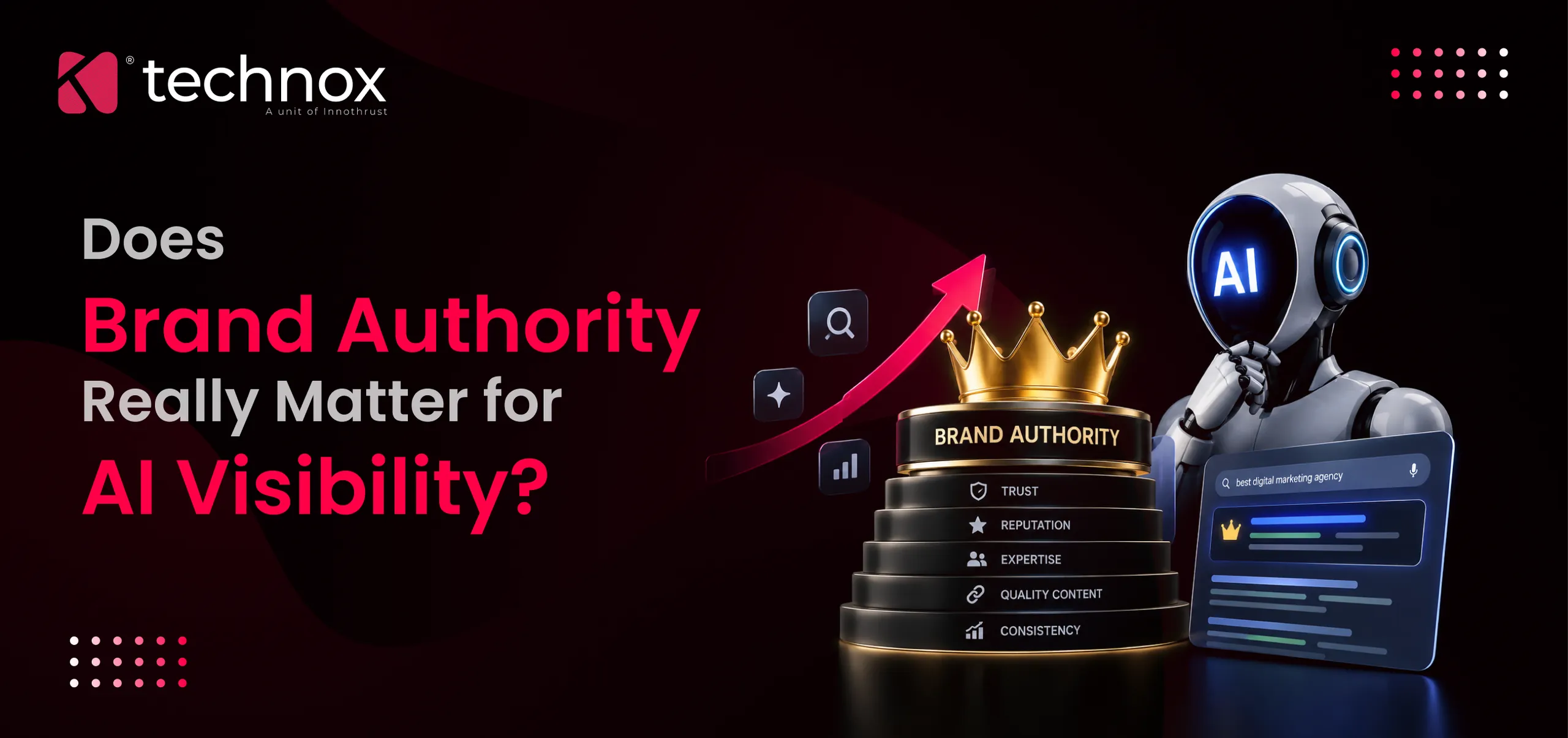
Brand authority in this context is the accumulated weight of independent, consistent mentions of your business across the web: review platforms, local directories, YouTube, industry publications, and social profiles, not just links pointing at your domain. A business can have a technically flawless website and still lose the ChatGPT recommendation because it has never built that independent footprint.
The Data: What Actually Predicts Which Brand Gets Recommended
Ahrefs analyzed 75,000 brands with a Domain Rating above 40 to see which signals correlate most strongly with AI Overview visibility, then extended the study to ChatGPT and Google AI Mode. The results reorder two decades of SEO priorities.
Why it matters: for twenty years, the backlink was the closest thing SEO had to a trust signal. This data shows it is a poor proxy for whether ChatGPT or Google AI Overviews will mention your business instead of a competitor's. That does not make link building worthless for classic rankings. It means Domain Rating should not be mistaken for AI visibility.
Business impact: a real estate developer with 200 backlinks from low-relevance directories will likely lose the ChatGPT recommendation to a competitor with 40 mentions across property news sites, YouTube walkthroughs, and Google reviews, even though the second developer's link count looks smaller.
How to apply it: redirect a portion of your SEO and PR budget from generic link acquisition toward earning your brand name organic mentions on platforms your buyers already trust.
The scale effect compounds quickly once this gap opens. Brands in the top quartile for web mentions earn up to ten times more AI Overview citations than the next quartile down, and roughly a quarter of brands have zero mentions in AI Overviews at all. That is not a gradual curve. It is a cliff, and it explains why one competitor gets named and another, with a perfectly good website, does not.
Where AI Systems Actually Pull Their Citations From
Business owners often assume that if their own website is well optimized, an AI engine will eventually find and cite it over a competitor's. The data says the opposite is closer to true.
Why it matters: your own website is not the primary battleground for the ChatGPT recommendation. It is one input among several, and often not the most influential one. A business that pours its entire budget into on-site content while ignoring its presence on review platforms, YouTube, and industry publications is optimizing the smaller half of the equation, and handing the other half to whichever competitor built it first.
Business impact: a healthcare or wellness brand is far more likely to be cited through a well-structured Google Business Profile, patient reviews, and mentions on health directories than through blog posts alone, no matter how well those posts are written.
How to apply it: audit where your brand is mentioned outside your own domain before auditing your own content again. If a business has never been mentioned on a single third-party site in its category, that is the real reason the AI answer skipped straight to a competitor.
This does not make owned content irrelevant. It means owned content works best as the source that earned mentions link back to and confirm, not as the only place your story is told.
Consistency Across the Web Is a Ranking Factor, Not Just a Housekeeping Task
This is the part most local and service businesses underestimate. NAP data, meaning your business Name, Address, and Phone number, is one of the clearest examples of a small technical detail with an outsized authority impact.
Why it matters: an AI system deciding which business to name in its answer is running the same kind of consistency check a human would. If your phone number on Google differs from the one on Facebook, and your address on a directory site is outdated, that is a legibility problem for a machine and a trust problem for a customer, at the same time. It is often the quiet reason a competitor with a cleaner footprint gets picked instead.
Business impact: a gym, clinic, or interior design studio with 15 different versions of its address scattered across old directory listings is quietly undermining every other investment in SEO and content.
How to apply it: run a NAP consistency audit across Google Business Profile, Facebook, major directories, and industry-specific listings at least once a quarter. Fix the top 15 to 25 highest-authority sources first; they carry disproportionate weight.
Trust Is the Real Currency, and It Is Getting Harder to Earn
Here is where brand authority stops being an abstract ranking factor and becomes a business survival question.
Why it matters: consumers are not blindly accepting whatever an AI assistant tells them about a brand. They are using AI to shortlist, then verifying independently before they commit. That means even getting the ChatGPT recommendation is only half the job.
Business impact: if your business shows up in an AI answer but your Google Business Profile is thin, your reviews are inconsistent, or your website contradicts what the AI said about you, you lose the sale at the verification step, not the discovery step. Brand authority is what survives that verification, and reviews specifically carry more of that weight than most businesses assume; see why e-commerce reviews matter for AI-driven product discovery for how AI systems actually weigh review volume, recency, and specificity.
How to apply it: treat every platform a prospect might check after an AI recommendation (Google Business Profile, review sites, LinkedIn, YouTube, your own site) as one connected trust surface. Inconsistent business hours or mismatched service descriptions across these surfaces actively damage conversion even when the AI recommendation itself was favorable.
Technical SEO Still Decides Whether Any of This Gets Read
None of the above works if a website cannot be crawled, understood, and indexed correctly in the first place. Brand authority and technical SEO are dependent stages of one pipeline, not competing priorities.
Structured data, implemented through Schema.org markup, is how a website tells search engines and AI crawlers explicitly what an entity is, rather than leaving them to infer it from unstructured text. A LocalBusiness schema that states your name, address, service area, and reviews in machine-readable format removes ambiguity that an AI model would otherwise have to guess at. It's worth being clear-eyed about what schema does and doesn't do here: our AEO vs. SEO breakdown covers testing that found schema alone doesn't move AI citation rates, even though it still earns richer, higher-click search results.
Core Web Vitals, Google's set of measurable page experience metrics covering loading speed, interactivity, and visual stability, still influence whether a page gets crawled efficiently and ranks well enough in traditional search to be considered a candidate for citation at all. A slow, poorly structured site does not just lose rankings. It loses crawl budget, the finite number of pages a search engine will bother to crawl and re-crawl, needed to keep an AI system's understanding of the business current.
The dependency chain looks like this: technical SEO earns the crawl and the index entry, structured data earns correct machine interpretation, and off-site brand mentions earn the citation. Skip any one link and the others cannot compensate for it.
What This Looks Like Across Different Types of Businesses
The common thread: none of these businesses can buy their way into this kind of authority the way they could once buy backlinks. It has to be earned through real coverage, real reviews, and real video presence, which is exactly why it becomes a durable moat once built. It's exactly why "why did ChatGPT pick them and not me" so often comes down to who built that moat first.
Measuring Whether Your Brand Authority Is Actually Working
Traditional SEO reporting (rankings and organic traffic) does not capture whether an AI engine is citing or recommending your brand over a competitor's. Track these instead.
A business that only tracks keyword rankings will have no early warning if a competitor overtakes it in AI-generated answers while organic rankings stay flat.
The Trends Worth Preparing For
Search Everywhere Optimization, the practice of maintaining brand presence across every surface a buyer might use to research a decision rather than Google alone, is replacing single-channel SEO thinking as the operating model for 2026 and beyond. Businesses that treat their Google Business Profile, YouTube channel, review platforms, and website as one coordinated entity, rather than separate departments with separate owners, are the ones showing up consistently across ChatGPT, Gemini, and traditional search at the same time, while their competitors keep asking why they were left out.
Monitoring for AI misrepresentation is also becoming a standing responsibility rather than a one-time check, given how many brands report being described inaccurately by AI systems. When that happens, the fix generally starts at the source content the AI drew from, correcting outdated information on your own site and third-party listings, rather than trying to argue with the AI output directly.
Where to Start If You Are Behind
Building this kind of authority is a structural project, not a single campaign. It typically starts with a technical audit to confirm the site is fully crawlable and correctly structured, since technical SEO services form the foundation everything else sits on. From there, AI search and GEO optimization work addresses entity clarity, structured data, and how the brand is described across the web.
Frequently Asked Questions
Why did ChatGPT recommend my competitor instead of my business?
Most likely because your competitor has a more independent, verifiable presence across the web (reviews, YouTube mentions, directory listings, third-party coverage), even if your website and backlink profile look stronger on paper. AI engines weigh off-site brand signals far more heavily than on-site SEO metrics when deciding who to name.
Does brand authority replace the need for traditional SEO?
No. Technical SEO and on-page optimization determine whether your site can be crawled, indexed, and understood correctly. Brand authority determines whether AI systems choose to mention you once that foundation exists. Both are required.
How is brand authority different from Domain Authority or Domain Rating?
Domain Authority and Domain Rating are link-based metrics from third-party tools that estimate ranking potential from backlink profiles. Brand authority for AI visibility is based on how consistently and credibly your business is mentioned across the web, including platforms that have nothing to do with backlinks, such as reviews, YouTube, and news coverage.
Can a new business with no backlinks build AI visibility?
Yes, and often faster than it could build traditional Domain Rating. A new business can earn AI Overview and ChatGPT visibility through a well-structured Google Business Profile, verified reviews, accurate schema markup, and third-party mentions, without waiting years for backlink accumulation.
Do backlinks matter at all for AI search?
They still matter for traditional organic rankings, which remain one input among several for AI citation eligibility. But backlinks alone are a weak predictor of AI visibility compared to branded mentions and video presence.
How long does it take to build meaningful AI visibility?
Most businesses see measurable movement in three to six months once technical foundations, structured data, and an active off-site mention strategy are in place. Categories with heavy third-party review reliance, such as healthcare and hospitality, often move faster.
Why does NAP consistency matter for AI visibility, not just local rankings?
AI systems run a similar consistency check to the one Google's local algorithm runs. Conflicting business details across the web create the same ambiguity for a language model that they create for a confused customer, which lowers the confidence a model needs to cite your business over a competitor's.
Does schema markup guarantee my brand gets cited by AI?
No. Structured data makes your entity legible and reduces ambiguity, which is necessary but not sufficient. Citation still depends on whether independent sources across the web corroborate what the schema states.
Why does YouTube matter so much for AI visibility?
YouTube transcripts and video content make up a substantial share of the data language models are trained and refined on. A brand mentioned consistently across product reviews, tutorials, and testimonials on YouTube generates cross-source corroboration that AI systems weight heavily as an authority signal.
What happens if an AI engine describes my brand incorrectly?
Correct the source content first (your own site, your Google Business Profile, and any third-party listing carrying the outdated information) rather than trying to dispute the AI's output directly. Corrections propagate as sources are re-crawled and re-referenced.
Is Search Everywhere Optimization the same thing as GEO?
They overlap but are not identical. GEO focuses specifically on optimizing for citation and mention within AI-generated answers. Search Everywhere Optimization is the broader discipline of maintaining consistent, discoverable brand presence across every platform a buyer might use during research, including but not limited to AI search.