A business that shows three different phone numbers across Google, Yelp, and its own website is telling search engines it can't keep its own records straight. Google reads that confusion as a trust problem, not a formatting quirk, and it prices that risk into your local rankings. This article breaks down what NAP consistency and local citations actually do inside Google's local algorithm, what the current ranking data says about their weight, and how to fix the inconsistencies that are quietly capping your visibility.
We'll cover why Google treats citations as a trust signal, what separates a citation from a backlink, the real numbers behind how much this matters, structured versus unstructured citations, where errors usually creep in, a practical fix-it sequence, where schema markup fits, and how AI search is starting to weight this data differently than Google's classic algorithm does. This sits inside the broader discipline of search engine optimization, and specifically within local SEO, so if you need the fundamentals first, our local SEO guide covers the wider framework this article builds on.
What NAP Means and Why It Has to Match Everywhere
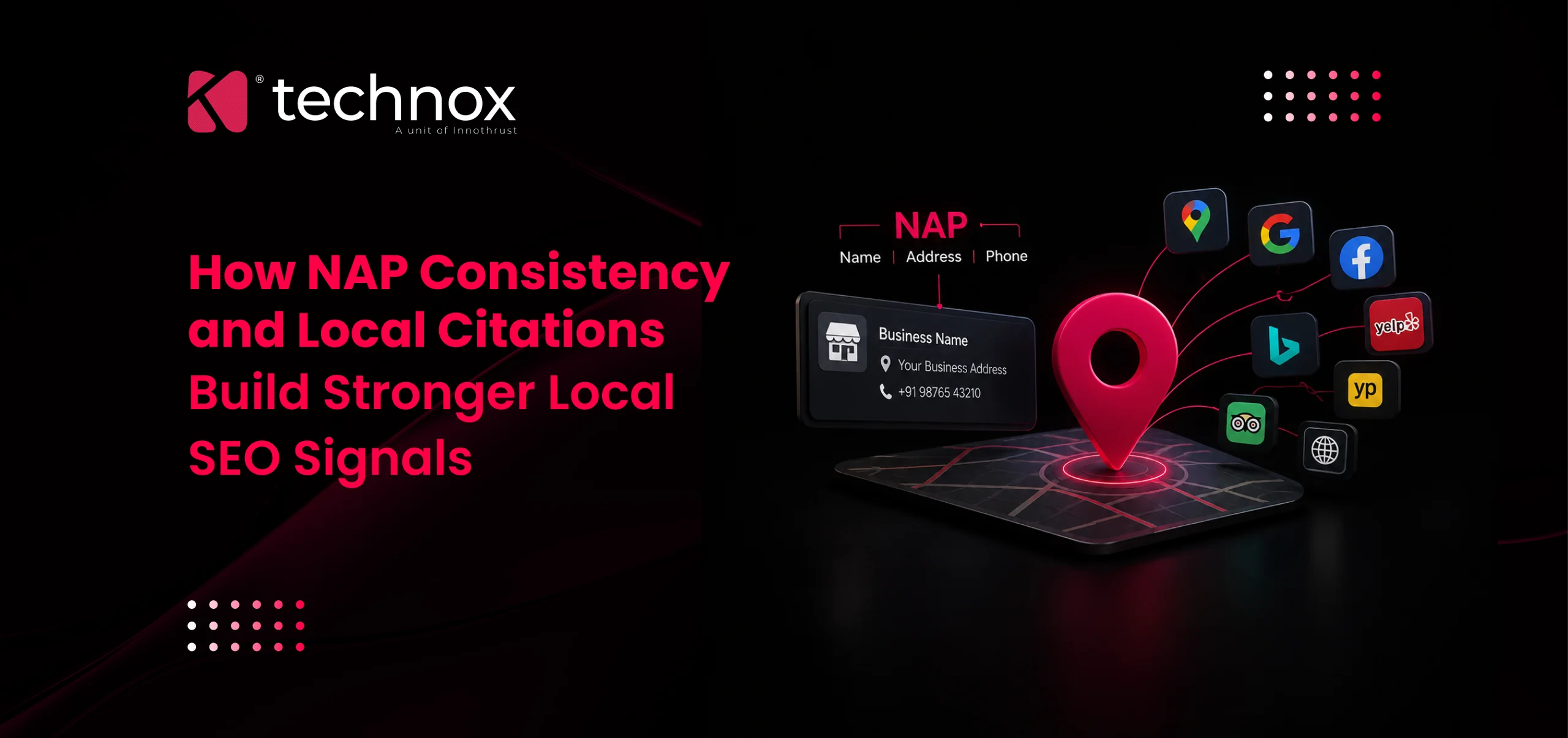
NAP stands for Name, Address, and Phone number, and NAP consistency means that information appears identically wherever your business is mentioned online. That includes your Google Business Profile, Yelp, Facebook, industry directories, your own website's footer, and any press mention that lists your contact details.
Consistency isn't really about having a "correct" format. It's about having the same format everywhere. "St." on one directory and "Street" on another, "Ltd" dropped from your legal name on a third listing, a suite number missing from a fourth. These are small mismatches individually, and they add up into a pattern Google can't fully trust.
Google's own guidance for Business Profiles is direct about this. Businesses should be represented "as it's consistently represented and recognized in the real world across signage, stationery, and other branding," with an address that is accurate and precise (Google Business Profile guidelines). That one sentence explains most of what this article is about. Google isn't grading your grammar. It's trying to confirm that a business exists, at a specific place, and can be reached, by cross-referencing every mention it can find.
Some local SEO guidance extends NAP to "NAP+W" (adding website URL) or even further to include hours and email. The core three fields still carry the most weight, since they're what every directory, aggregator, and AI assistant checks first.
Why Google Treats Citations as a Trust Signal
A local citation is any online mention of your business's Name, Address, and Phone number, whether or not that mention includes a clickable link. This is where a lot of people mix up citations with backlinks, and the distinction matters more than it sounds.
A backlink is a hyperlink from another site to yours, built specifically for referral traffic and link equity. A citation can exist entirely without a link. A chamber of commerce directory listing, a mention in a local newspaper article, or an entry on an industry association page can all function as citations even if none of them link back to your site, as long as the NAP data matches what Google already has on file.
One listing is a claim. Fifty consistent listings across reputable directories are a pattern Google can verify. That's the same logic search engines apply to backlinks: a single vote doesn't mean much on its own, but consistent signals from independent sources build confidence in what you're telling Google about your business.
Citations Feed Prominence, Not Just Relevance
Inside Google's local ranking model, citations sit mostly under the prominence pillar, alongside reviews and backlinks. Prominence measures how well known and trusted a business is, based on how often and how consistently it's referenced across the web. A business with clean, matching citations across dozens of sources looks more established to Google than one with scattered, conflicting mentions, even if both businesses are otherwise identical on paper.
What the Data Actually Shows
Most local SEO advice treats citations as either critically important or barely worth the effort, and both framings miss the nuance. The clearest source on this is the Local Search Ranking Factors survey, run by Whitespark and BrightLocal, which polls roughly 50 local SEO practitioners on what actually moves rankings. The 2026 edition, released in November 2025, is the first to separate out AI search visibility as its own category, which matters a great deal for how this topic should be read going forward.
The pattern worth noticing here: citation signals carry single-digit weight in classic ranking factor terms, but the trust and behavior data around inaccurate listings is much larger. Google may only weight citations directly at 6 to 7 percent, but the downstream effect of bad data (fewer clicks, fewer calls, higher bounce rates from confused visitors) feeds into behavioral signals that carry far more weight on their own.
Structured Citations vs Unstructured Citations
Not every citation looks the same, and treating them identically is a mistake worth avoiding.
This distinction matters more now than it did a few years back. BrightLocal's own research into how large language models handle local search found that unstructured citations, the kind that show up in editorial content and "best of" lists rather than directory fields, carry real weight in how AI systems answer local queries. The top individual AI visibility factors in the 2026 Whitespark and BrightLocal survey include "presence on expert curated best of type lists" and "quality and authority of unstructured citations," both ranked ahead of several traditional structured-citation factors.
In practice, a mention in a local journalist's roundup of "best interior designers in Coimbatore" can now do more for AI search visibility than another submission to a generic business directory, even though the directory listing is far easier to control.
There's also a middle case worth knowing about: partial citations, where the business name appears but the address or phone number is missing, or where only a phone number shows up on a page with no business name attached. These don't carry the full weight of a complete citation, but they're not worthless either, and cleaning up partial mentions into complete ones is often a quick win during an audit.
Where NAP Errors Actually Come From
Most businesses don't set out to create inconsistent listings. They accumulate them, usually without anyone noticing until a ranking dip forces an audit.
A business relocates and updates its Google Business Profile but forgets the other thirty listings. Old directory entries from years earlier keep circulating with the previous address, sometimes indefinitely, because nobody owns the task of updating them.
A new employee lists the business slightly differently. "Rspace Interiors Pvt Ltd" on one directory, "Rspace Interior Design" on another. Neither is wrong exactly, but Google now has to guess whether these are the same entity or two separate ones.
Data aggregators propagate an old error at scale. A handful of large data providers feed business information to hundreds of smaller directories automatically. If the source record is wrong, that error spreads faster than any manual fix can catch up with, sometimes reappearing months after you thought it was resolved.
Suite numbers and formatting details get dropped. "123 Main Street, Suite 4B" becomes "123 Main Street" on a form that had no field for it, and now two unrelated businesses at that address look identical to a crawler.
None of these are dramatic mistakes. That's exactly why they're common: nobody notices a two-character discrepancy until it's already cost several months of ranking stability.
A Simple Fix-It Sequence
Fixing inconsistent citations works better as a sequence than a scramble. Doing it out of order wastes effort correcting listings that will just get overwritten by an upstream error later.
Establish one source of truth first. Decide exactly how your name, address, and phone number will be written, down to abbreviations and punctuation, before touching a single listing. Write it down somewhere the whole team can see it.
Correct your Google Business Profile. This is the highest-weight listing by a wide margin, at 32% of local pack ranking weight, so it goes first, not last.
Fix the data aggregators. A small number of data providers feed hundreds of smaller directories. Correcting the source stops new errors from propagating even before the downstream listings are touched.
Audit your own website's NAP. Check your footer, contact page, and any location pages against your GBP listing character by character. This is the fix most businesses skip, despite it being one of the top 15 individual ranking factors on its own.
Work through top-tier directories. Bing Places, Apple Maps, Facebook, and major industry-specific directories relevant to your sector come next.
Re-audit on a quarterly cadence. New errors creep back in through automated data feeds, staff turnover, and third-party submissions. A one-time cleanup degrades within a year without a recheck.
Tools like BrightLocal's Citation Tracker or Whitespark's Local Citation Finder can automate the discovery step, though manual verification of your top 15 to 20 highest-authority listings is still worth the time. Automated distribution tools speed up volume but tend to introduce their own small formatting inconsistencies if left unchecked, which is worth weighing before handing the entire process to a bulk submission service.
Where Schema Markup Fits (and Where It Doesn't)
Businesses sometimes treat LocalBusiness schema markup as a substitute for citation work, and that's worth correcting directly. Schema is a way of describing your NAP data in a machine-readable format on your own website, using Google's documented structured data guidelines for local businesses (Google Search Central, LocalBusiness structured data). It helps Google parse your on-site NAP with more confidence. It does nothing for the fifty other places your business is mentioned across the web.
Think of schema as making your own website's NAP unambiguous, and citations as confirming that NAP against independent third parties. You need both. A perfectly marked-up website with inconsistent external citations still sends Google a mixed signal, because schema only speaks for the domain it's installed on. The practical rule: implement schema once your master NAP is finalized, not before, since schema built on data you're about to change just means updating it twice.
How AI Search Is Weighting Citations Differently
Search Everywhere Optimization has become a practical necessity rather than a buzzword, because a growing share of local discovery now happens inside ChatGPT Search, Perplexity, Google AI Mode, and AI Overviews rather than a traditional results page. These systems don't crawl the web the same way Google's classic index does, and they weight citation signals differently as a result.
The Whitespark and BrightLocal 2026 survey found that citations carry 13% of AI search visibility weight, roughly double their weight in classic local pack rankings, tied with link signals as the second most influential category behind on-page factors. That's a meaningful shift. It suggests businesses optimizing purely for the local pack, while ignoring their footprint of unstructured mentions and third-party recognition, are underinvesting in the channel growing fastest right now.
There's a separate concern worth flagging for multi-location or franchise businesses: independent research from SOCi's Local Visibility Index has found meaningful gaps between what AI assistants surface about a business and what's actually listed on its Google Business Profile. That's a strong argument for treating citation accuracy as an AI trust signal, not only a Google ranking factor.
A Quick Note for Multi-Location Businesses
Every additional location multiplies the number of citation points that can drift out of sync, and the most common failure mode isn't one wrong number so much as inconsistent suite formatting, duplicate listings created after ownership changes, and location pages that don't match each branch's individual GBP. This is worth handling as a coordinated system rather than location by location. For the full process, see managing a Google Business Profile across multiple locations and ranking multiple business locations in local search.
Common Mistakes That Undo Citation Work
A few recurring errors show up across almost every industry vertical, from real estate to healthcare to fitness.
Treating citation building as a one-time project instead of an ongoing maintenance task
Choosing volume over quality, submitting to dozens of low-authority directories instead of a smaller number of relevant, high-authority ones
Letting a business's GBP category drift out of alignment with what the business actually does, an active negative ranking factor per the 2026 survey (full fix in optimizing a Google Business Profile)
Creating a second GBP listing after a rebrand instead of updating the original, resulting in duplicate profiles competing against each other
Ignoring industry-specific directories in favor of generic ones, even though niche directories often carry more relevance weight for a given search
Building citations using a tracking number or landing page URL instead of the real business phone number and website, which breaks the exact match Google is looking for
What's Changing Going Forward
Three shifts are worth watching heading into the next year of local search.
Unstructured citations are gaining ground on structured ones. Editorial mentions, "best of" list placements, and unlinked brand mentions now carry meaningful weight in AI visibility scoring, which means digital PR and local media outreach are becoming legitimate local SEO tactics, not adjacent ones.
Semantic matching is replacing exact-string matching. Google's systems increasingly parse business information the way a language model would, recognizing that "St." and "Street" refer to the same thing, rather than requiring character-for-character matches. This reduces some of the historical anxiety around minor formatting differences, though it doesn't excuse genuine errors like a wrong suite number or an outdated phone line.
Review velocity is outpacing citation growth in ranking weight. Since review signals climbed from 16% to 20% of local pack weight between the 2023 and 2026 surveys, businesses that treat citations as their only local SEO lever are leaving a larger opportunity on the table.
Fixing NAP inconsistencies and building the right citations is detailed work, and it's easy to lose track of thirty or forty directories without a system. If you'd rather have this audited and managed for you, Technox Technologies runs this as part of our work as an SEO company in Coimbatore, handling the correction sequence end to end rather than leaving it to spreadsheet tracking.
Frequently Asked Questions
What is NAP consistency in SEO?
NAP consistency means a business's Name, Address, and Phone number appear identically across every online listing, directory, and mention, including the business's own website.
Why does NAP consistency matter for local rankings?
Google cross-references NAP data across multiple sources to confirm a business is legitimate and correctly located. Consistent data across sources makes a business 40% more likely to appear in the local pack, according to BrightLocal research.
What's the difference between a citation and a backlink?
A citation is any mention of your business's NAP information, and it doesn't require a clickable link to count. A backlink is a hyperlink from another site to yours. Citations can exist with or without an accompanying link.
Who needs to worry about local citations?
Any business with a physical location or a defined service area, including single-location shops, multi-location franchises, healthcare practices, and service-area businesses like contractors or agencies.
How much does citation management typically cost?
Costs vary widely. Manual audits and corrections can be done in-house for the cost of staff time, automated citation building services typically charge per listing, and fully managed local SEO services bundle citation work into broader monthly retainers.
How long does it take to fix NAP inconsistencies?
Correcting your Google Business Profile and top directories can happen within days. Data aggregator changes propagating to smaller directories can take several weeks to fully filter through, and ranking impact is usually assessed over a three to six month window.
Which tools are commonly used for citation audits?
BrightLocal's Citation Tracker, Whitespark's Local Citation Finder, and Moz Local are the most widely used tools for identifying and monitoring NAP consistency across directories.
How do you measure whether citation cleanup worked?
Track local pack keyword rankings before and after the cleanup over a three to six month period, alongside a NAP consistency score from an audit tool, aiming for 95% consistency or higher across your top citation sources.
How is AI search changing the value of citations?
AI search tools weight citation signals roughly twice as heavily as classic local pack rankings do (13% versus 6 to 7%), with unstructured mentions in editorial content and curated lists carrying particular weight.
Does schema markup replace the need for citation building?
No. Schema markup clarifies your NAP data on your own website for search engines, but it has no effect on how consistently your business is represented across third-party directories and listings.