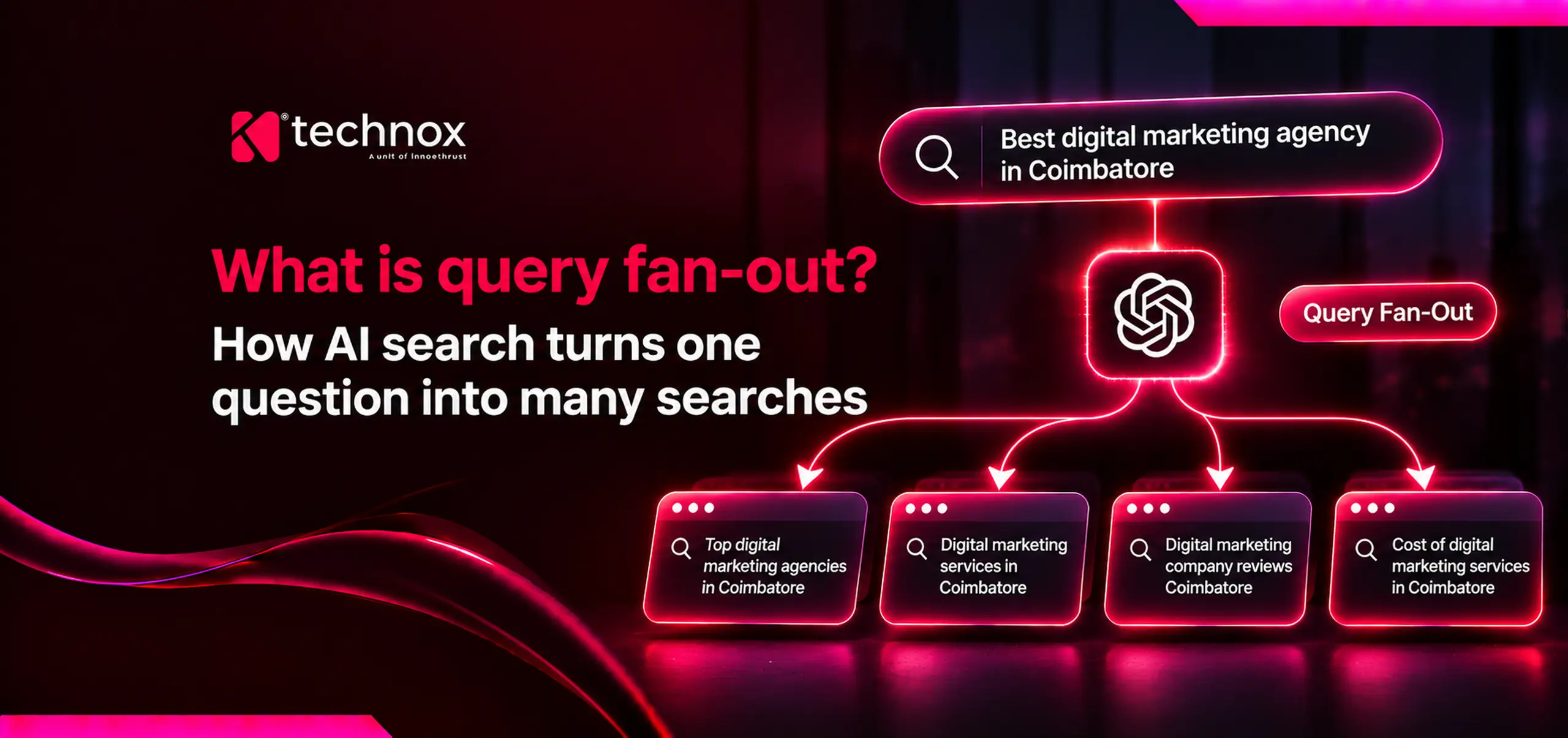
Query fan-out is the technique AI search engines use to answer a question: the AI breaks your question into smaller sub-questions, runs a search for each one at the same time, and combines what it finds into a single answer. Google describes AI Mode as "issuing multiple related searches concurrently across subtopics and multiple data sources". For a business, the important consequence is that an AI answer can cite pages that rank for searches nobody typed. Two separate studies of these hidden searches, one on Gemini and one on ChatGPT, each found that 95% of them had no measurable search volume.
Start with one question, because it decides whether fan-out helps or hurts you: does your page answer the follow-up questions a customer would ask next, or only the one in its title? Fan-out rewards the first kind.
Technox offers AI SEO services, so we have an interest in this topic. This guide uses Google's own descriptions, independent studies and the platforms' developer documentation, and says where the numbers disagree.
What query fan-out is
Google used the term when it launched AI Mode in March 2025. Its announcement said AI Mode "uses a 'query fan-out' technique, issuing multiple related searches concurrently across subtopics and multiple data sources and then brings those results together to provide an easy-to-understand response" (Google, March 2025).
At Google I/O in May 2025, Google's head of Search, Elizabeth Reid, described it as "breaking down your question into subtopics and issuing a multitude of queries simultaneously on your behalf". She added that Deep Search, a research mode inside AI Mode, "uses the same query fan-out technique but taken to the next level. It can issue hundreds of searches" (Google, May 2025).
The idea is older than the name. A Google patent application published in August 2024, "Search with stateful chat", describes a language model generating "synthetic queries" from a user's question and context, and using them to select the documents behind a generated answer (Google Patents, US 2024/0289407 A1). A patent application shows what Google has explored, not exactly how AI Mode works today.
Google is not the only one doing this. The developer documentation for OpenAI's web search tool, Perplexity's search tool and Google's Gemini API shows their models turning a question into one or more searches before answering, as covered later in this guide.
A worked example
Google's own examples show the pattern. In its May 2026 guide to generative AI features, Google used the question "how to fix a lawn full of weeds", with fan-out queries such as "best herbicides for lawns", "remove weeds without chemicals" and "how to prevent weeds in lawn" (PPC Land, May 2026). Google's March 2025 announcement used a comparison question about sleep tracking across a smart ring, a smartwatch and a tracking mat.
Here is how the same pattern might look for a local business. This is our illustration, not real AI output:
A clinic whose website has one generic "Services" page is unlikely to match most of those searches. A clinic with clear sections on back pain treatment, session prices, location and hours, plus genuine reviews, has a chance at several of them.
How many searches each engine runs
The number varies widely by engine, model and question. Most figures come from developer APIs or tracking tools rather than the consumer apps, so treat them as estimates.
Nobody outside Google has measured AI Mode's fan-out directly. The Gemini figures come from the Gemini API, which is a related system, not AI Mode itself, and they differ sharply: Seer forced search on for every prompt, while Surfer's test let the model decide.
What the research says about fan-out and citations
Four findings matter most for businesses:
Fan-out queries are long and rarely searched. Seer Interactive found 95% of Gemini 3 fan-out queries had zero monthly search volume. They averaged 6.7 words, 21.3% contained a year and 26.4% contained a brand name (Seer Interactive, November 2025). Keyword tools will not show you most of them.
They change from run to run, but stay on topic. Surfer ran prompts repeatedly through Gemini with search grounding and found only about 27% of fan-out queries repeated across runs, while about 90% fell into four or fewer topic clusters (Surfer, September 2026). Cover the topics, not an exact list of queries.
Ranking for the sub-questions is linked to AI Overview citations. In Surfer's study of 10,000 keywords, the more fan-out queries a page ranked for, the more likely it was cited in an AI Overview (Spearman correlation 0.77). Of cited pages that ranked, 51.2% ranked for the main query and at least one fan-out query, against 19.6% for the main query alone. Surfer notes this is correlation, not causation.
For ChatGPT, rankings matter less. AirOps analysed 15,000 ChatGPT prompts and found 85% of retrieved pages were never cited, and 32.9% of cited pages appeared only in Google results for a fan-out query rather than the original question (AirOps, March 2026). Grow and Convert found only 27% of sources ChatGPT cited ranked on Google's first page for its fan-out queries, and 23% on Bing (Grow and Convert, March 2026).
In plain terms: for Google's AI features, ranking for the related questions around your topic helps. For ChatGPT, being a clear, trusted source matters as much as ranking. Our engine-by-engine guide to optimising for AI search covers those differences.
How to see real fan-out queries yourself
You cannot see AI Mode's fan-out queries directly, but the developer versions of several AI engines show the searches they ran:
Gemini API. When grounding with Google Search is turned on, Google's API reference lists a webSearchQueries field described as "Web search queries for the following-up web search" (Google AI Studio API reference). Google's grounding documentation says the model "automatically generates one or multiple search queries and executes them" (Google AI Studio).
OpenAI Responses API. Responses that use the web search tool include a web_search_call item, and a search action "will usually (but not always)" include the queries that were searched (OpenAI Developers).
Perplexity Agent API. Perplexity's web search tool documentation describes a single search call running "several reformulated queries" (Perplexity docs).
These need a developer key and some basic scripting, or a tool built on them. Free "fan-out generators" such as iPullRank's Qforia ask a model to predict likely sub-queries; they are useful for brainstorming, but they are predictions, not observed searches. A practical approach for a small business: run your ten most important customer questions through one of these APIs each quarter and note which topics keep coming up.
How to optimise for query fan-out
List the follow-up questions customers actually ask. Sales calls, WhatsApp chats, reviews and Google's People Also Ask boxes are better sources than keyword tools, because most fan-out queries have no search volume.
Answer them on the main page, not on dozens of thin pages. According to DemandSphere's summary, Google's May 2026 guide says rewriting content to target every long-tail variation is unnecessary and, at scale, may run into its scaled content abuse policy; Google also confirmed its spam policies apply to generative AI responses (DemandSphere, May 2026).
Write sections that stand on their own. Each section should have a clear heading and answer one sub-question in its first sentences, so an AI engine can use it without the rest of the page. Our guide to on-page AEO shows how.
Include the specifics fan-out queries look for. Prices or price ranges, comparisons, locations, hours, the current year where relevant, and named products or brands. A quarter of the fan-out queries in Seer's study included a brand name.
Build supporting pages where a sub-topic genuinely needs depth, and link them from the main page. Our guides to topical authority and internal linking cover how to structure this.
Keep pages current. A page with last year's prices or an old address can be retrieved and still not be cited.
For local businesses, name the details. Areas served, services, opening hours and how to book, consistent with your Google Business Profile.
What not to do
Do not create a separate page for every fan-out query a tool suggests. The lists change between runs, and mass-produced pages risk Google's scaled content policy.
Do not stuff exact fan-out phrases into a page. Google's systems understand synonyms, and the GEO research behind much of this field found keyword stuffing did not help; see our comparison of SEO, AEO, GEO and LLMO.
Do not treat a fan-out tool's output as what AI Mode actually searched. Only the developer APIs show observed queries, and even those are a related system.
How to tell if it is working
Fan-out is invisible in normal analytics, so measure the outcomes: AI impressions in Search Console, citations in Bing Webmaster Tools, a monthly sample of customer questions run through the AI engines your customers use, and AI referral visits in Google Analytics 4. Our guide on how to measure AI visibility sets this up step by step.
Where Technox fits
You can apply most of this yourself by listing your customers' real questions and making sure your main pages answer them clearly. Where we help is collecting real fan-out queries for your topics through the developer APIs, mapping them against your pages, and rewriting or restructuring pages so they cover the sub-questions without creating thin content.
Ask for a free audit or contact us. Our AI SEO services in Coimbatore page explains how we work.
Frequently asked questions
What is query fan-out in AI search?
Query fan-out is when an AI search engine breaks one question into several related sub-questions, runs searches for them at the same time, and combines the results into one answer. Google used the term when it launched AI Mode in March 2025, and OpenAI's and Perplexity's search tools also turn questions into multiple searches.
Does Google use query fan-out in AI Overviews?
Google has confirmed fan-out for AI Mode and Deep Search, and its May 2026 guide to generative AI features describes fan-out as part of how those features find content. Google does not publish exactly when AI Overviews use it.
How many searches does query fan-out run?
It varies. One study using the Gemini 3 API with search forced on found 10.7 fan-out queries per prompt on average, while another Gemini test found usually two to four. Studies put ChatGPT at about two and Perplexity at about 1.4. Google says Deep Search can issue hundreds of searches.
Is there a query fan-out tool?
Yes, two kinds. Developer APIs from Google, OpenAI and Perplexity can show the searches their models actually ran. Free generators such as iPullRank's Qforia predict likely fan-out queries, which is useful for brainstorming but is not observed data.
Should I create a page for each fan-out query?
No. Fan-out queries change between runs, most have no search volume, and Google has warned that rewriting content for every long-tail variation is unnecessary and may run into its scaled content abuse policy. Cover the sub-questions on your main pages, with supporting pages only where a topic needs depth.
How do I optimise for query fan-out?
Answer the follow-up questions customers actually ask, in self-contained sections with clear headings, include specifics such as prices, locations and comparisons, link related pages together, and keep the information current.