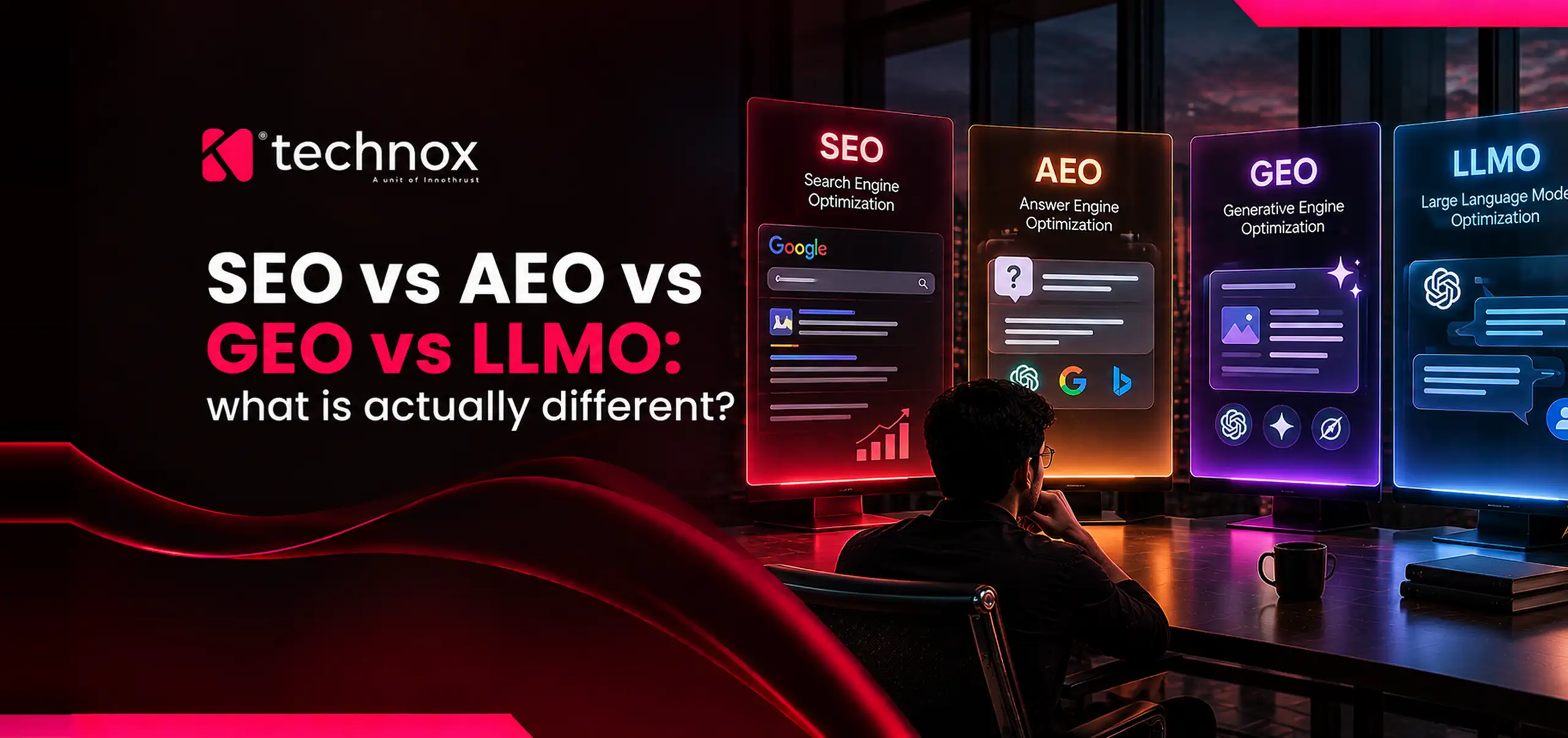
SEO, AEO, GEO and LLMO are four names for overlapping work, not four separate services. SEO (search engine optimisation) earns rankings and clicks in search results. AEO (answer engine optimisation) aims to make your content the direct answer, a term from the featured snippet and voice search era. GEO (generative engine optimisation) aims to get your business cited or mentioned in AI-written answers from tools such as ChatGPT, Perplexity, Gemini and Google's AI Overviews. LLMO (large language model optimisation) is, in most usage, another name for GEO. Google's position is that all of it is still SEO. That is mostly right for Google's own AI features. The real differences are in what you measure, which platforms you check, and how much work you do on sources outside your own website. Start with one question, because it settles most of the confusion: does your agency's proposal list different tasks for each acronym, or the same tasks under four names? If the tasks are the same, you are paying for vocabulary. Technox sells SEO and AI SEO services, so we have an interest in how these terms are used. This post compares the four labels. For the wider picture of how AI search works and what earns citations, read our guide to what AI SEO is. Each term describes the same goal, being found when someone looks for what you offer, from a different angle. You will also see AIO (AI optimisation), GSO (generative search optimisation) and LLM SEO. Wikipedia's article on generative engine optimisation lists AEO, LLMO, AIO and AI SEO as other terms for the same concept, and notes that no consensus definition separating them had been established in academic literature as of early 2026 (Wikipedia). The terms arrived years apart, which explains why their meanings overlap. SEO is the oldest. It grew up with web search engines in the 1990s and is still the base the other three build on. AEO comes from the voice search era. A Search Engine Watch article written around 2018, about voice search, says the strategy "has come to be known as AEO, or 'answer engine optimization'" (Search Engine Watch). Jason Barnard of Kalicube says he coined the term; Kalicube's own page gives both 2017 and 2018 as the year. That is why some guides still define AEO as featured snippets and voice answers, while others now use it for AI answers. GEO has a clear origin: a research paper titled "GEO: Generative Engine Optimization", first posted on 16 November 2023 by researchers from Princeton University and IIT Delhi, among others (arXiv). The first author, Pranjal Aggarwal, was at IIT Delhi. The paper was published at KDD 2024, a major data science conference held in Barcelona in August 2024 (Princeton University). The paper is worth knowing because much GEO advice traces back to it: The researchers built GEO-bench, a benchmark of 10,000 queries, and tested ways of rewriting web pages to see which made generative engines show them more. They reported that GEO methods could boost visibility in generative engine responses by up to 40%. Citing sources, adding quotations and adding statistics were the top-performing methods. Keyword stuffing, a classic SEO habit, showed little or no improvement, and on Perplexity it performed 10% worse than the unchanged page. Sites ranked lower in search results benefited significantly more. Citing sources raised visibility by 115.1% for websites ranked fifth in search results, while the top-ranked site's visibility fell by 30.3% on average (arXiv, version 1). That last finding is the strongest argument that GEO is more than SEO: in the paper's experiments, a page did not need to rank first to be used. LLMO has no documented origin that we could find, and no standards body defines it. It appears mostly in agency and tool vendor glossaries, usually as a synonym for GEO, and occasionally as an offshoot focused on how language models read content. Read five comparison posts and you will get at least three definitions of AEO. When we reviewed pages ranking for these terms in October 2026, we found AEO defined as featured snippets and voice answers on some, as AI summaries on others, and as specific tools like Perplexity and Copilot on one. GEO covered all AI answers on most pages but only Google AI Overviews on another. LLMO was a synonym of GEO, an offshoot of it, or a separate discipline, depending on the page. None of these definitions is official. The useful question is not which definition is right, but what work and what measurement a provider attaches to the label. The platforms themselves play down the differences. Google. Danny Sullivan, now a director within Google Search and formerly its search liaison, told the WordCamp US audience in August 2025: "Good SEO is good GEO, or AEO, AIO, LLM SEO, or LMNOPO. So, they're all fine." (Search Engine Land). In June 2026, Brendon Kraham, a Google vice president, wrote "Don't worry about all the new names. Good GEO, AEO, LLM SEO is good SEO" and said Google's generative AI features "are rooted in the same core ranking and quality systems as traditional Search" (Think with Google, June 2026). Google's own guide to generative AI features, published in May 2026, states that optimising for generative AI search "is optimizing for the search experience, and thus still SEO", as quoted by Search Engine Journal. According to the same summary, the guide also says you do not need llms.txt files, content chunking, special schema markup or AI-specific writing to appear in those features, and that seeking inauthentic mentions "isn't as helpful as it might seem" (Search Engine Journal, May 2026). Google's John Mueller was blunter in August 2025: "The higher the urgency, and the stronger the push of new acronyms, the more likely they're just making spam and scamming." (Search Engine Roundtable, August 2025). Microsoft. Bing's Krishna Madhavan wrote in October 2025: "Whether you call it GEO, AIO, or SEO, one thing hasn't changed: visibility is everything." He also said "Traditional SEO is still essential", and explained that assistants like Copilot break content into smaller pieces, a process called parsing, before assembling answers (Microsoft Advertising, October 2025). OpenAI. OpenAI says "Any public website can appear in ChatGPT search", provided the site does not block its OAI-SearchBot crawler. It does not publish how ChatGPT chooses which sources to cite (OpenAI Help Center). The foundations are shared: a crawlable site, pages that answer real questions, clear information about your business, and a reputation others confirm. The table shows where the work and the measurement split. The research supports this split. For Google's AI Overviews, the overlap with normal rankings is high and growing: BrightEdge found the share of AI Overview citations that also rank organically rose from 32.3% in May 2024 to 54.5% in September 2025, reaching 75.3% in healthcare but only 22.9% in e-commerce. Only 16.7% of citations came from top-10 results (BrightEdge, September 2025). Standalone AI assistants look different. University of Toronto researchers compared 1,000 ranking-style queries and found "uniformly low domain-level overlap" with Google's top 10: 4.0% for GPT-4o, 11.1% for Gemini 2.5 Flash, 12.6% for Claude 4.5 Sonnet and 15.2% for Perplexity Sonar Pro (arXiv, 2026). An earlier paper by the same team found AI search showed "a systematic and overwhelming bias towards Earned media", meaning third-party coverage, over brand-owned content (arXiv, September 2025). In plain terms: for Google's AI features, good SEO carries most of the load. For ChatGPT and other assistants, what others publish about you matters more, which is the part of GEO that genuinely goes beyond SEO. Our post on whether brand authority matters for AI visibility covers that off-site side. Practitioners mostly agree. Jeremy Moser of the agency uSERP told Digiday that "success in AI visibility is 80 percent good fundamental SEO", while Michael King of iPullRank argued that "each channel needs its own love" (Digiday, March 2026). Shaun Anderson of Hobo adds a warning for new businesses: doing only "good SEO" on a new site in isolation can leave you "invisible for months in AI Overviews" (Hobo, April 2026). Almost every business needs SEO first, then a share of AEO and GEO work that depends on how its customers search. This is how we would weight it: For local businesses, our guides to local SEO and optimising your Google Business Profile come before any AI work. For online stores, see AI SEO for ecommerce. For getting named in assistants, see how to rank on ChatGPT and Google AI Mode optimisation. India is not a side market for this. When Google brought AI Mode to India in June 2025, it named the US and India as the biggest markets for AI Overviews, where they were driving more than a 10% increase in usage for the queries that show them (Google India, June 2025). When we checked Google's autocomplete suggestions in India in October 2026, they included "full form" and "meaning" for these terms, alongside "aeo services in india", "geo agency in india" and "geo agency malaysia". Buyers are still learning the vocabulary while agencies have started selling it. Spending is moving into this area. In a Conductor survey of more than 250 enterprise executives, 94% said they planned to increase AEO and GEO investment in 2026, and AEO and GEO took an average of 12% of digital marketing budgets in 2025 (Conductor via Business Wire, January 2026). Conductor sells software in this market, so read that as direction, not proof. Where money moves, relabelled services follow. Ask any provider these questions: Which tasks in your AEO or GEO plan are not already in your SEO plan? Ask for the task list, not the label. How will you measure it? A credible answer names platforms, a prompt sample of at least 50 questions, and the data sources. Our guide on how to measure AI visibility explains what good measurement looks like. Do you guarantee a mention in ChatGPT or AI Overviews? Nobody can. OpenAI does not publish how sources are chosen, and AI answers vary from one run to the next. Is llms.txt, page chunking or special schema the main deliverable? Google says none of these is needed for its AI features. What off-site work is included? Reviews, directory listings, trade press and partner pages are where GEO adds something real. Buying or faking mentions is not; Google says inauthentic mentions are less helpful than they seem. Who writes the content? The GEO paper's best results came from adding real citations, quotations and statistics, which requires someone who knows your subject. We treat SEO, AEO and GEO as one programme with three sets of checks: rankings and clicks, answer visibility in Google, and mentions and citations across AI assistants. For most Coimbatore businesses, that means fixing the SEO foundations first, then adding answer-focused content and off-site work where customers actually use AI tools. If you want to know where you stand, ask for a free audit or contact us. Our AI SEO services page explains how we work, and our comparison of AEO vs SEO goes deeper on answer visibility. SEO is search engine optimisation, AEO is answer engine optimisation, GEO is generative engine optimisation and LLMO is large language model optimisation. All four describe ways of making a business easier to find, in search results, direct answers or AI-written answers. Mostly. Google says optimising for its generative AI features is still SEO, and its AI features are built on the same ranking systems. The genuinely new part is off-site: standalone AI assistants such as ChatGPT cite third-party sources heavily, so reviews, press and listings matter more than in classic SEO. In most usage, yes. LLMO has no official definition or documented origin, and Wikipedia lists it as another term for generative engine optimisation. A few providers describe it as an offshoot focused on how language models read content, but the work is largely the same. Not exactly. The term was in use by around 2018 for voice search answers, and many guides still tie it to featured snippets. Today many people also use it for AI answers such as Google's AI Overviews, which is why definitions differ between guides. No. You need one strategy with separate measurement. Build on SEO foundations, write clear answers to customer questions, and add off-site work that gets your business named on sources AI tools trust. Then check each platform separately. Not for Google. Google's guide to generative AI features says llms.txt files, content chunking and special schema are not needed to appear in AI Overviews or AI Mode. Start with local SEO and a complete Google Business Profile, which drive how you appear in Google's local results. Then add clear answers to the questions customers ask and get listed on trusted local and industry sites that AI assistants can cite. Use a fixed set of at least 50 customer questions, run them on the AI platforms your customers use every month, and record mentions, citations and accuracy. Add AI referral visits from Google Analytics 4 and citation data from Bing Webmaster Tools.The four terms at a glance
Where each term came from
Why online definitions contradict each other
What Google, Microsoft and OpenAI say
What actually differs in practice
Which one does your business need?
How to tell if an agency is just renaming SEO
Where Technox fits
Frequently asked questions
What is the full form of SEO, AEO, GEO and LLMO?
Is GEO just SEO?
Is LLMO the same as GEO?
Is AEO the same as featured snippets?
Do I need separate strategies for SEO, AEO and GEO?
Do I need an llms.txt file for AI search?
Which is best for a small business in Coimbatore?
How do I measure GEO results?
SEO
HOME>
BLOGS>
SEO
SEO vs AEO vs GEO vs LLMO: what is actually different?
Read Time14 mins
AuthorTechnox Technologies Team
PublishedOct 30, 2026