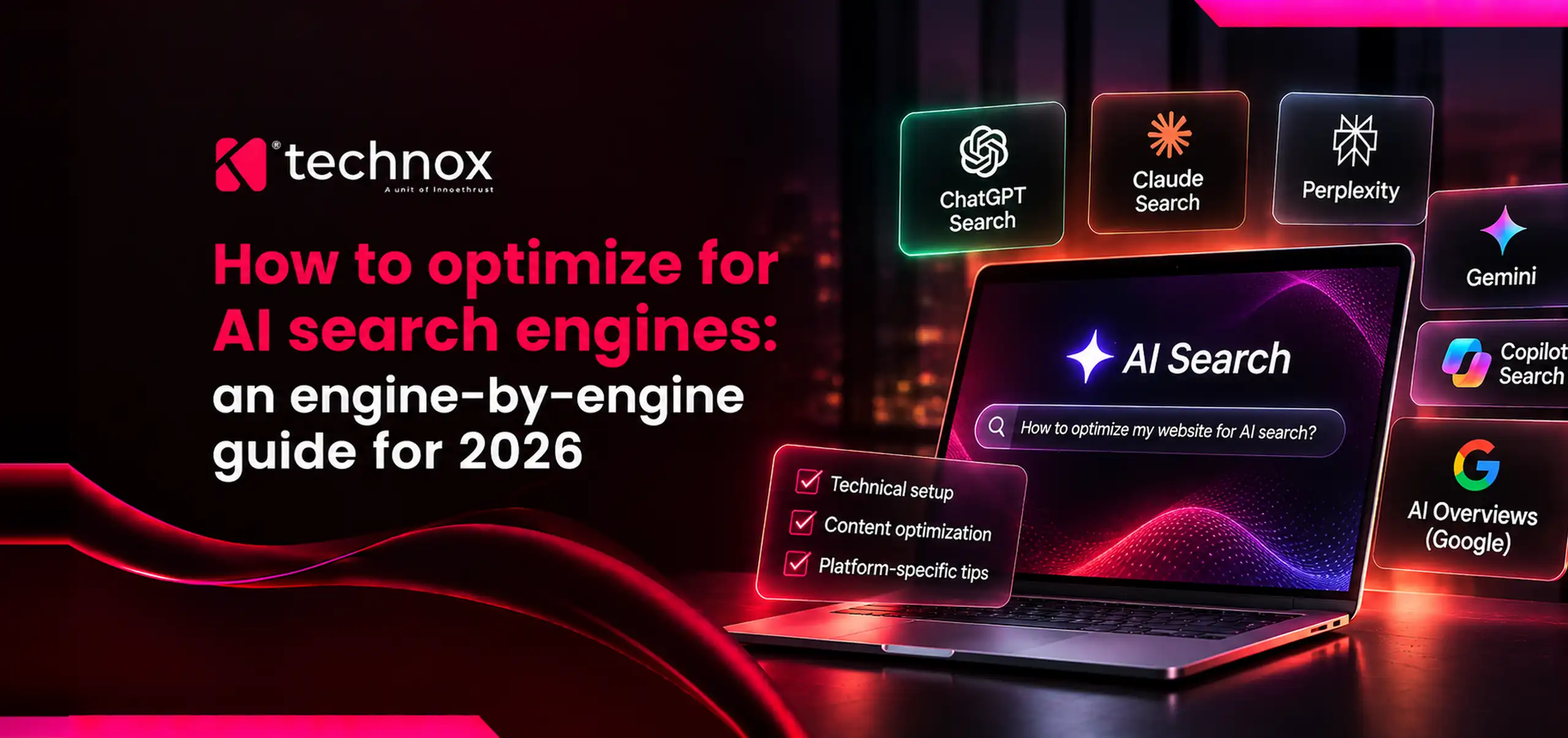
To optimize for AI search engines, make sure each engine can reach your pages through the index it actually uses, then give it content worth citing. That index differs by engine. Google's AI Overviews and AI Mode draw on Google's Search index, and Google describes grounding the Gemini app in the same index. ChatGPT search uses third-party search providers such as Bing, plus content from partners. Microsoft's Copilot Search runs inside Bing. Perplexity runs its own index of more than 200 billion URLs. Claude's web search was reported in 2025 to use Brave Search. The content that earns citations is largely the same everywhere; the access rules, controls and data are not.
Start with one question, because it covers most of the ground: is your website properly indexed in both Google and Bing? Those two indexes feed Google's AI features, Gemini, Copilot and, in part, ChatGPT. If either one is missing pages, fix that before anything AI-specific.
Technox offers AI SEO services, so we have an interest in this topic. This guide is built from each platform's own published guidance. Where a platform has said nothing, we say so.
Why one plan for "AI search" is not enough
The engines rarely cite the same sources. Writesonic compared 70,879 prompts that drew citations from ChatGPT, Gemini, Perplexity and Google AI Overviews in May and June 2026. Only 3.8% of cited sources were used by all four, and 72% to 73% of cited domains appeared on just one engine. Overlap between pairs ranged from a Jaccard similarity of 0.119 for ChatGPT and Gemini to 0.237 for Perplexity and AI Overviews (Writesonic, July 2026). Writesonic sells AI visibility software, so treat the figures as direction rather than proof.
The foundations are still shared. Google's guide to its generative AI features, published in May 2026, says they are "rooted in our core Search ranking and quality systems" and use retrieval-augmented generation and query fan-out to pick content from the Search index. It also says llms.txt files get no special treatment, special schema or Markdown versions are not required, pages do not need to be pre-chunked, and chasing inauthentic mentions is unlikely to help (Semrush summary of Google's guide, May 2026). If the acronyms around this topic are confusing, our comparison of SEO, AEO, GEO and LLMO untangles them.
The engines at a glance
How to optimize for Google AI Overviews and AI Mode
Google's AI features use the same index and ranking systems as normal search, so classic SEO carries most of the load. Google's June 2026 guidance for site owners stresses distinctive rather than generic content, clear organisation, a good page experience, and high-quality images and video (Google, June 2026).
Google also gives you controls, and they matter because they can remove you from AI answers by accident:
nosnippet "will also prevent the content from being used as a direct input for AI Overviews and AI Mode" (Google robots meta tag documentation).
max-snippet limits how much of a page can be used as a direct input for AI Overviews and AI Mode. Setting it very low on key pages limits what AI can quote.
data-nosnippet, the attribute for hiding part of a page from snippets, is not described by Google as affecting AI features.
The Search Console opt-out. Since 31 August 2026, every site can choose in Search Console whether to appear in or help ground AI Overviews, AI Mode and AI Overviews in Discover. Google says sites that opt out "will not receive traffic or impressions from our generative AI features", and the setting is not used as a ranking signal outside those features (Google, June 2026, updated August 2026).
Check that nobody on your team has switched the opt-out on or added nosnippet to important pages. For the content side, see our guides to Google AI Mode optimisation and on-page AEO.
How to optimize for the Gemini app
Google links the Gemini app to grounding in its Search index, so the Google steps above apply. The difference is one control. Google's crawler documentation says Google-Extended lets publishers manage whether content Google crawls may be used for training Gemini models and describes grounding as "providing content from the Google Search index to the model at prompt time". It also says Google-Extended "does not impact a site's inclusion in Google Search nor is it used as a ranking signal" (Google crawler documentation, updated October 2026).
In practice: blocking Google-Extended in robots.txt can reduce your presence in Gemini without touching your Google rankings or AI Overviews. Make that choice on purpose, not because a plugin added it. Gemini does not always show its sources; Google says not all responses include related links (Gemini Apps Help).
How to optimize for ChatGPT search
OpenAI says ChatGPT search "leverages third-party search providers, as well as content provided directly by our partners", and that "Any website or publisher can choose to appear in ChatGPT search" (OpenAI, October 2024). Its help centre adds that ChatGPT may share search queries with third-party search providers such as Bing (OpenAI Help Center).
Three things follow from that:
Be properly indexed in Bing. If Bing cannot find your pages, one of ChatGPT's search routes cannot either. Our guide on how to rank on ChatGPT covers the Bing connection in detail.
Allow OAI-SearchBot. This is OpenAI's crawler for ChatGPT search, and blocking it keeps your content out of ChatGPT's search summaries and snippets. Our post on technical SEO for AI search visibility covers the robots.txt rules.
If you sell products, look at product feeds. OpenAI's commerce documentation says merchants share a regularly refreshed CSV or JSON feed so ChatGPT can surface their products accurately in search and shopping, and that recommended attributes such as rich media and reviews "improve ranking, relevance, and user trust". Instant Checkout is limited to approved partners (OpenAI Developers). Our post on AI SEO for ecommerce covers product data more broadly.
We found no OpenAI statement on whether sitemaps or IndexNow affect ChatGPT directly, so treat any claim that they do as unverified.
How to optimize for Microsoft Copilot and Bing
Microsoft says Copilot Search in Bing, launched in April 2025, blends traditional and generative search, and it gives access to the sources it uses (Search Engine Roundtable, April 2025). Bing has published practical guidance for AI search:
Sitemaps and lastmod. Bing calls sitemaps a "foundational signal" for making sure URLs are covered in AI-powered search such as Copilot. The lastmod date should reflect when the content actually changed; Bing ignores the changefreq and priority tags. It recommends pairing sitemaps with IndexNow for real-time URL submission (Bing Webmaster Blog, July 2025).
Duplicates. Bing says "Many LLMs rely on data grounded in the Bing index", and that AI systems group near-duplicate URLs and choose one to represent the group, which may not be the page you want. Its fixes: canonical tags, 301 redirects, meaningfully different regional pages with hreflang, and IndexNow when you consolidate pages (Bing Webmaster Blog, December 2025).
data-nosnippet. Bing supports this attribute: marked text stays out of Bing snippets and AI-generated answers but remains indexed and available for ranking (Bing Webmaster Blog, October 2025).
The duplicate point matters for businesses with near-identical service or city pages, such as one page per Coimbatore locality with the same text. Make each page genuinely different or consolidate them.
How to optimize for Perplexity
Perplexity runs its own search index. Its research team says the index "tracks over 200 billion unique URLs", that a model decides whether to index a URL partly from its likely update frequency, that pages are split into "self-contained spans" which are retrieved and ranked individually, and that early filters remove "clearly non-responsive or stale content". PerplexityBot "complies with explicit limits set forth in robots.txt files" (Perplexity Research, September 2025).
That points to three habits:
Allow PerplexityBot in robots.txt.
Write sections that make sense on their own, with a clear heading and a direct answer in the first sentences, because Perplexity ranks parts of pages, not just pages.
Keep important pages genuinely current. Updating the date without changing the content is not the same thing.
Perplexity has not published an optimisation guide for site owners. Its Publishers' Program, launched in July 2024, shares revenue with partner publishers when answers reference their content; its launch partners were mainly news and media brands (Perplexity, July 2024).
How to optimize for Claude
Claude's web search was reported in March 2025 to use Brave Search: Anthropic added Brave Search to its list of subprocessors, and Claude's search results matched Brave's for the same query (Simon Willison, March 2025). We could not find a 2026 confirmation, so check before relying on it.
What you can do: search for your business and key services on Brave Search to see whether your pages appear, and allow Claude-SearchBot, the crawler Anthropic uses to index pages for search quality. Our guide on how to measure AI visibility lists Anthropic's crawlers and what each does.
What works on every engine
Five habits carry across all six engines:
Keep important pages up to date. Seer Interactive found that 75% of pages cited by ChatGPT, Gemini and Perplexity for four brands had been updated within the past year, and 88% within two years. The study is observational and small, and measures last update rather than publication date (Seer Interactive, July 2026).
Write sections that stand on their own. Google says you do not need to chop pages into fragments, and Perplexity ranks self-contained spans. Both are served by clear headings with a direct answer underneath.
Be distinctive. Original information, real prices, local detail and first-hand experience give an engine a reason to choose your page over a generic one.
Make your business easy to identify. Consistent name, address, services and profiles across the web help every engine connect mentions to you. Our post on entity SEO explains how.
Earn mentions on sources others trust. Reviews, directories, trade press and partner pages matter most for engines that rely less on Google's rankings. See whether brand authority matters for AI visibility.
And two things to skip: making llms.txt or special AI markup your main project, and buying or faking mentions. Google has said its AI features do not require the first and that the second is unlikely to help.
A crawler checklist for AI search
Training crawlers such as GPTBot and ClaudeBot are a separate decision: blocking them affects whether your content can be used to train future models, not whether these search features can find you. Check that your key pages are indexed in Google Search Console and Bing Webmaster Tools. Review robots.txt and your SEO plugin settings for blocked AI search crawlers, nosnippet tags and the Search Console AI opt-out. Submit an accurate sitemap with real lastmod dates, and turn on IndexNow if your platform supports it. Merge or rewrite near-duplicate locality pages. Rewrite your main service pages so each section answers one question directly, with your own details. Keep your Google Business Profile, directory listings and reviews consistent and current. Measure each engine separately, using our AI visibility measurement guide, and repeat monthly. For a fuller list, use our SEO and AI visibility checklist. Most of this is work you can do yourself with Search Console, Bing Webmaster Tools and a careful look at robots.txt. Where it gets harder is diagnosing why one engine cites competitors and not you, fixing duplicate and technical problems across a large site, and earning mentions on sources the engines trust. If you want help, ask for a free audit or contact us. Our AI SEO services in Coimbatore page explains how we work. Make sure each engine can reach your pages through the index it uses: Google for AI Overviews, AI Mode and Gemini; Bing for Copilot and partly for ChatGPT; Perplexity's own index; and Brave Search for Claude, as reported. Then publish distinctive, up-to-date content with sections that answer questions directly. Get indexed in Bing, allow OpenAI's OAI-SearchBot crawler in robots.txt, and publish clear, specific pages. OpenAI says ChatGPT search uses third-party search providers such as Bing plus partner content. Online stores can also share a product feed through OpenAI's commerce program. Get your pages indexed and eligible for snippets, publish distinctive content with clear organisation, and check that you have not used nosnippet or a very low max-snippet on key pages, or opted out of AI features in Search Console. Google says its AI features use its core ranking and quality systems. Allow PerplexityBot, keep important pages genuinely updated, and write sections that make sense on their own. Perplexity runs its own index of more than 200 billion URLs and ranks self-contained parts of pages. No. Google says Google-Extended does not affect inclusion or ranking in Google Search. It controls use of your content for Gemini training and grounding. AI Overviews and AI Mode are controlled by snippet rules and the Search Console opt-out. Not for Google. Google's guide to its generative AI features says llms.txt files are treated like any other text file. We found no statement from the other engines in this guide that they use llms.txt for search. Be easy to identify and easy to cite: consistent business details across the web, genuine reviews, listings on trusted directories and trade sites, and pages with specific, original information. Engines that rely less on Google's rankings lean more heavily on what others publish about you.What to do first if you run a business in Coimbatore
Where Technox fits
Frequently asked questions
How do I optimize my website for AI search engines?
How do I optimize my website for ChatGPT search?
How do I get cited in Google AI Overviews?
How do I optimize for Perplexity?
Does blocking Google-Extended remove me from AI Overviews?
Do I need an llms.txt file to appear in AI search?
How do I get my brand mentioned by AI?