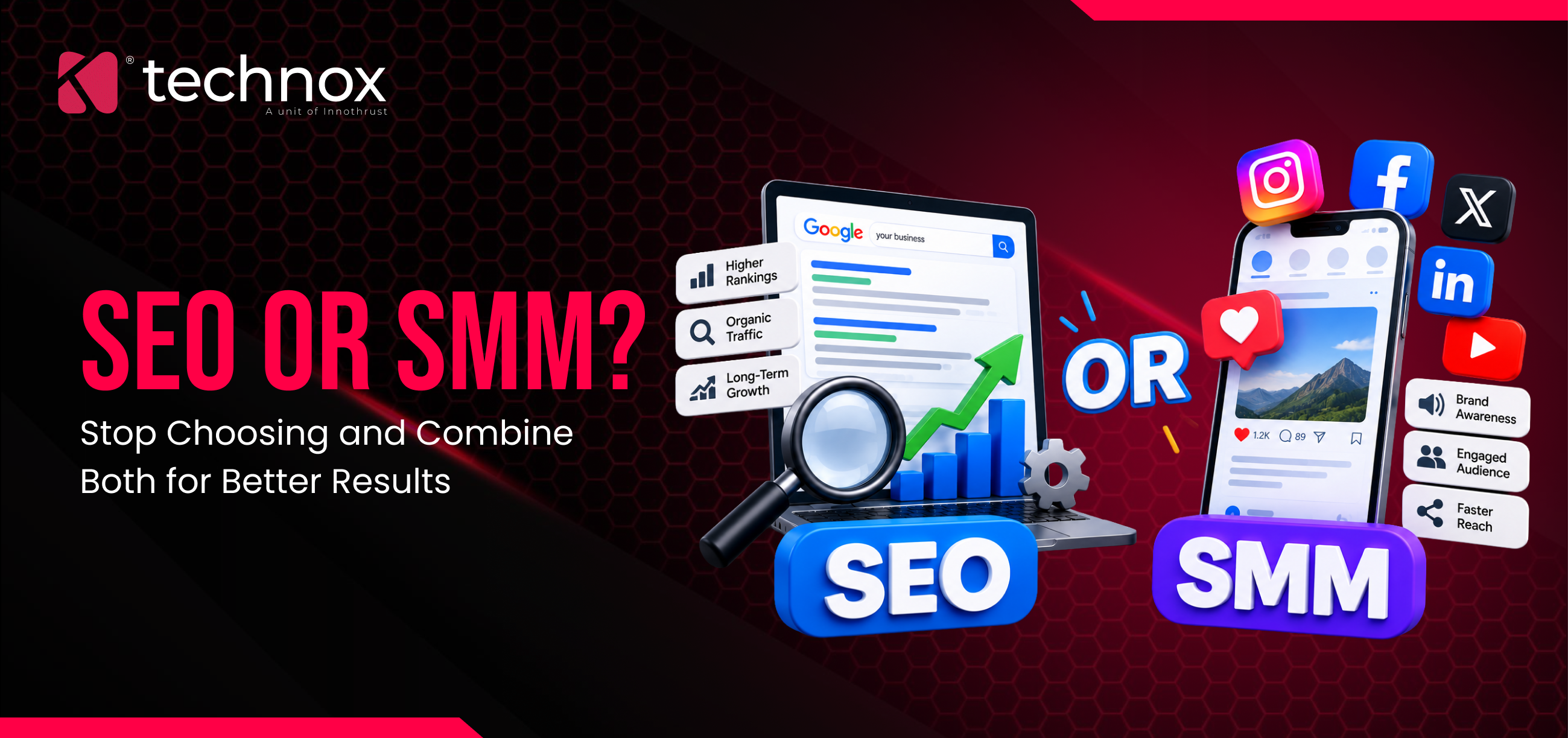
The Real Question Isn't SEO vs SMM
Most business owners frame this as a budget decision. Do we put next quarter's marketing spend into SEO or into social media marketing?
It sounds like a reasonable question. It is also the wrong one.
SEO and SMM solve two different problems at two different points in a customer's decision.
The SEO Moment
SEO shows up when someone already knows what they want and types it into Google. A person searching "best interior designers in Coimbatore" already has search intent. For businesses competing in location-based searches, local SEO determines how that visibility works in a specific market. SEO is what gets your website in front of them.
The SMM Moment
SMM shows up before that moment. Someone does not yet know your business exists, but they're scrolling, watching, or reading something that puts you in front of them anyway.
A person scrolling Instagram who has never thought about renovating their living room stops on a reel of a striking before-and-after transformation. There's no search intent yet. SMM is what creates that intent. Weeks later, that same person searches for the brand by name, and SEO closes the loop.
Why the Gap Matters
SEO captures demand that already exists. SMM creates demand that did not exist yet.
A business that only does one is either missing the people who are not searching yet, or missing the people who are searching right now. Neither gap is small.
What SEO Actually Does for Your Business
SEO actually does more than place a business on Google. Search Engine Optimization structures a website, its content, and its technical foundation so that search engines can find it, understand it, and rank it for relevant queries.
The Three Layers of SEO
1. Technical SEO: site speed, crawlability, mobile usability, structured data
2. On-page SEO: content quality, keyword relevance, internal linking, search intent match
3. Off-page SEO: backlinks, brand authority, mentions from credible sources
Why SEO Compounds
A blog post or service page that ranks well keeps generating traffic and leads for months or years after it's published, without ongoing ad spend.
BrightEdge's traffic-channel research has tracked this consistently for over a decade. Its figures put organic search's share of trackable website traffic well ahead of social referrals, even as social platforms have grown their own on-platform search behavior.
The Tradeoff: Time
SEO rarely produces results in the first few weeks. A new page needs to be indexed, evaluated against competing content, and given time to accumulate the engagement and link signals that push it up the rankings.
For a business that needs leads this month, SEO alone is usually too slow to be the only plan. That is where the distinction between SEO and Google Ads becomes useful: one builds organic visibility over time, while the other buys immediate placement.
What SMM Actually Does for Your Business
Social Media Marketing uses platforms like Instagram, Facebook, LinkedIn, YouTube, and short-form video apps to build awareness, demonstrate expertise, and create direct engagement, whether or not that audience is actively looking for a solution.
Where SEO waits for a search, SMM interrupts a scroll.
Speed and Reach
A campaign or a single piece of content can go live within a day and start generating visibility immediately. This makes SMM the better lever for launches, seasonal promotions, hiring drives, or simply staying visible between purchase cycles.
Two-Way Interaction
Comments, shares, direct messages, and community discussion happen naturally on social platforms in a way a static webpage cannot replicate.
The Tradeoff: Shelf Life
Social content has a short shelf life. A post that performs well today is largely invisible a week later unless it's paid to stay visible. The awareness SMM builds needs a consistent, ongoing publishing cadence, not a one-time push.
Does Social Media Really Affect Your Google Rankings?
This is one of the most searched and most misunderstood questions in this space, so it deserves a direct answer.
The Direct Answer: No
Google's own spokespeople, including John Mueller and Gary Illyes, have repeatedly stated over more than a decade that likes, shares, follower counts, and comments play no direct role in how Google ranks a page. Ahrefs documents this in detail, tracing the public record back to Matt Cutts's original comments in 2010.
A post going viral on Instagram does not, by itself, push a webpage up the results page.
The Indirect Effect: Yes
Social media still matters to SEO, just not directly:
More shares → more backlinks. Widely shared content reaches people who can link to it from their own websites, and backlinks remain one of Google's strongest ranking signals.
More visibility → more branded search. People who see a brand on social media later search for that brand name directly, which search engines treat as a trust signal.
More reach → faster indexing. Content discovered through social sharing tends to get crawled and indexed sooner.
Social signals themselves don't move rankings. But everything social media generates around those signals absolutely does. Treating SMM purely as a vanity metrics channel misses where its real SEO value sits.
Where SEO and SMM Have Become the Same Game
This is the part most SEO vs SMM comparisons miss entirely, and it's why this decision matters more in 2026 than it did five years ago.
Search Has Changed Shape
Google's AI Overviews and AI Mode now answer a large share of queries directly on the results page, often without a click to any website. SparkToro's June 2026 study with Similarweb found that 68% of US Google searches now end without a click to anywhere, up sharply from around 60% just two years earlier.
ChatGPT Search, Perplexity, Gemini, and Copilot add an entirely new discovery layer on top of this. They don't rank ten blue links. They synthesize an answer and choose which sources to cite based on how clearly a brand's information is structured, how consistently it shows up across the web, and how much authority it has on the topic.
What This Means for Visibility
Citation-tracking research from firms like Peec AI and Profound, synthesized across hundreds of millions of AI citations, consistently finds that community platforms and social networks, particularly Reddit, and increasingly LinkedIn, make up a large and growing share of the sources these systems cite.
A brand that shows up consistently in forum discussions, LinkedIn posts, YouTube videos, and Reddit threads is building entity authority: the pattern recognition an AI system uses to decide a brand is trustworthy and real.
Where the Lanes Merge
A well-optimized website gives AI systems something structured and accurate to pull from.
A consistent social media presence gives those same systems corroborating evidence that the brand is active and credible outside its own website.
Neither alone builds that pattern. Together, they do. This combined approach is sometimes called Search Everywhere Optimization, and the AI SEO discipline built around it is quickly becoming a baseline expectation, not a trend.
A Simple Framework: How Much of Each Do You Actually Need
There's no universal split that works for every business. The right allocation follows how your customers actually behave.
Lean SEO-First
If your customers already know what they're looking for when they start searching (a plumber during a leak, software with a specific feature, a product with a known name). High-intent search traffic converts faster. SMM plays a supporting role by building trust once the prospect has already found you.
Lean SMM-First
If your customers don't know they need your product until they see it (a home décor brand, a new app category, a service most people have never considered). Awareness has to exist before search intent can form. SEO then captures the branded searches that follow.
Run Both in Parallel
If you're in a competitive, considered-purchase category (interior design, real estate, higher-ticket B2B services). Buyers here research across multiple touchpoints before deciding: a website, then a portfolio on Instagram, then reviews, sometimes in the same afternoon. Missing either channel means missing part of that validation loop.
The Gut Check
If a stranger heard your business name for the first time right now, could they find consistent, credible information about you on Google and see an active, relevant presence on the social platform their audience actually uses?
If the answer to either half is no, that's the gap to close first. A free audit is a fast way to find out where that gap actually is.
Five Ways SEO and SMM Compound Each Other
Repurpose long-form SEO content into social formats. A detailed guide built for search intent can become a carousel, a short video script, or a LinkedIn post, extending its reach without duplicating the research effort.
Use social engagement data to inform SEO topics. The questions your audience asks in comments and DMs are often the exact long-tail queries they later type into Google. This is free, real-time keyword research.
Drive social traffic to conversion-ready pages, not just the homepage. Linking a campaign to a specific, optimized landing page lets that traffic contribute to both immediate conversions and the page's long-term SEO signals.
Keep brand information identical everywhere. Business name, description, and contact details should match exactly across the website, Google Business Profile, and every social profile. Inconsistent entity information is one of the most common reasons AI systems and search engines struggle to build a confident picture of a brand.
Let case studies and client proof do double duty. A results-driven case study earns backlinks and ranks in search. The same proof, reformatted as a testimonial video or short-form post, builds trust on social platforms. One asset, two channels, no extra production cost.
Where Businesses Get This Wrong
Mistake 1: Treating Them as Separate Departments
A business running social campaigns that never link back to an SEO-optimized page is generating awareness that evaporates. A business investing heavily in SEO while ignoring social media is winning search visibility while losing the discovery layer that increasingly feeds AI search citations.
Mistake 2: Judging One Channel by the Other's Timeline
Expecting a blog post to generate leads in a week is unrealistic. Expecting a single social campaign to permanently move organic rankings is equally unrealistic. Each channel needs to be measured against what it's actually built to do.
Mistake 3: Faking Momentum
Buying followers, engagement, or backlinks is the costliest mistake. Search engines and AI systems are both increasingly good at detecting inconsistency between a brand's claimed authority and its real, verifiable activity. Manufactured signals tend to create more risk than they remove.
Metrics That Actually Prove It Is Working
Tracking both channels with the same metrics hides what each one is really doing.
SEO Metrics
Organic traffic growth
Keyword rankings for intent-matched terms
Conversion rate from organic landing pages
Backlink quality
SMM Metrics
Engagement rate relative to audience size
Follower growth among the right audience segment (not just total followers)
Click-through rate to owned website pages
Branded search volume over time
The Connection Point: Branded Search
When a business sees its own name being searched more often after a social campaign, that's measurable proof the two channels are reinforcing each other rather than working in isolation.
Bringing It Together
SEO and SMM were never competing for the same job.
SEO is the channel that shows up when someone already wants what you offer. SMM is the channel that makes someone want it in the first place. Increasingly, social presence also contributes to the wider body of information surrounding a brand across search and AI platforms.
A business that only builds one half of that loop is leaving the other half to competitors.
Technox Technologies works with businesses across Coimbatore and beyond to build SEO and social media strategies that run together rather than in parallel silos, from SEO services for businesses in Coimbatore to social media marketing built around content strategy and audience engagement.
For businesses specifically trying to show up in AI Overviews, ChatGPT, and Gemini alongside traditional Google results, the AI SEO team focuses on the entity and search visibility work described above.
Frequently Asked Questions
1. Should a new business start with SEO or SMM first?
A brand-new business with no existing search demand usually benefits from starting with SMM, since there's little for SEO to capture until people know the brand exists. Once social activity starts generating branded searches, SEO investment becomes far more effective because there's already demand to capture.
2. Is SEO or SMM cheaper for a small business?
Cost depends heavily on execution rather than the channel itself. SMM can start with a smaller upfront spend but requires ongoing, consistent content production to stay visible. SEO often needs more upfront investment in content and technical work but continues generating traffic without repeated spend once it ranks.
3. Can strong social media presence replace SEO entirely?
No. Social platforms aren't built to capture high-intent search behavior the way Google and AI search tools are, and most social content loses visibility within days without paid promotion. A brand relying only on social media misses the large share of customers who search directly for a solution.