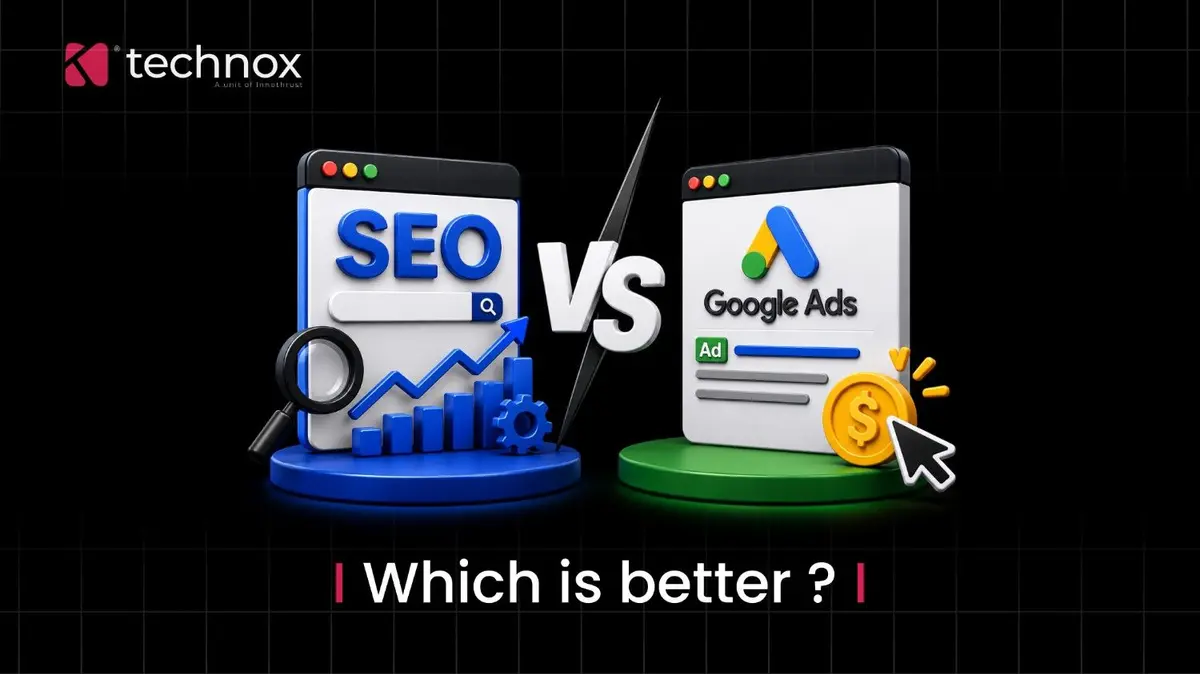
Asked as a contest, this question has no honest answer. SEO and Google Ads are not two ways of doing the same job; they are two instruments that answer different business questions, and the useful decision is how to split money between them. Search engine optimization earns unpaid positions in organic results, while Google Ads (the paid side of search engine marketing) buys placement at the top of the same page. One builds an asset, the other rents attention. What has changed recently is the ground both stand on: through 2026, paid results have been taking click share from organic across major verticals (Search Engine Land), which makes a lazy “SEO always wins” answer out of date. This page is about choosing and combining the two. How long SEO takes to work and what it costs are answered separately, in our timeline guide and the pricing breakdown.
SEO and Google Ads answer different questions, not the same one better
Google Ads answers “how do I get qualified traffic this week?” You enter an ad auction, pay per click, and appear almost immediately for the terms you choose. SEO answers “how do I stop paying for every visit?” You earn positions over months, and once earned they keep delivering without a per-click charge. Judging one by the other's strength is the root of most bad advice: criticising SEO for being slow is like criticising a building for not being a tent, and criticising ads for stopping when you stop paying is like criticising a tent for not being a building. Each is correct for a different problem. If you are new to the organic side, what is SEO cover the mechanics before you weigh the trade.
The head-to-head, on the dimensions that actually decide it
Ignore the generic pros and cons lists. These are the six dimensions that change a real budget decision.
Read the colours honestly: neither column is all green. Ads win on speed and control, SEO wins on durability and unit economics. A business that needs revenue this quarter and a business protecting its margin next year are not making the same choice.
Ads rent attention, SEO buys an asset
The deepest difference is not speed, it is what you own at the end. Every click from Google Ads is a rental: you pay, a visitor arrives, and the meter resets. That cost does not fall with time, and industry benchmarks have average search cost per click drifting upward, around the mid four-dollar mark globally and rising roughly a tenth year over year. SEO inverts the curve. The investment is heaviest at the start and the cost per acquired visit falls as pages mature, because the same ranking keeps delivering visits you no longer pay for. Somewhere in a successful campaign the two lines cross, and organic starts delivering the cheaper customer.
The test that settles it for most owners: if you switched both off tomorrow, ads would give you nothing next month, and SEO would still be working. That is the difference between renting and owning, and it is why roughly half of marketers surveyed name organic search their best-ROI channel.
Fund ads when you need speed, fund SEO when you need margin
The clearest way to decide is by situation, not by preference. If several statements in one column describe you, that is where the next rupee should go.
The 2026 wrinkle: Google is re-monetising the results page
Here is the part most comparison articles have not caught up with, and it argues against pure organic loyalty. Across 2026, analyses of major verticals found classic organic click share falling by roughly 11 to 23 percentage points year over year, while text ads gained ground in every category measured (Search Engine Land). In one consumer category tracked, classic organic share fell from about 73% to 50% of clicks while paid results climbed from 16% to 36%. The free surface of the results page is getting smaller and more contested at the same time as AI answers absorb informational queries.
Two conclusions follow, and they pull in opposite directions. First, ads are becoming harder to avoid for commercial terms, because paid occupies more of the space buyers see. Second, that makes durable organic positions more valuable, not less, precisely because they are harder to win. The right response is not to abandon either channel; it is to stop treating the split as permanent and review it as the results page keeps changing.
Compare them on cost per enquiry, not cost per click
Most channel arguments are lost at the measurement stage, before either side has made its case. Cost per click flatters ads because it is easy to read and arrives in a tidy dashboard, while organic looks free because no invoice appears for each visit. Both readings are wrong. The only fair comparison is fully loaded cost per enquiry: for ads, media spend plus management divided by the enquiries it produced; for SEO, the retainer plus content and technical investment divided by the enquiries attributed to organic. Run that calculation every month and the picture usually turns twice. Around month three SEO looks expensive, because the investment has landed but the results have not. Somewhere near the end of the first year it turns again, as the same spend spreads across a growing base of positions you are no longer paying per click for. Judge both channels on the same denominator over the same window, or you are not comparing them at all.
Your situation decides the split, not your preference
Use this as a starting allocation, then adjust with your own numbers. The percentages are a direction, not a formula.
Run together, each channel makes the other cheaper
Treating this as a choice wastes the biggest advantage, which is that the two channels feed each other. Four combinations worth running:
Let ads pick your SEO targets. Paid search data tells you within weeks which terms actually convert, so you invest months of SEO effort only in keywords already proven to produce customers. That becomes much more useful when you understand how search intent shapes the value of a query, rather than judging keywords by volume alone.
Let SEO lower your ad costs. Genuinely useful landing pages built for organic tend to improve ad relevance and landing page experience, which feeds Quality Score and can reduce what you pay per click.
Own both listings on the terms that matter. On your highest-intent commercial searches, appearing in the paid slot and the organic results takes more of the visible page than either alone.
Use ads to bridge the ramp. Run paid coverage on your money terms while organic matures, then taper spend on the terms where you have earned a strong position, and redeploy it to the ones you have not.
The fourth play is the one most businesses miss. Ads and SEO are usually budgeted as rivals in the same spreadsheet, when the smarter pattern is a planned handover: pay for the visibility you have not earned yet, and stop paying for the visibility you have.
The question changes as your business matures
“Which is better” means something different depending on where you are standing. A good answer meets you at the right stage.
If you are comparing SEO with another organic marketing channel, our guide to SEO vs SMM explains how search and social media differ in audience intent, reach, and visibility.
The questions people actually ask
Is SEO better than Google Ads?
Neither is universally better; they solve different problems. Google Ads buys immediate, precisely targeted traffic that stops when the budget stops. SEO earns durable positions that keep working without a per-click cost, but takes months to build. The right question is how to allocate between them based on your urgency, margin and time horizon.
Should a small business start with SEO or Google Ads?
It depends on the runway. If you need enquiries within weeks, start with ads and build SEO alongside. If you can invest for six to twelve months and want your cost per lead to fall over time, lead with SEO. Most businesses that can afford both run ads for speed while organic matures, then taper.
Do Google Ads improve your organic rankings?
No. Google is explicit that advertising with Google has no effect on your presence in organic search results. Paying for ads does not buy rankings. Ads do help SEO indirectly, though, by revealing within weeks which keywords convert, so your organic effort targets terms already proven to produce customers.
Is it cheaper to run SEO or Google Ads?
Their cost structures differ rather than one simply being cheaper. Ads carry a permanent cost for every click, which tends to rise as competition increases. SEO front-loads the investment and the cost per acquired visit falls as pages mature. Over a long enough horizon organic usually wins on unit economics; over a single month, ads are the only one that can deliver.
Stop picking sides, start allocating
The businesses that get this right rarely have a favourite channel. They know what each one is for, they fund ads where speed and control matter, they fund SEO where durability and margin matter, and they let the two feed each other. Google itself keeps the line clean between them: advertising has no effect on your presence in organic results (Google Search Central), so you are genuinely running two separate systems and can size each on its own merits. Set the split by your situation, review it as the results page shifts, and treat any agency that insists one channel is always the answer with the skepticism it deserves.
Want the split worked out against your actual margins and market? See our full SEO services and start with an audit that shows what you could stop paying for.