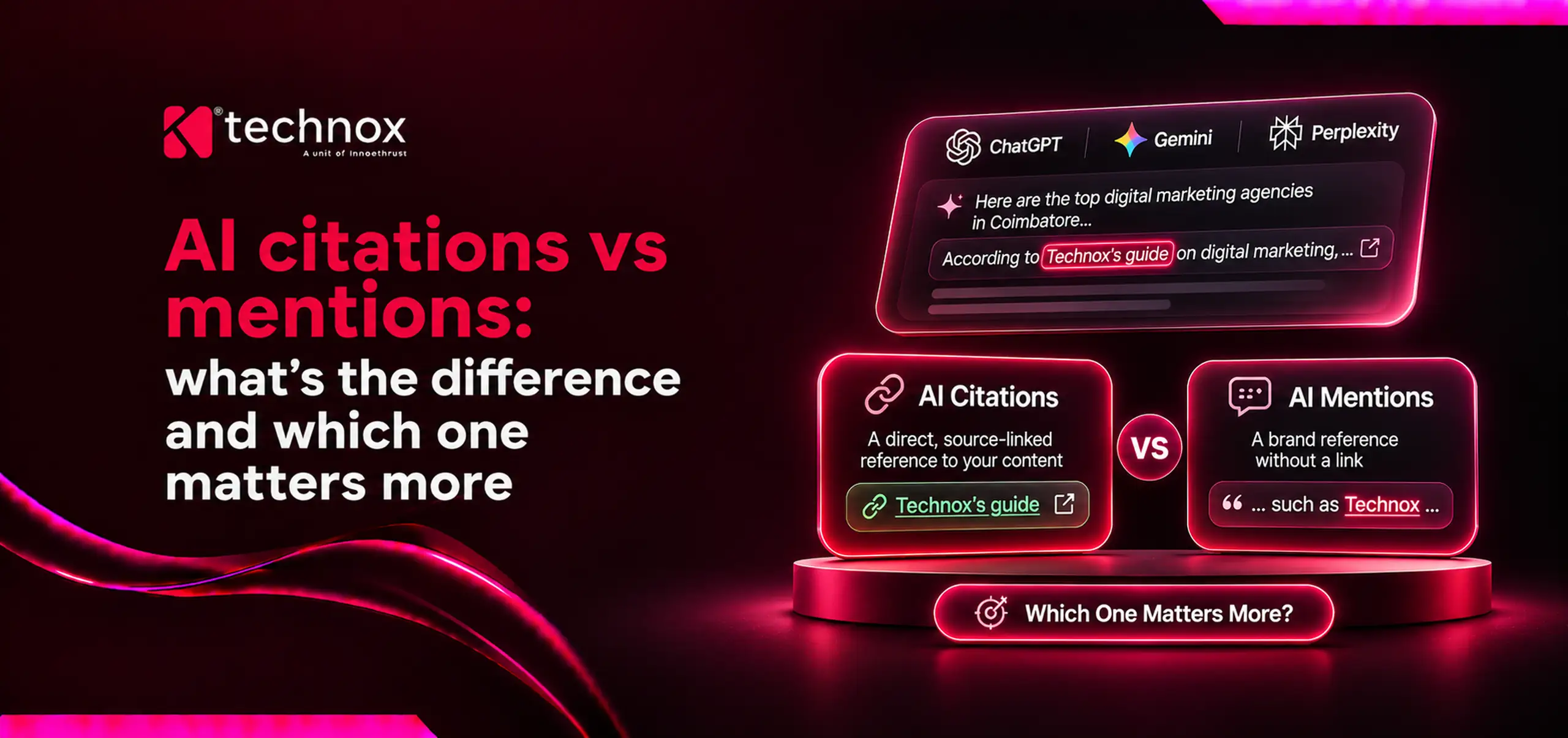
An AI citation is a link to your page that an AI tool shows as a source for its answer. An AI mention is your brand's name written into the answer itself. They are separate events and often happen apart: in a Semrush study of 3,981 domain appearances across ChatGPT, Gemini, AI Overviews and AI Mode, 61.7% were citations where the brand was never named, 25.1% were mentions with no citation, and only 13.2% were both. A citation can send a visit. A mention puts your name in front of the buyer. Which one you need depends on the kind of question your customers ask.
Start with one question: when someone asks an AI tool about your category, do you need them to read your name, or to click through to your page? A Coimbatore physiotherapy clinic wants to be named when someone asks for "the best physio near RS Puram". A software company publishing guides on GST e-invoicing mostly wants the click. Most businesses need both, but for different pages.
A note before we start: Technox sells AI SEO services in Coimbatore, so we have an interest in this topic. The figures below come from published studies and platform documentation, linked in each section, and we have flagged where those studies disagree.
A citation is a source link; a mention is your name in the answer
For any AI answer, your brand ends up in one of four positions.
Semrush calls the first outcome a "ghost citation": your content did the work, but the reader never sees your name.
One naming trap matters for local businesses. In local SEO, a "citation" also means a listing of your business name, address and phone number on a directory such as Justdial or Sulekha. That is a different thing from an AI citation, although consistent local citations and NAP details can help AI tools recognise your business when they do mention it.
Most citations do not name the brand, and most mentions have no link
Several studies in 2025 and 2026 measured how often the two overlap. Each counted differently, but they agree on the main point: being cited and being named are largely separate.
The studies do not agree on every platform. Semrush found ChatGPT had an "87% citation rate, 20.7% mention rate" when a brand appeared, while BuzzStream found 92.7% of GPT-5.4-mini's citations also named the brand. The difference likely comes from what was counted (domain appearances versus brand mentions), the prompts used and the model version tested. Treat any single number as a description of that study, not a fixed property of ChatGPT.
Each AI platform shows citations differently
How often a platform links the brands it names varies widely. Ahrefs checked more than 31,000 mentions of its own brand from its Brand Radar database and recorded how often each platform included a link.
The practical reading: on Perplexity, a mention usually comes with a link. On AI Overviews and Gemini, your brand is often named with nothing to click. If you only count referral visits in Google Analytics, you will miss most of your mentions on Google's own AI surfaces. Our engine-by-engine guide to AI search covers what each platform reads.
Which one matters more depends on the question being asked
The type of prompt decides which outcome is realistic. BuzzStream found that on list prompts such as "best project management tools", only 7.2% of mentions were backed by a citation. On single-brand prompts such as "Is Asana good?", the figure rose to 39.0%. In other words, when buyers ask AI tools to recommend options, the name in the list is usually all you get.
Do not assume a citation means traffic either. In Kevin Indig's usability study of Google AI Mode, the median number of external clicks per task was zero, and 77.6% of sessions had no external visits at all. The study was small (37 participants, 250 sessions) and covered AI Mode only, but it is a useful warning: being a source is not the same as getting the visit.
Industry matters too. BuzzStream found healthcare brands had the highest share of mentions backed by citations, at 34.5%, while retail brands were named without a citation most of the time, with only 16.5% of mentions cited. For a clinic, that suggests good medical content has a better chance of being both quoted and named. For a retail store, expect most AI visibility to be name-only.
Why you get cited but not named, or named but not cited
Cited but not named usually means your content is useful but not tied to your brand in the answer. Semrush found informational content earns citations but rarely mentions, and long prompts trigger more citations but fewer brand mentions. The AI took your facts and moved on.
Named but not cited usually means other websites are talking about you. AirOps found 85% of brand mentions originate from third-party pages rather than the brand's own site. The AI picks up your name from reviews, lists, news and forums, and often cites those sources instead of your site.
Location changes the odds. In the same Semrush study (115 prompts across 14 countries), brands were mentioned in 50% of AI answers in India and Sweden, against 18% to 22% in Italy, Brazil and the Netherlands. For Indian businesses, that points to more room to be named than global averages suggest, though the sample is small.
How to measure citations and mentions separately
Track the two as separate numbers, because they move for different reasons. The tools that track AI visibility define their metrics differently, so check the formula before comparing reports.
Even the headline metric differs between tools. Peec AI divides by all responses, while Profound's Visibility Score divides by "all responses that mention at least one brand", so the same answers can produce two different scores.
Write 30 to 50 prompts your customers actually ask, split into recommendation, comparison and how-to questions.
Run each prompt on the platforms your buyers use, and repeat the runs, because answers change from one run to the next.
Record four things per answer: mentioned or not, cited or not, which page was cited, and which competitors appeared.
Add the first-party data platforms give you: citation counts in Bing Webmaster Tools, AI features data in Search Console and AI referrals in GA4.
Report mention rate and citation rate side by side, with the number of answers checked.
Our guide on how to measure AI visibility walks through the full set-up, including which data each platform reports.
How to turn a citation into a mention, and a mention into a citation
Write comparison content, not only how-to content: Semrush found comparative content produced 2.4 times more brand mentions than informational content.
Put your brand name inside the facts: For pages that are cited but not named, Semrush suggests "adding clearer brand references, product mentions, or comparison sections". A passage that says "Technox audits found..." carries your name with the fact; "audits found..." does not.
Earn coverage on third-party sites: With 85% of mentions coming from third-party pages, reviews, local news, association lists and "best" roundups are how you get named. Our guide on getting your brand mentioned in ChatGPT, Gemini and Perplexity covers this step by step.
Give-named-but-uncited mentions a page to cite: If AI tools name you but cite a directory, publish the page they need: clear services, prices or ranges, areas served and credentials. That is the content ranking on ChatGPT depends on.
Keep your entity consistent: The same business name, description and details everywhere help AI tools connect a mention to your business. See our post on entity SEO.
Cover the follow-up questions: AI tools split one question into several searches, so pages that answer the related questions get more chances to be cited. Our explainer on query fan-out shows how.
Where Technox fits
If you track only one number, usually traffic, you will miss part of your AI visibility: a clinic can be named in most "best physio" answers and see no change in Google Analytics, while a content-heavy site can be cited often and never named. As an SEO company in Coimbatore that also works on AI search, we set up mention and citation tracking separately, find which pages earn citations and which third-party sources drive mentions, and then fix whichever side is weak.
If you are not sure where you stand, start with the free version: run ten of your customers' questions through ChatGPT, Gemini and Perplexity this week and note, for each answer, whether you were named, linked, both or neither.
Frequently asked questions
What is the difference between an AI citation and an AI mention?
An AI citation is a link to a page shown as a source for an AI answer. An AI mention is a brand name written into the answer text. A brand can be cited without being named, named without being cited, or both.
What is a ghost citation?
A ghost citation is when an AI tool uses your page as a source but does not name your brand in the answer. In Semrush's June 2026 study, 61.7% of domain appearances across ChatGPT, Gemini, AI Overviews and AI Mode were ghost citations.
Is an AI citation the same as a backlink?
No. A backlink is a link to your site on another website. An AI citation is a link shown inside an AI tool's answer. Both can send visitors, but a citation appears in the AI interface rather than on a web page that search engines crawl.
Are AI citations the same as local citations?
No. In local SEO, a citation is a listing of your business name, address and phone number on a directory or map service. An AI citation is a source link in an AI answer. Consistent local citations can still help AI tools recognise and mention your business.
Which AI platform links to brands most often?
In Ahrefs' analysis of more than 31,000 mentions of its own brand, Perplexity included a link 51.6% of the time and Google AI Overviews only 10.7% of the time, with AI Mode, ChatGPT, Copilot and Gemini in between. That data covers one brand, so results for your business will differ.
Do brand mentions without links still matter?
Yes. In recommendation answers, the brand name is often the only visibility on offer: BuzzStream found only 7.2% of mentions in list-style answers came with a citation. Being named puts you on the buyer's shortlist even when there is nothing to click.